










Chatty vs MooseDesk comes down to one line. Chatty is built to convert shoppers before they buy, MooseDesk to clear support volume after they do. MooseDesk gives unlimited AI replies on a permanent free plan and charges for seats, tickets and catalog size. Chatty meters AI conversations by tier and charges $0.40 past the cap.
Start with the proof, because it's the fastest thing to check. Chatty publishes eight named case studies, including $300,000 in AI-assisted revenue in year one at BARABAS and $75,000 across 5,141 conversations at Stonehenge Health, which works out to about $14.59 a conversation. MooseDesk publishes aggregate percentages, 92% auto-resolved and 70% self-service, with no store, period or method attached to either.
Both apps rate near-perfect on the Shopify App Store, so neither is the weak option. This is a fit comparison, not a quality comparison. The question underneath the shortlist is whether chat pays for itself, and most comparisons answer it with a price difference when it's closer to a mission statement.
Five questions settle the choice faster than a feature list:
- Does either AI prove it converts, or only claim it?
- What is each company's pricing actually metering, and why?
- Does the agent reach a shopper who hasn't asked anything yet?
- What happens after the AI stops?
- What does each free plan really buy?
Chatty publishes this comparison, so read it accordingly. Every MooseDesk figure below links to a MooseDesk page you can check, every Chatty figure links to the case study it came from, and where MooseDesk is the better product this article says so. All figures verified August 2026.
- Published proof: Chatty publishes eight named case studies, the largest being $300,000 in AI-assisted revenue in year one at BARABAS. MooseDesk publishes aggregate percentages with no named store, date or stated method.
- Metered unit: Both apps gate seats and catalog size on near-identical ladders. The unit they disagree on is the one that matters: MooseDesk meters tickets, Chatty meters AI conversations.
- Proactive outreach: Chatty ships eight live on-site campaign templates including cart recovery. The MooseDesk app documents none, though the same developer ships cart recovery as a separate free WhatsApp app.
- Ticketing: MooseDesk is genuinely stronger here, with structured ticket volumes per plan, workload reporting and a mature FAQ builder.
- Ratings: MooseDesk holds 5.0 across 452 reviews, Chatty 4.9 across 1,880. The ratings differ by 0.1 and the samples differ by roughly 4x, which puts about 1,400 more merchants on record about Chatty.
Do Chatty and MooseDesk prove their AI converts?
Chatty does, one named store at a time. MooseDesk publishes numbers too, but none a merchant can trace back to a store.
MooseDesk's homepage publishes four figures:
- 92% of tickets auto-resolved by AI
- Average first reply under 30 seconds
- A 70% self-service rate
- More than 12,000 chats a day
Those are real, specific, confident numbers, and they're more than most apps in this category publish at all.
Then ask the four questions any published number has to survive. Which store produced it? Over what period? Across how many conversations? And what counts as "auto-resolved"? The MooseDesk homepage, pricing page and Shopify listing answer none of the four.
Chatty's case study library runs to eight named merchants, each on its own page. Five publish revenue figures:
| Merchant | Industry | Chat-attributed revenue | Chat-to-sale | AI performance |
| BARABAS | Menswear | $300,000 in year one, 800 orders | Not published | 88% resolved |
| Just Nutritive | Health and beauty | $150,000 across 7,699 conversations in 63 days | Not published | 98% resolved |
| Stonehenge Health | Supplements | $75,000 over 7 months | 11.36% | 99.9% resolved, 71.33% AI-handled |
| Montana West | Fashion accessories | $41,115 over 6 months | 11.9% | 80.71% AI-handled |
| Decathlon (Réunion) | Sports retail | $30,000 assisted across 4,000+ conversations | 9.0% | 96.6% resolved |
Two definitions matter when reading that table, and Chatty owes them the same way it just asked MooseDesk for them. Resolved means the conversation ended without being escalated to a person. AI-handled means the AI carried the whole conversation with no human involved at any point. They are different denominators, so only compare like with like across rows. Revenue is attributed last-touch, meaning a sale counts when a chat happened in the same session, so some of those orders would have landed anyway.
The difference shows up the moment you try to do arithmetic. Stonehenge Health's page publishes $75,000 in attributed revenue across 5,141 conversations over 7 months, which works out to about $14.59 per conversation.
You can reproduce that from two figures printed on one public page, and then go check whether $14.59 a conversation is worth paying for on your own catalog.
Run the same exercise on 92% and there's nothing to divide. The percentage is the whole disclosure.
That matters more than it sounds, because a resolution rate isn't a property of the AI alone. Look down the table and the spread is wide: 88% at BARABAS, 98% at Just Nutritive, 99.9% at Stonehenge Health, and on the AI-handled measure 71.33% at Stonehenge against 80.71% at Montana West. Same AI, five stores, and no single number describes it.
What moves the figure is the question mix a catalog generates. A supplement store fields "does this interact with blood thinners", which has a correct answer sitting in the product data. A fashion accessories store fields fit and style questions that need judgment the product data doesn't contain. Catalog size moves with catalog type in this sample, so we can't separate the two, and five stores is a hypothesis rather than a law.
That's enough to make the point about 92%, though. An unattributed resolution rate goes past unverified into unusable, because you can't tell what it would mean on your catalog. A merchant selling dresses can't use a number generated by a store selling supplements, and nothing on MooseDesk's site says which one it was.
Chatty's case studies are still Chatty's own reporting, not an audited result, and a named merchant isn't an independent auditor. What the naming buys is checkability. A skeptical merchant can open BARABAS, see $300,000 in AI-assisted revenue across 800 orders in year one at 88% resolution, and go ask that brand directly. No equivalent path exists for 92%.
Neither number proves one AI answers better than the other. What they do reveal is what each company chose to count in the first place: MooseDesk counts tickets that went away, Chatty counts orders that arrived. Before you compare a single feature, each company has already told you which number it agreed to be measured on.
What each app's pricing is really metering
Both apps gate seats and catalog size, on ladders close enough that they barely distinguish the products. The unit they disagree on is tickets against AI conversations, and that single difference explains more about each product than any feature list will.
A pricing page tells you more than a feature list does, for the unglamorous reason that marketing writes one of them and the people who have to make the unit economics work write the other.
Both pages follow the same logic. A vendor gives away whatever it isn't being judged on and charges for what it is. So if you compare on monthly price alone, what you're really picking is the number your store will be judged by for the next year. Across the wider category the same test applies, and which billing unit matches how your store generates chat volume decides more than the monthly figure does.
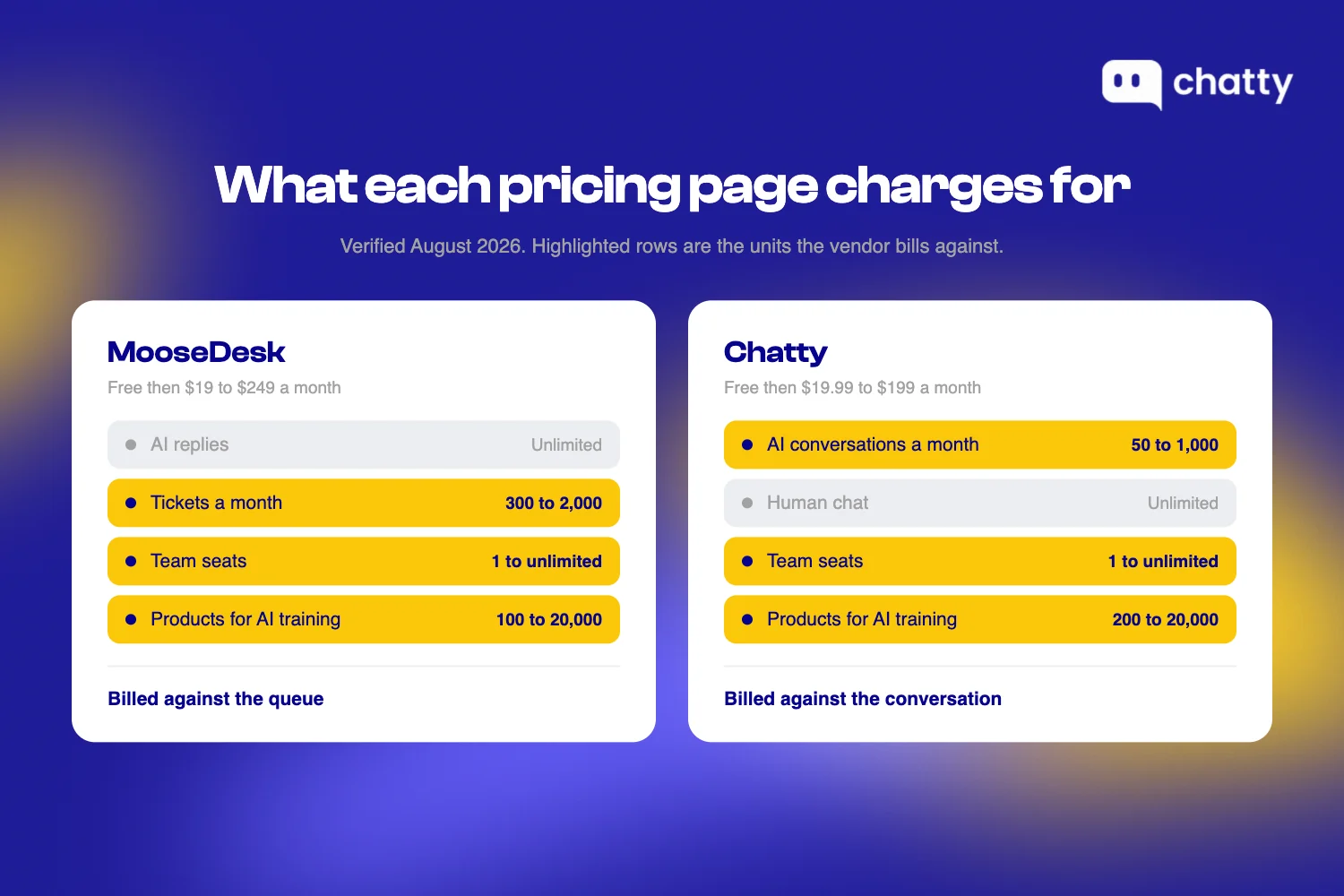
Two meters, two different bets:
Why MooseDesk can afford unlimited AI replies
MooseDesk keeps replies unlimited on every tier, including free, because a reply is the one thing it doesn't need you to ration.
MooseDesk's pricing gates four things instead (verified August 2026):
- Team members: 1 on Free, rising to unlimited on Business at $249
- Products for AI training: 100 to 20,000
- Email channels: none on Free
- Monthly ticket volume: 300 on Growth at $49, 2,000 on Business
Every paid tier carries a 7-day trial.
That structure is coherent, and it isn't a trick. A reply that resolves a ticket removes work from the queue, and removing work from the queue is what MooseDesk sells. More replies makes its core number look better, so charging for them would mean charging customers to improve the vendor's own metric.
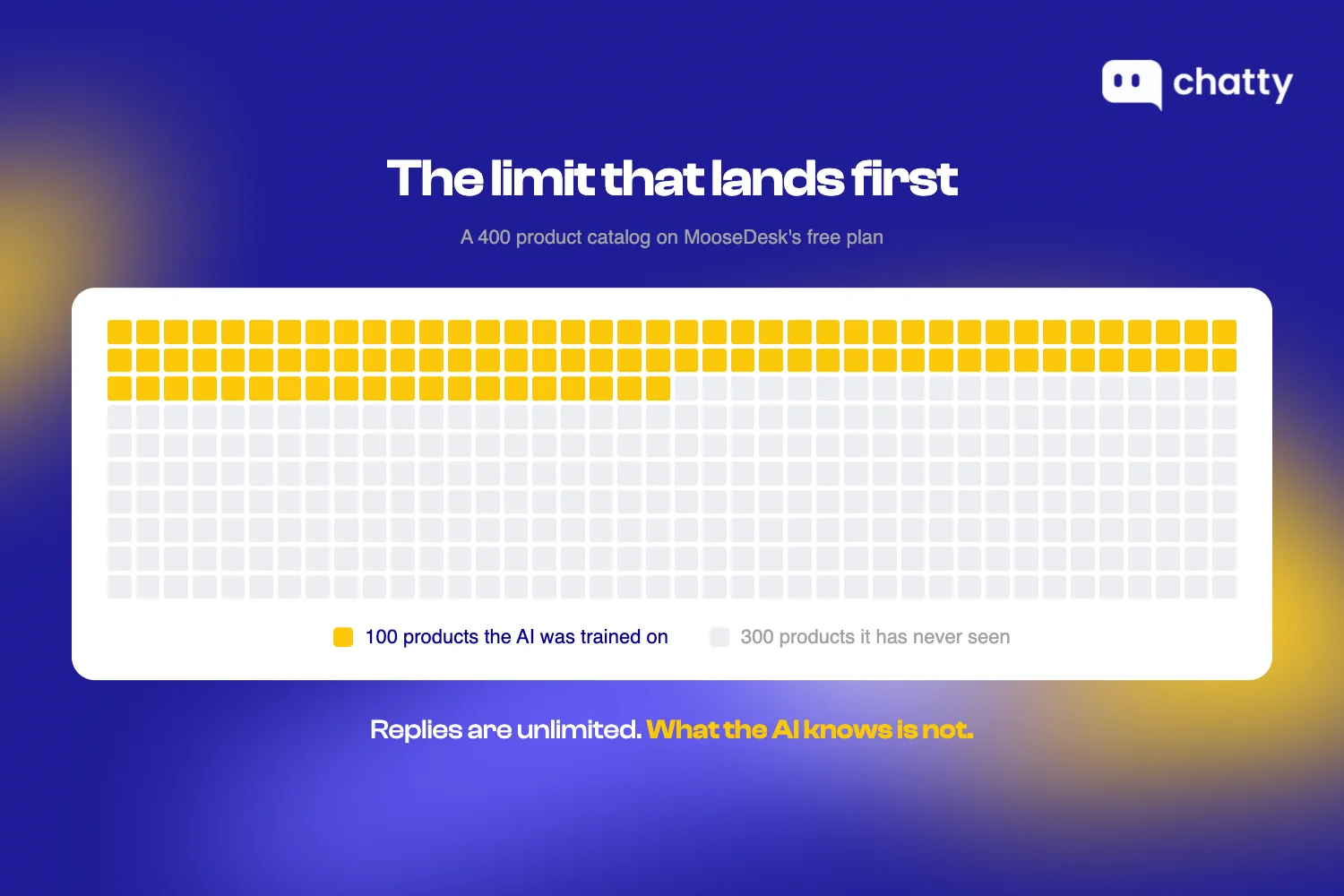
Unlimited AI replies at $0 is more generous than anything Chatty offers on AI volume, and that should be said plainly. The same plan also allows one team member, no email channel, and 100 products for AI training.
The product cap is the one that will actually stop you. A 400-SKU catalog on MooseDesk's free plan gets an AI trained on a quarter of its products, so the limit lands on what the AI knows long before it lands on how much the AI can say. That's the reverse of how "unlimited AI replies" reads at a glance.
Why Chatty meters conversations instead
Chatty meters the conversation, which is the unit a sale happens inside.
Its tiers run 50 AI conversations a month on Free, 100 on Basic at $19.99, 500 on Pro at $68.99, and 1,000 on Plus at $199 (verified August 2026). Additional conversations cost $0.40 each. Catalog access scales alongside, from 200 products on the free plan to 20,000 on Plus.
Metered pricing has an obvious downside. A busy store can hit its cap mid-month and start paying overage, and on pure cost per message MooseDesk is cheaper by a wide margin. For a high-volume support queue there's no argument to make here.
What the meter buys is exposure. A vendor charging by the conversation has to care whether those conversations were worth having, because a merchant who sees no return just stops paying for volume. That pressure is why Chatty's case studies count orders and revenue rather than tickets that went away.
Neither model is wrong, they just disagree about what a good month looks like. Most stores reading this aren't drowning in tickets, they're watching carts stall. Price against that, and treat the monthly figure as the last input rather than the first.
Chatty messages shoppers first. MooseDesk needs a second app.
Every reactive chat tool shares one ceiling, no matter how good its AI is. A reactive tool can only answer a shopper who already decided to ask, and most never ask. The two apps close that gap in different places, and the difference is worth understanding before you pick.
Chatty ships eight live proactive chat campaign templates inside the same app. Four do commercial work: Cart booster, Abandoned cart reminder, Remove items from cart, and Product recommendation. A ninth, for cart views, is still in development.
The targeting layer separates a campaign from a popup. You scope each campaign four ways:
- Page: specific URLs or all pages
- Audience: all visitors, or returning visitors only
- Device: desktop, mobile or both
- Timing: delay after load, scroll depth, or time on page
You then set a priority rank from 1 to 10 on each campaign, with proximity to checkout used as the tiebreaker when two campaigns share a rank. A cap of five proactive messages per visitor session applies, and only one displays at a time.
Merchants tend to skim past the priority setting, which is a mistake. A returning visitor sitting on a cart page qualifies for several campaigns at once: cart booster, product recommendation, newsletter signup. Rank them by proximity to checkout and the shopper gets the cart message, while the newsletter prompt waits for a session where nothing is at stake.
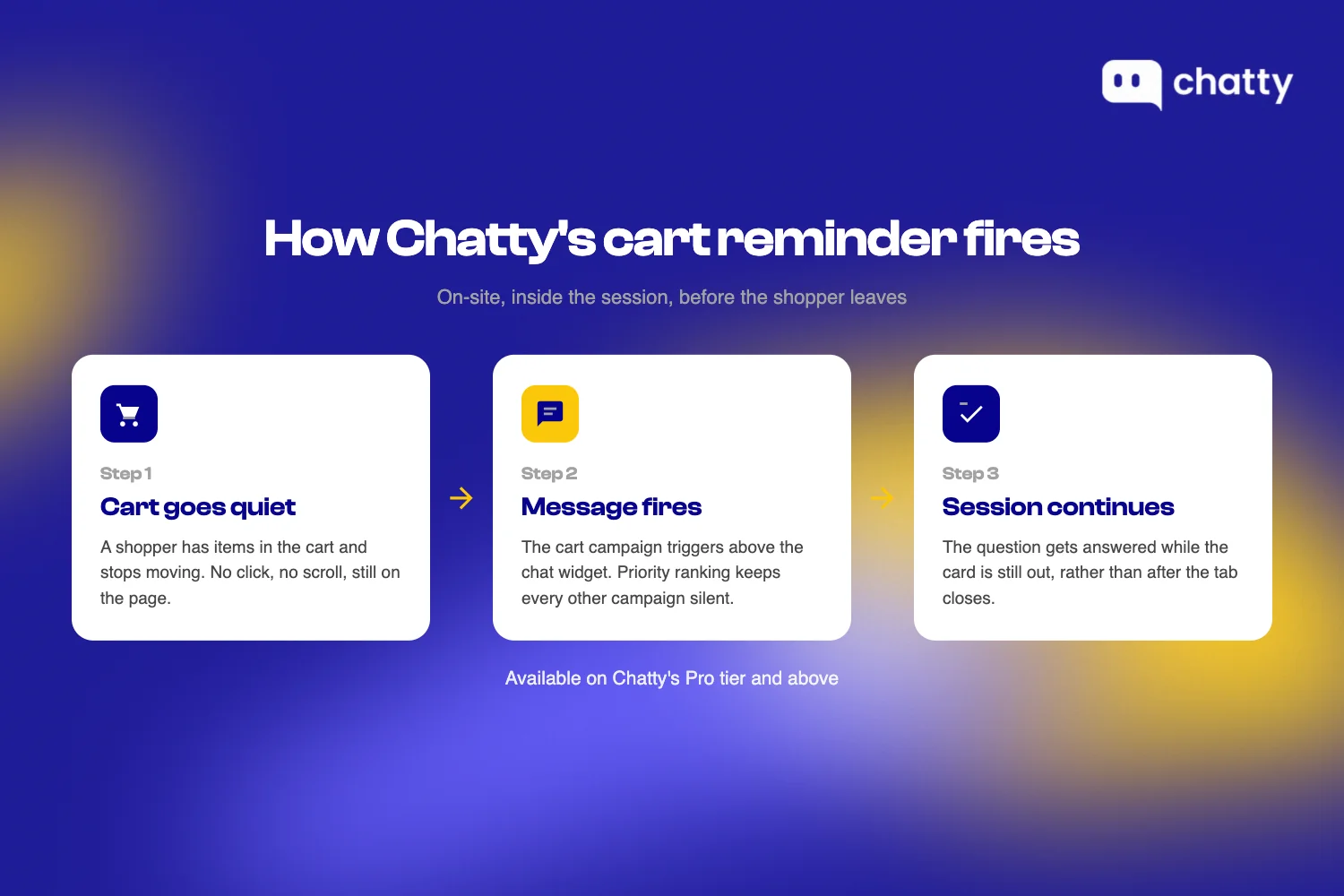
Here's the limitation Chatty should state plainly, because it decides which app suits you. Every one of those triggers is an on-page event. Chatty's abandoned cart reminder fires when a shopper goes idle on your site and appears above the chat widget. It intercepts the session before it ends. It cannot reach anyone who has already closed the tab.
The MooseDesk app documents no proactive messaging or cart recovery, across its Shopify App Store listing, its homepage, its pricing page and its 37-article help center. But its developer, Vegahub Technology, publishes a second Shopify app, Moose WhatsApp Chat Button, which is free, Built for Shopify certified, and describes itself as recovering abandoned carts through WhatsApp reminders.
So the honest comparison isn't presence against absence. It's two different interception points. Chatty catches the shopper while they're still on the page, in the same inbox as everything else. Vegahub catches them after they leave, on WhatsApp, through a second app you install and configure separately.
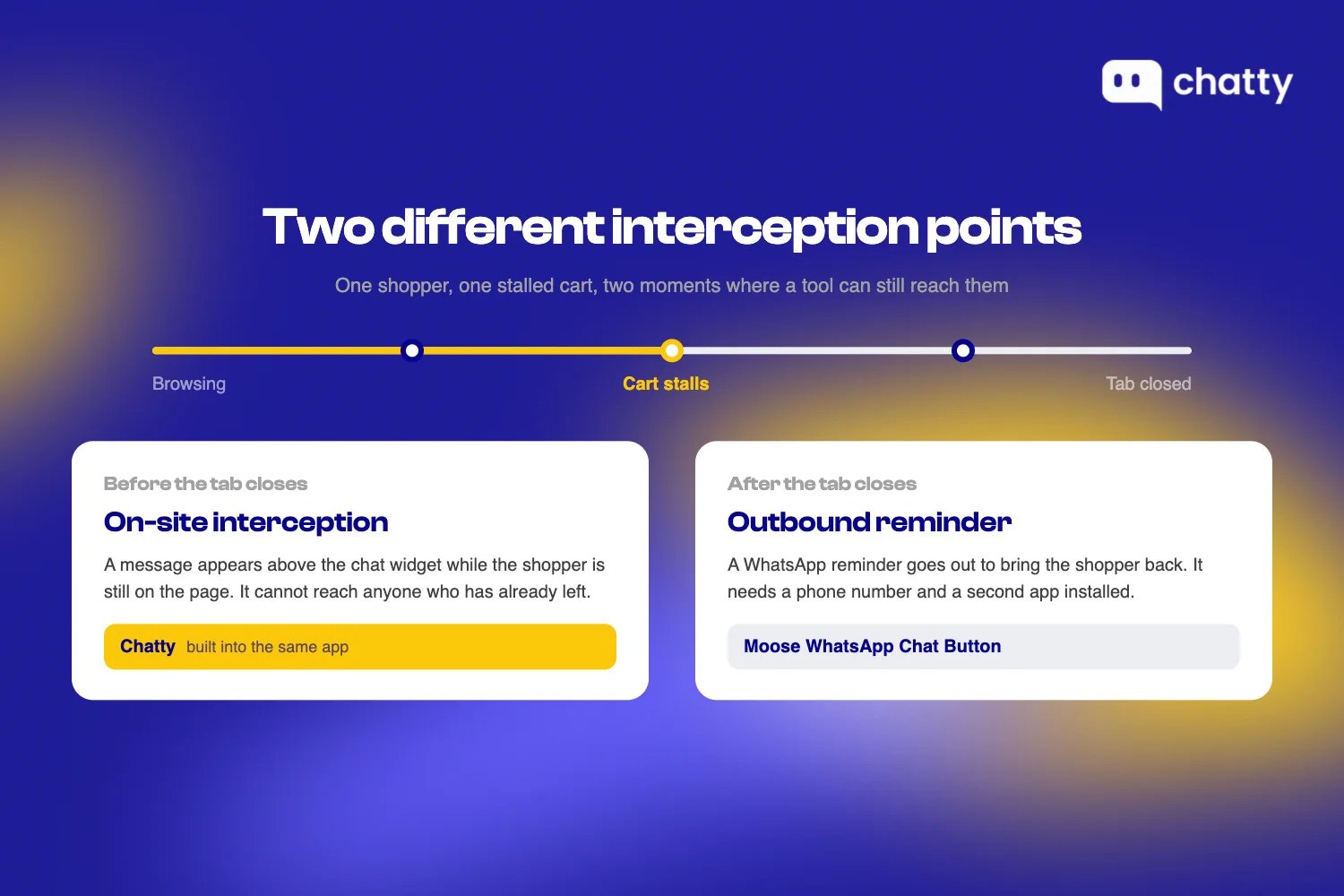
Which one fits depends on where your carts die. If shoppers stall at checkout with a question, an on-page message answers it while the card is still out. If they leave and never come back, an outbound channel is what reaches them, and Chatty's proactive campaigns do not.
One practical note on cost. Chatty's four commercial templates start on the Pro tier at $68.99, so testing whether a proactive message turns into an order means paying for a month. The free plan will show you whether the AI answers your catalog correctly, which is a different question and worth answering first.
What happens after the AI stops
Chatty and MooseDesk both hand a conversation to a person. The two apps disagree about what the handoff is for.
MooseDesk treats the handoff as the beginning of a tracked ticket. Chatty treats it as a rule the merchant set before the shopper ever arrived. Each app is stronger on its own side of that line:
Where MooseDesk is genuinely stronger
MooseDesk is the better product for a queue, and it isn't close.
Structured ticket management sits at the center of the platform rather than bolted onto a chat widget. Plans carry explicit monthly ticket volumes, 300 on Growth and 2,000 on Business, which tells you the system was designed around the ticket. Add workload and agent performance reporting, customer profiles, and an FAQ builder mature enough to carry a 70% self-service claim, and the shape of the product is clear.
For a support team of three or more sharing a queue, that shape is correct and Chatty doesn't match it. If your bottleneck is volume arriving after the sale, and the win you need is more tickets handled per agent per day, MooseDesk is the more sensible buy.
The workload reporting gets less attention than it deserves. Knowing which agent is carrying the queue, which tags keep recurring, and where handling time piles up is how a support lead decides whether to hire, retrain, or go rewrite a policy page that keeps generating the same question. Chatty reports on agents but doesn't go this deep.
Where Chatty's handoff is stronger
A shopper with a wallet open and a size question doesn't wait in a queue, and recovering that session afterwards costs far more than answering in the moment. Chatty's escalation is built around that timing problem.
The merchant sets the handoff rule before a single shopper arrives, and the AI applies it. Four triggers fire the handoff: the customer asks for a person, the AI returns two consecutive low-confidence answers, the same question gets asked twice, or the AI detects frustration.
Where the conversation lands is the merchant's choice of three destinations:
- Transfer to human in the Chatty inbox
- Collect info and follow up by email
- Show contact methods
AI backup covers the wait. While a shopper waits for an agent, the AI can keep replying all the time, only outside business hours, or not at all. If you sell into three time zones and staff one of them, that setting is what keeps the AI working overnight without anyone toggling anything twice a day.
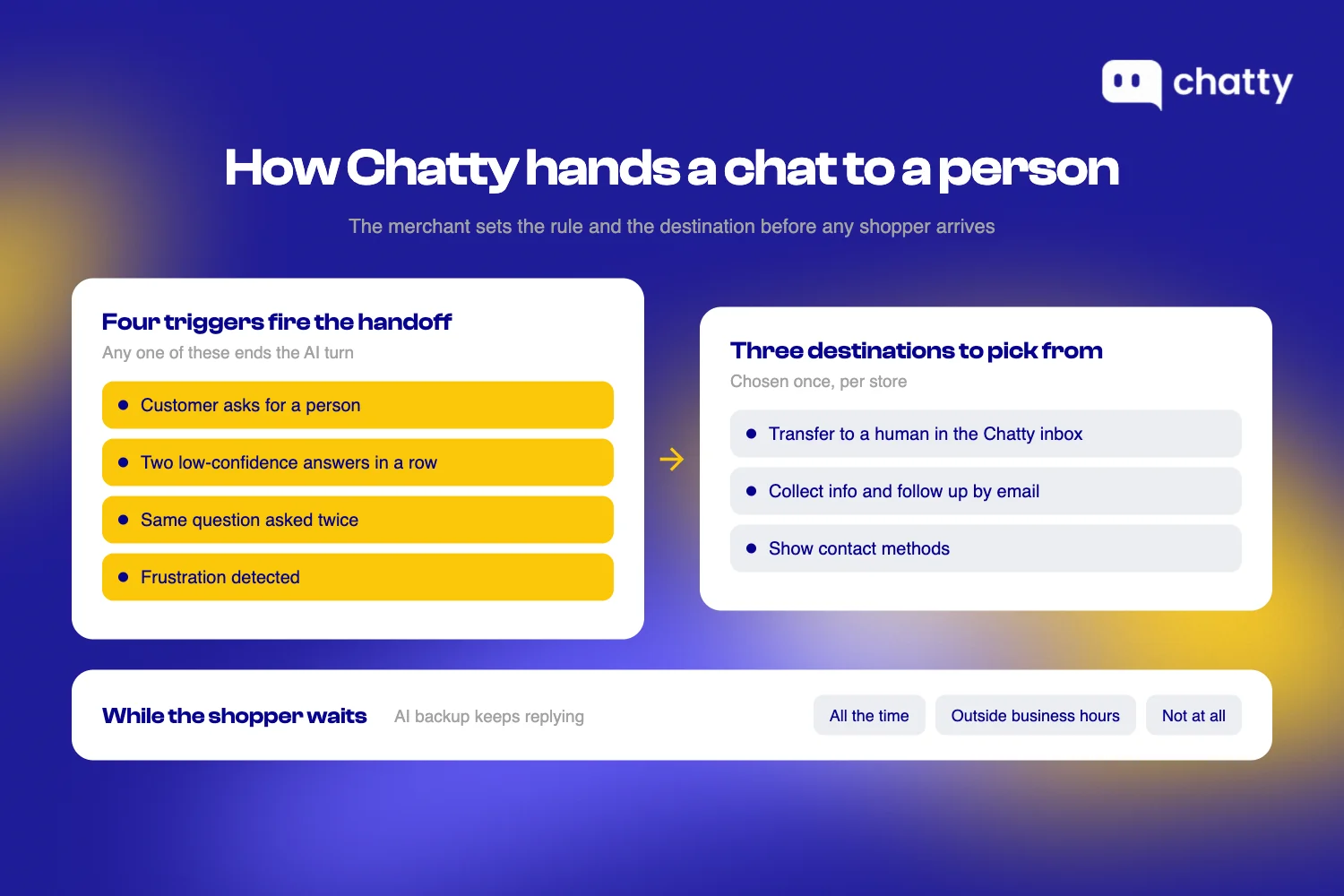
Both tools hand off, so the difference isn't whether but when it gets decided. Chatty's rule and destination are configured up front, while MooseDesk's queue resolves it in the moment, which is consistent with the queue being what MooseDesk is priced to shrink.
Worth noting on the self-service side: Chatty also ships an FAQ builder, with categories, CSV export, a hosted FAQ page, an embeddable block and FAQ analytics. The gap between the two here is narrower than the feature table suggests.
Chatty vs MooseDesk, feature by feature
Chatty and MooseDesk land differently across the capabilities merchants actually shortlist on:
| Capability | Chatty | MooseDesk |
| AI training source | Product catalog, custom Q&A, FAQ content | Products, FAQ Builder, past Q&A |
| AI usage limit | Metered, 50 to 1,000 conversations a month by tier | Unlimited replies on every tier |
| Live and human chat | Unlimited on every plan | Unlimited, scoped by team seats |
| Product recommendations | Yes, with smart sync on top sellers | Yes |
| Proactive outreach | 8 on-site campaign templates with targeting and priority | Not documented in the MooseDesk app |
| Abandoned cart recovery | On-site, on Pro and above | Via the developer's separate free WhatsApp app |
| Ticket management | Inbox and help center | Full ticketing, volumes capped on Growth and Business |
| FAQ builder | Yes, with hosted page, embeddable block and analytics | Yes, with template library |
| Workload and agent reporting | Basic agent analytics | Detailed workload and performance tracking |
| Escalation control | 4 auto-triggers, 3 destinations, configurable AI backup | Configurable agent transfer conditions |
| Channels | Web chat, WhatsApp, Messenger, Instagram, email (AI on social from Pro) | Web chat, Messenger and Instagram free, email from Starter |
| Languages | 19, capped by tier: 1 free, 3, 10, unlimited | Language switcher from Starter, multilingual FAQs |
| Order tracking | Yes | Yes, plus a TrackingMore integration |
| Mobile app | Yes | Yes |
| Published per-store results | 8 named case studies with revenue | Aggregate percentages only |
The table doesn't split into better and worse. It splits into before and after: almost everything MooseDesk leads on happens after a purchase, almost everything Chatty leads on happens before one. A ticket volume of 2,000 a month and eight behavior-triggered campaigns aren't competing specifications, which is why counting features gets you nowhere on this pair.
The channel row needs a caveat. Listing more channels is a fact about coverage, not an argument about quality, and multi-channel AI performance varies by channel across this category, ours included. Read that row as where each app can appear, not as a claim that the AI works identically everywhere it appears.
Selling in more than one language
Roundup articles routinely name MooseDesk the pick for multilingual brands. That claim is worth checking against what each vendor actually documents, because the two do not line up the way the roundups suggest.
MooseDesk's Shopify listing lists a language switcher starting on Starter at $19, multilingual FAQs, and a multi-language tag in its feature list. Its help center carries one article on setting up translation in the widget. Its own AI chatbot feature page doesn't mention language at all.
Chatty documents 19 languages with explicit per-tier limits: one on Free, three on Basic, ten on Pro, unlimited on Plus. Auto-translate covers chatbox labels, FAQ content and questions, and from Pro the inbox translates a shopper's message and previews your reply before it sends.
The honest read cuts against both the roundups and any easy win here. Chatty documents more depth on paper, but its free plan is a single language, so a store selling into three markets gets nothing usable from Chatty's free tier either. Multilingual only becomes a real point of difference from the paid tiers up, and if it matters to you, price it at Basic or Pro rather than at $0.
The wider case those roundups make for MooseDesk usually rests on three things: AI training depth, pricing transparency and scalability. The first two are settled above, in the catalog ceiling and the pricing tables. Scalability depends entirely on which axis you scale: MooseDesk scales seats and tickets more cheaply, Chatty scales conversations and catalog further.
Chatty vs MooseDesk pricing, side by side (verified August 2026)
Both apps run a free plan and a 7-day trial on paid tiers. What the free plans actually buy differs more than the price tags suggest:
| Tier | Chatty | MooseDesk |
| Free | 50 AI conversations a month, 200 products, 1 seat | Unlimited AI replies, 1 seat, 100 products, Messenger and Instagram included, no email channel |
| Entry | Basic $19.99: 100 AI conversations, 500 products, 5 seats | Starter $19: 3 seats, 500 products, 1 email channel |
| Mid | Pro $68.99: 500 AI conversations, 8,000 products, 10 seats, proactive campaigns and cart recovery | Growth $49: 10 seats, 5,000 products, unlimited email channels, 300 tickets a month |
| Top | Plus $199: 1,000 AI conversations, 20,000 products, unlimited seats | Business $249: unlimited seats, 20,000 products, 2,000 tickets a month |
| Overage | $0.40 per additional AI conversation | Not applicable, replies are unlimited |
| Trial | 7 days on paid plans | 7 days on paid plans |
Read the free row twice. MooseDesk's is more generous in two places, and both are real: unlimited replies, and Messenger and Instagram included at $0 where Chatty gates AI on social channels to Pro. On what the AI actually knows it's tighter, at 100 products against Chatty's 200, and both give you one seat.
Under 100 SKUs with a single operator, MooseDesk's free plan is simply the better free plan.
Run the arithmetic before assuming the metered plan is the expensive one, but run it properly, because how AI chatbots are priced varies more across this category than the headline figures suggest. Chatty's Pro at $68.99 covers 500 AI conversations. Used in full that's about $0.14 each; at 100 conversations it's $0.69, so the per-unit figure only means something at the volume you actually hit.
Then measure the other side against gross margin rather than revenue. Stonehenge Health's $14.59 per conversation is attributed revenue before cost of goods, on last-touch attribution, at a $124.85 average order value. Your own revenue per conversation will be lower, and it's the one that decides whether a metered plan is expensive on your store.
At the top tier the comparison breaks down completely, so don't read the $199 and $249 rows as competing prices. Chatty's Plus buys conversation volume and unlimited seats, MooseDesk's Business buys seats, catalog depth and 2,000 tickets. A store that needs both is shopping for two products.
Chatty vs MooseDesk on the Shopify App Store (verified August 2026)
Both apps sit near the top of the category, and the numbers only mean something in pairs:
| Metric | Chatty | MooseDesk |
| Rating | 4.9 (1,880 reviews) | 5.0 (452 reviews) |
| Launched | June 9, 2022 | August 22, 2023 |
| Listing name | Chatty AI Chatbot & Live Chat | Moose AI Chatbot & Live Chat, by Vegahub Technology |
The ratings differ by 0.1. The samples differ by roughly 4x, which means about 1,300 more merchants have gone on record about Chatty than have reviewed MooseDesk in total.
A 4.9 across 1,880 reviews is a better-established estimate than a 5.0 across 452, and it's also a longer record, since Chatty has been listed 14 months longer. The honest reading is that Chatty's score is more thoroughly tested and slightly lower, and that 0.1 across samples this different settles nothing either way.
MooseDesk's record deserves saying out loud rather than explaining away. Only one of its 452 reviews sits below four stars. Accumulating that in under three years is fast for this category, and a young app holding near-perfect reviews at that rate is a serious product.
Neither rating tells you which app will convert better on your store, which is the question this whole comparison keeps returning to.
What switching actually costs you
This article ends by telling you to trial both, so it owes you the cost of doing that.
Two things carry over cleanly. Your FAQ content moves, because both apps build FAQs and Chatty exports questions to CSV. Your product catalog moves too, since both train the AI by syncing from Shopify rather than from anything you type in.
Three things don't. Chat and ticket history stays behind in whichever inbox recorded it, so a shopper who wrote to you last month arrives at the new app as a stranger. Any custom Q&A you wrote to patch gaps in the AI's answers has to be rewritten. And the widget itself changes appearance mid-quarter, which is worth timing away from a sale.
Setup is fast on both, and neither needs a developer. Both install from the Shopify App Store, sync the catalog automatically, and put a widget on the storefront from the theme editor. MooseDesk publishes a get-started guide framed around five minutes, and the honest version for either app is that the widget goes live quickly while the AI needs a few days of real conversations before you can judge it.
Support differs on paper. MooseDesk gates priority support to Growth at $49 and dedicated support to Business at $249. Chatty doesn't tier support by plan.
The practical cost of a proper trial is one paid month each, not two free ones. Both free plans answer whether the AI handles your catalog. Neither answers whether chat pays, because the features that would show you that sit on Chatty's Pro and MooseDesk's Growth.
Which one fits your store
Four questions settle this faster than any feature table.
Is your bottleneck tickets arriving or shoppers leaving? If your inbox fills up after the sale with exchanges, order status and policy questions, MooseDesk is built for that queue and prices for it. If shoppers reach the cart and stall, the queue isn't your problem.
Which number would you put in a board update: tickets deflected or revenue from chat? That's the scoreboard you're buying, and it's set the day you pick the tool.
Where do your carts die, on the page or after the shopper leaves? On the page, Chatty's proactive campaigns intercept the session. After they leave, you need an outbound channel, which means the Moose WhatsApp app or a dedicated email tool, and Chatty's proactive campaigns won't reach them.
How many people share your inbox? Three or more and you want structured ticketing with workload reporting, which is MooseDesk's territory and not a close call.
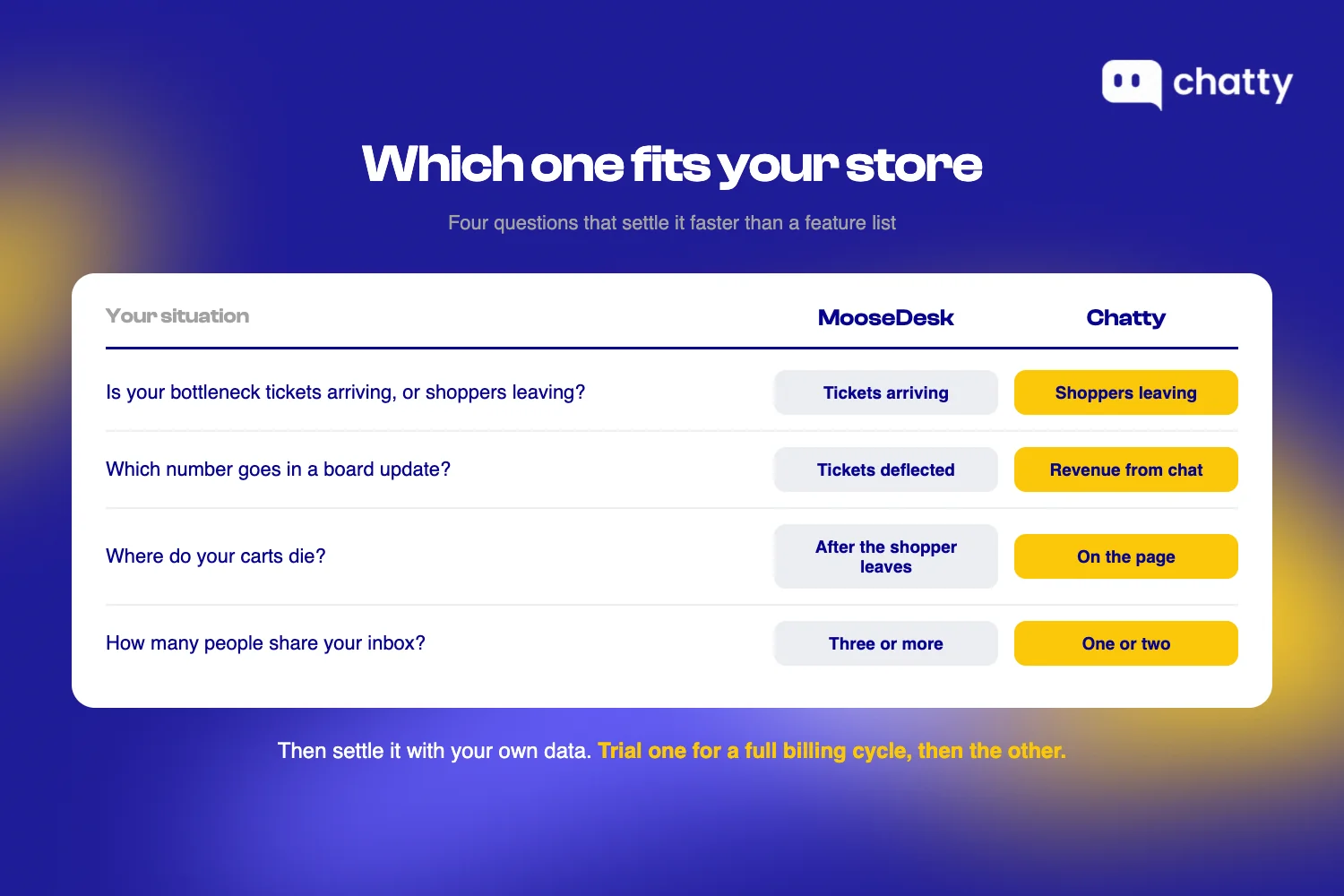
The case for MooseDesk holds up. For a support-heavy store under 100 SKUs, the free plan is generous, the ticketing is stronger, and the review record is earned. If your bottleneck is shoppers leaving before they ask, and the win you need is orders that chat can be traced to, Chatty is the more sensible buy.
Then stop reading comparisons and settle it with your own data. Trial one app for a full billing cycle against a month with comparable traffic and no promotion running, record whether tickets or revenue moved, then trial the other. Chatty's free plan runs 50 AI conversations a month on 200 products. At the 9% to 12% chat-to-sale in the case studies above, that's four to six orders: enough to see whether the AI answers your catalog correctly, not enough to trust the rate.
If Shopify's own free app is also on your shortlist, the same questions apply there, and Chatty vs Shopify Inbox runs them against it.
Install it free and check the number yourself, or read the deeper breakdown on the Chatty vs MooseDesk comparison page.
FAQ
Yes. MooseDesk's Free plan includes unlimited AI replies with no time limit. The limits sit elsewhere: one team member, 100 products available for AI training, and no email channel.
The two apps meter different units. MooseDesk charges for seats, tickets and catalog size, so replies stay free. Chatty charges $0.40 per conversation past the plan cap, which is the unit a sale happens inside. Cheaper per message isn't the same as cheaper per outcome.
Not in the MooseDesk app itself, which documents no proactive messaging. Its developer, Vegahub Technology, ships cart recovery in a separate free app, Moose WhatsApp Chat Button, which reaches shoppers on WhatsApp after they leave. Chatty's cart recovery is on-site and in-session, on Pro and above.
No. The 0.1 gap sits across very different samples, and ratings get harder to hold as volume and tenure grow. Neither score predicts which app converts better on your store.
Under 100 SKUs with one person answering messages, MooseDesk's free plan gives more AI volume for $0, plus Messenger and Instagram. Above 100 SKUs, Chatty's free tier trains on 200 products, which matters more than reply volume once the AI starts meeting products it has never seen.
Technically yes, but two chat widgets on one storefront confuse shoppers and split your history across two inboxes. Run them in sequence instead. Trial one for a full billing cycle, record whether tickets or revenue moved, then trial the other.