






 Blog
 Free tools
 Help center





An AI sales agent for Shopify is software that sells on your store. It recommends products, adds them to the Shopify cart, brings shoppers back to their cart and marks the orders it helped sell. A chatbot answers questions, while an AI sales agent moves the shopper to the order.
That difference matters more now because the label has stopped meaning anything. Many chat apps on the Shopify App Store now call themselves an "AI agent." Some of them are the same chatbot with a new name.
This guide gives you a definition you can check and a 4-question test for any free trial. It ends with a table that separates AI sales agents from chatbots and helpdesks.
- An AI sales agent is defined by actions, not answers
It recommends, adds to the Shopify cart, brings shoppers back to the cart and marks the order.
- An AI chatbot is one feature of an AI sales agent
Shoppers see the chat window first, but the agent also works in search, on product pages and at the cart.
- The word "agent" proves nothing on its own
Gartner warned in 2025 that many vendors rebrand chatbots as agents, so test the actions yourself.
- Run four checks before you pay
Live store data, a real cart action, a proactive greeting on the right page, and orders you can filter in Shopify admin.
- Measure orders, not conversations
Conversations handled is a support number. Orders and revenue recorded on the Shopify order are the sales number.
What is an AI sales agent for ecommerce?
An AI sales agent for ecommerce is software that sells to shoppers on your online store. It recommends products, adds them to the cart, brings shoppers back to a cart they left and records which orders it helped sell.
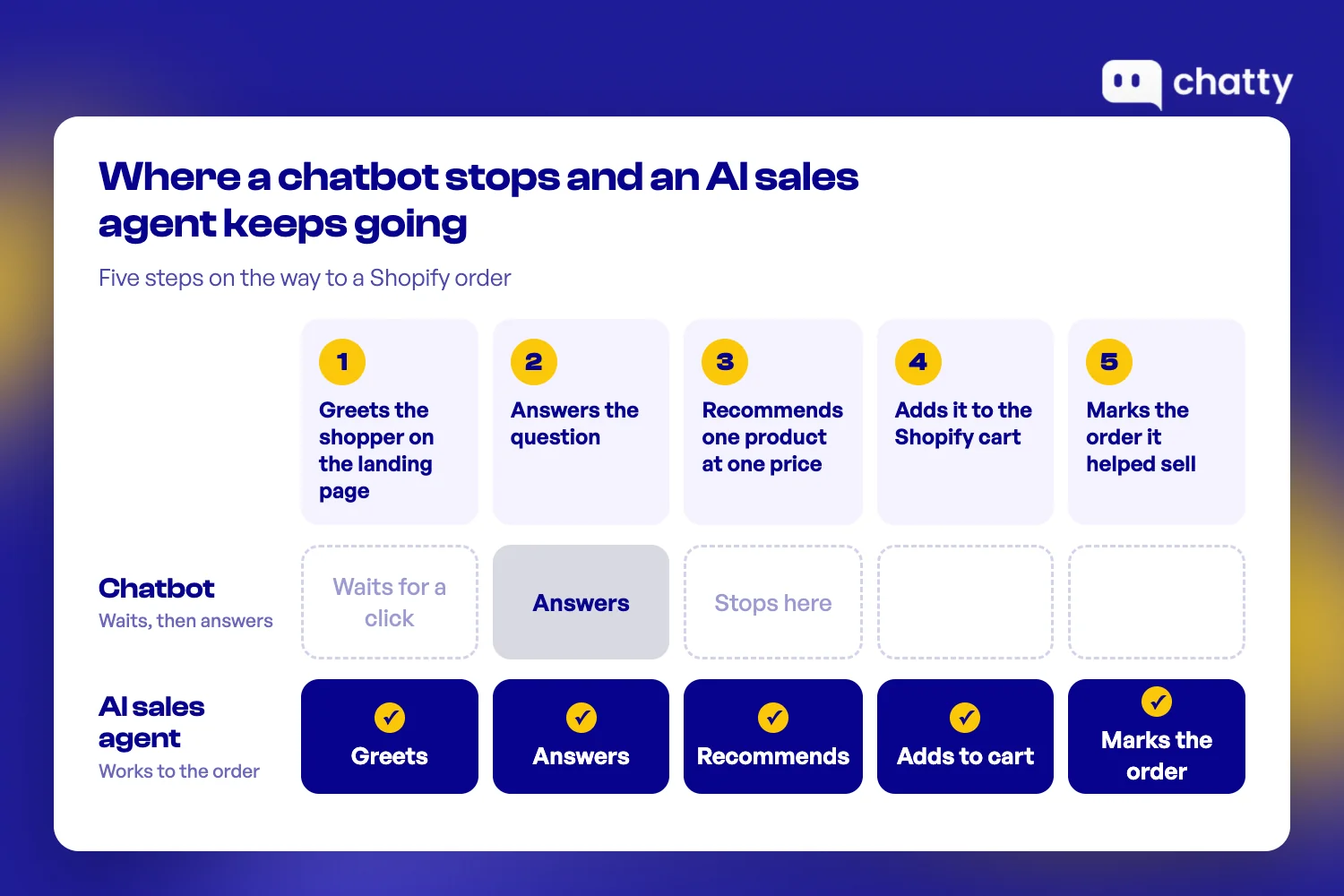
Shopify calls it "software that uses artificial intelligence to complete sales tasks with minimal or no human oversight" (2026). That definition is right, but it leaves out the part a merchant needs to know: which tasks. On a Shopify store, the tasks are concrete, and each one leaves a trace you can see.
For a Shopify store, an AI sales agent reads your own store data: products, variants, prices, stock, discounts and shipping rates. It works inside the real Shopify cart and the real Shopify order, rather than in a separate widget that only links out.
A shopper asks for "the same jacket in medium." A sales agent checks stock for that variant and puts it in the cart.
An AI chatbot is one feature of an AI sales agent. Shoppers see the chat window first, so people often treat the two words as the same thing. An AI sales agent also sells in the search bar, on product pages and at the cart.
In B2B software, "AI sales agent" usually means an AI SDR. That tool finds leads, writes cold email and books meetings for a sales team.
This article covers the ecommerce meaning: the agent on your storefront that helps shoppers buy. If you came for outbound prospecting, the rest of this page will not apply.
The older debate about scripted bots and conversational AI asked how well a tool talks. The useful question in 2026 is what the tool does to the order.
What an AI sales agent does on the buying path
An AI sales agent does four jobs, one at each stage of the buying path. Each job ends in something you can observe.
The stakes are high because most visitors leave without buying. The median Shopify store converts 1.4% of sessions, and the top 20% convert above 2.7%. That comes from 433 stores measured from July to October 2026 by Littledata.
Here are the four jobs, in the order a shopper meets them:
When a shopper lands: greets them on the page they arrived on
An AI sales agent starts the conversation before the shopper asks. A widget that waits for a click only meets the small share of visitors who open it.
A good sales agent greets shoppers on the page they landed on, such as the product page your ad sent them to. The greeting names that product or that collection.
"Looking for the waterproof version of this boot?" leads to a product. "How can I help?" leads nowhere in particular.
While they decide: turns a need into one product at one price
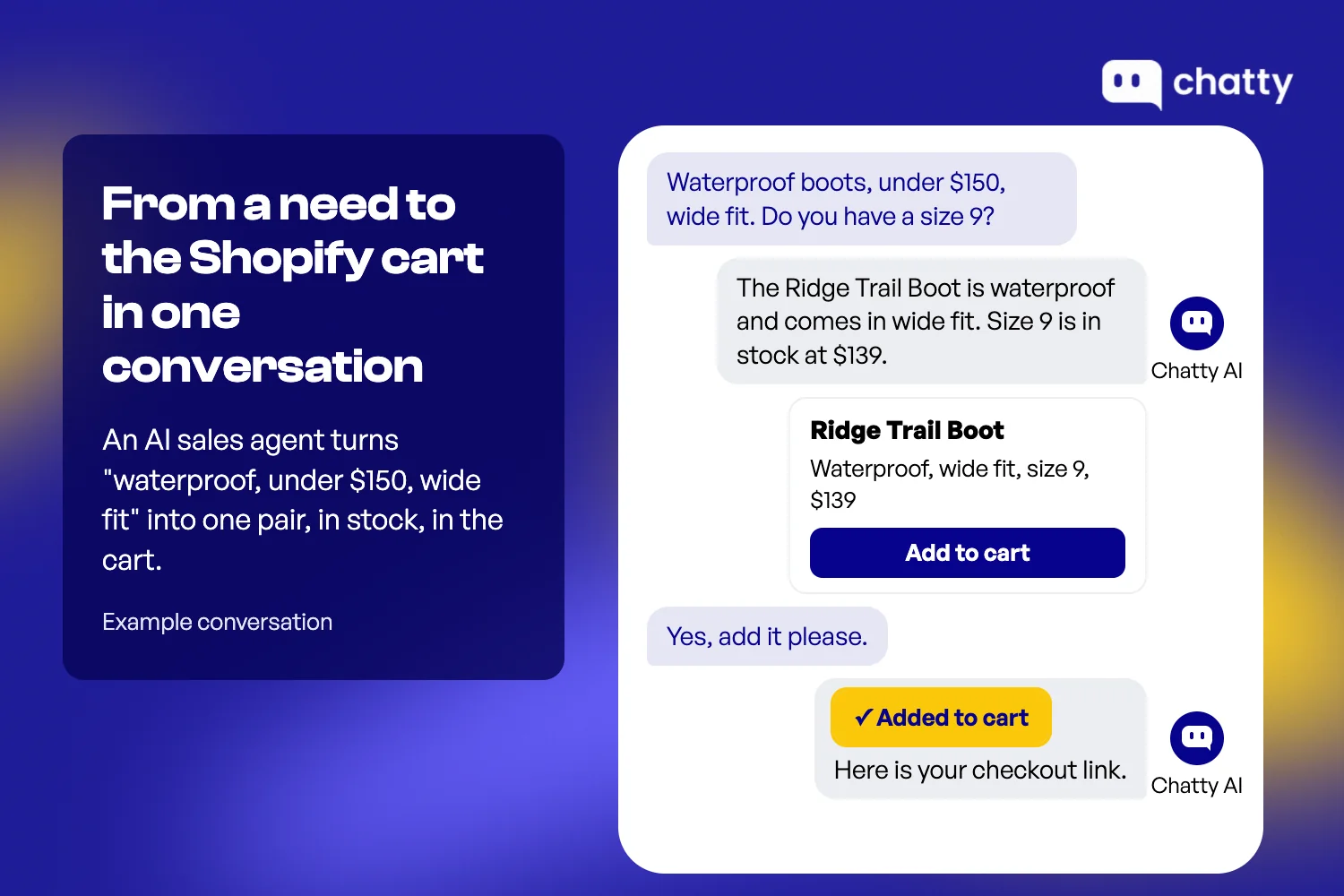
An AI sales agent narrows a vague need down to one product, one variant and one price. Say a shopper writes "waterproof, under $150, wide fit."
The agent searches the catalog by those attributes and checks which sizes are in stock. Then it names the one pair that fits.
The agent compares two products when the shopper is stuck between them. It suggests products that go with the item, such as the matching care spray. When the size is out of stock, it says so and offers what is in stock, instead of guessing.
At the cart: adds to the real Shopify cart and brings shoppers back
An AI sales agent adds the chosen product to the real Shopify cart in the same conversation. Then it sends the checkout link. Checkout and payment stay with Shopify, so nothing about your checkout changes.
Carts left behind are the second big leak. The average documented cart abandonment rate is 70.22%, based on 50 studies, according to Baymard Institute (2025). A sales agent reminds shoppers about the cart they left and brings them back to finish the order.
After the order: looks after the customer and marks the sale
After the order, an AI sales agent keeps the customer's trust. It looks up order status and answers shipping questions. When a person should take over, it hands the chat to your team with the context attached.
The last job is the record. A sales agent marks each order it assisted, inside Shopify, so you can see which sales it touched. Without that mark, every other claim about revenue stays a claim.
A 4-question test: is it an AI sales agent or a chatbot with a new name?
You can tell an AI sales agent from a renamed chatbot by testing four actions in a free trial. The label on the listing will not tell you.
In June 2025, Gartner warned about "agent washing": vendors rebranding chatbots, AI assistants and automation tools as agents without real agentic features. Gartner estimated that only about 130 of the thousands of vendors claiming agentic AI offer real agentic features, as reported by MarTech.
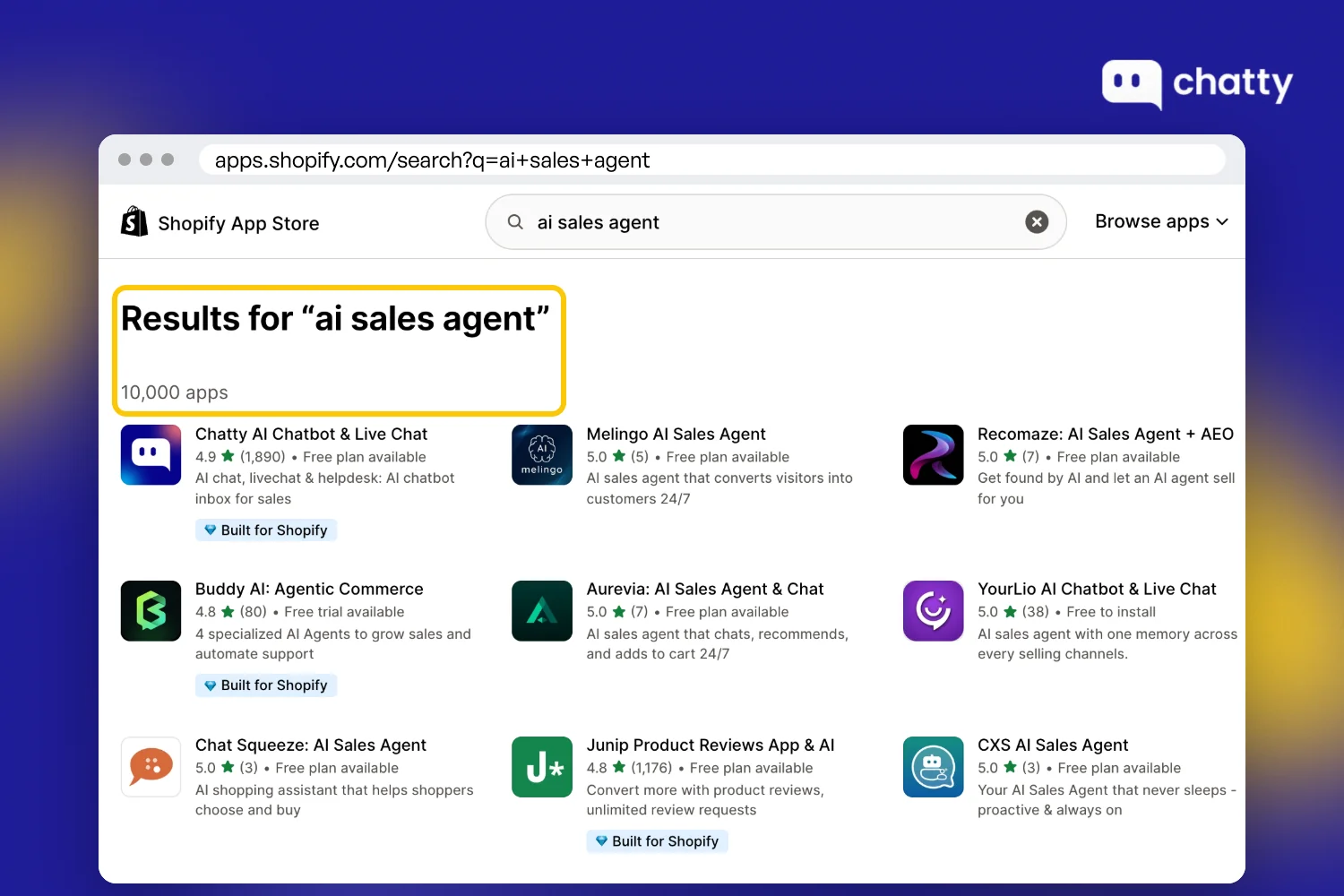
Start with a quick filter. Swap the product name in a vendor's headline for "a chatbot," and if the sentence stays true, it describes a chatbot.
Then run these four checks:
- Where does the answer come from? A sales agent reads your live Shopify data at the moment of the question. To check it, change a price or a stock level on a test product, then ask about that product again.
- Can it act in your Shopify cart? Ask it to add a specific variant, like the blue one in size 8. Then open the cart and look for that exact variant.
- Does it start the conversation on the right page? Open a product page from an ad link or a collection page. A sales agent greets you about what is on that page.
- Can you find the orders it helped sell in Shopify admin? Ask where the order record lives. You should be able to filter orders in Shopify admin, rather than trust a number on the vendor's own dashboard.
Four yeses means you are looking at an AI sales agent. A tool that answers well but fails checks 2 to 4 is a chatbot. A tool that starts working only after a customer has a problem is a helpdesk.
Check 4 carries the most weight. A tool can pass the first three in a demo and still leave you guessing about revenue. If a vendor cannot show you the order record, treat every revenue figure in its pitch as unverified.
The test checks actions, not answer quality. Pair it with a simple accuracy check: ask ten real product questions and compare each answer with your product pages.
AI sales agent vs chatbot vs helpdesk: the three kinds of tools
Shopify merchants choose between three kinds of tools: ticketing helpdesks, generic AI chat widgets and sales-first Shopify agents. Each one is built for a different job, and the measure tells them apart.
Many helpdesks and widgets now add an "AI agent" tab, so ask what each tool is measured on. The answer tells you more than the label.
| Ticketing helpdesk | Generic AI chat widget | AI sales agent for Shopify | |
|---|---|---|---|
| Starts when | A customer has a problem | A visitor opens the chat | A shopper lands on your store |
| Answers from | Your team, macros, help articles | A script or your help pages | Your products, variants, stock, prices, discounts and policies |
| Takes actions | On tickets (assign, tag, close) | Rarely, mostly links | In the Shopify cart and on orders |
| Where it shows up | Email and support inbox | A chat bubble | Search bar, product pages, chat, cart |
| You measure | Tickets closed, response time | Chats answered, deflection | Orders and revenue from conversations |
| Right for | Post-purchase volume | FAQ coverage | Turning visitors into orders |
Here is what each kind of tool does well:
Ticketing helpdesks
A ticketing helpdesk organises the work that starts after something goes wrong. Email, returns, order changes and complaints become tickets with owners, tags and response times.
A helpdesk is the right tool when post-purchase volume is your main pain. It is measured by tickets closed, so it rarely touches the sale itself. Our helpdesk vs live chat guide covers when a chat should become a ticket.
Generic AI chat widgets
A generic AI chat widget answers questions from a script or from your help pages. It waits for the visitor to open the bubble, and it usually links out rather than acting in the cart.
A widget is the right tool when you want quick FAQ coverage with little setup. It is measured by chats answered and deflection, which are support numbers.
Sales-first Shopify agents
A sales-first Shopify agent starts when a shopper lands on your store. It reads your Shopify catalog, acts in the real cart, and records the orders it assisted. It is measured by orders and revenue from conversations.
If your goal is more revenue from chat, start with a sales agent. Keep your helpdesk for tickets.
An AI sales agent fits Shopify stores that already get traffic and want revenue from chat without running a full helpdesk. Ticket volume grows with returns, order changes and email. At that point, run the AI sales agent beside a helpdesk instead of replacing one with the other.
The agent works the storefront, and the helpdesk works the tickets.
How to measure an AI sales agent: orders, not conversations
Measure an AI sales agent by the orders and revenue recorded on your Shopify orders. Conversations handled and resolution rate describe support work, and they say nothing about whether the agent sold anything.
Two kinds of order credit are worth separating:
- Assisted orders. The shopper talked to the agent before buying. The agent was part of the path, but other things may have made the sale.
- Direct orders. The order contains a product the agent showed or recommended in the conversation. This is the closer link between the conversation and the sale.
Two orders show the difference. A shopper asks about sizing, the agent recommends a pair, and the shopper buys that pair. That order is assisted and direct.
Another shopper chats about shipping times, then buys something the agent never mentioned, so that order is assisted only.
Ask any vendor where in Shopify admin you can filter the orders it helped sell. A vendor dashboard is useful, but an order-level mark in your own admin is the version you can audit. Our guide shows how to find chat orders in Shopify.
Be honest about what attribution means. Attributed revenue counts the orders the agent touched, and some of those shoppers would have bought anyway.
To see the extra revenue, compare similar periods with the agent on and off. You can also hold back a share of traffic as a control group.
Also keep resolution rate apart from accuracy. A conversation can be closed without a person and still contain a wrong price.
Chatty AI Sales Agent: the definition on a real Shopify store
Chatty is the AI sales agent for Shopify stores. Every shopper gets their own sales rep: Chatty greets them, recommends the right product, brings them back to their cart and looks after them once they buy. It answers from your own Shopify data, and marks every sale it helped make on the Shopify order.
AI chatbot and live chat are two standout features of Chatty. The AI chatbot answers from your own Shopify data, and with live chat your team takes over from the AI and closes the sale.
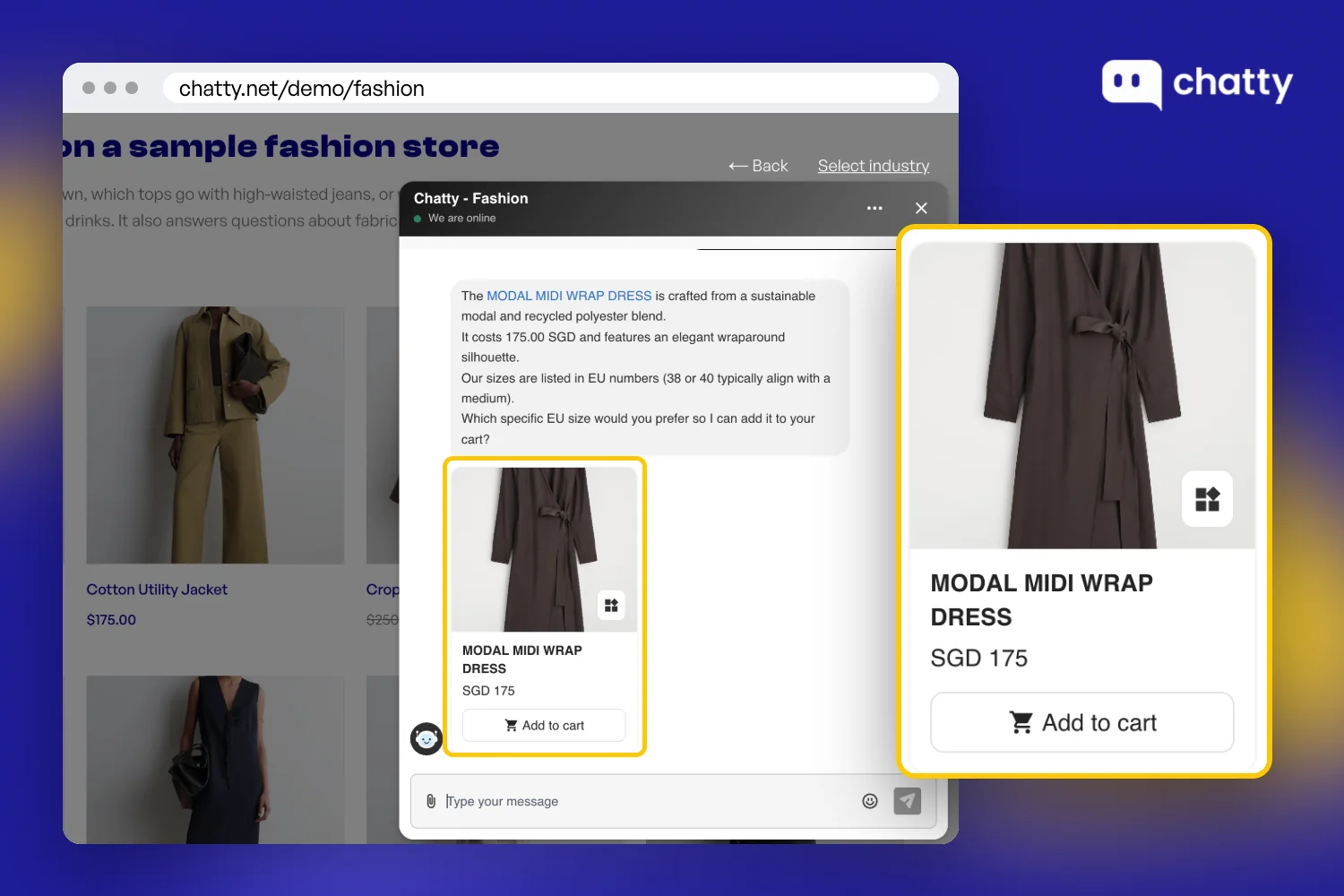
Here is how Chatty, the AI sales agent for Shopify, maps to the four checks:
- Live store data. Chatty answers from your own Shopify data: products, prices, stock, discounts and shipping.
- Cart action. Chatty adds products to the shopper's real Shopify cart and sends the checkout link. Checkout and payment stay with Shopify.
- Starts the conversation. It helps shoppers in the search bar, on product pages, in chat and at the cart. Welcome messages can target the landing pages your ads send shoppers to, and the abandoned cart reminder is on Pro and Plus.
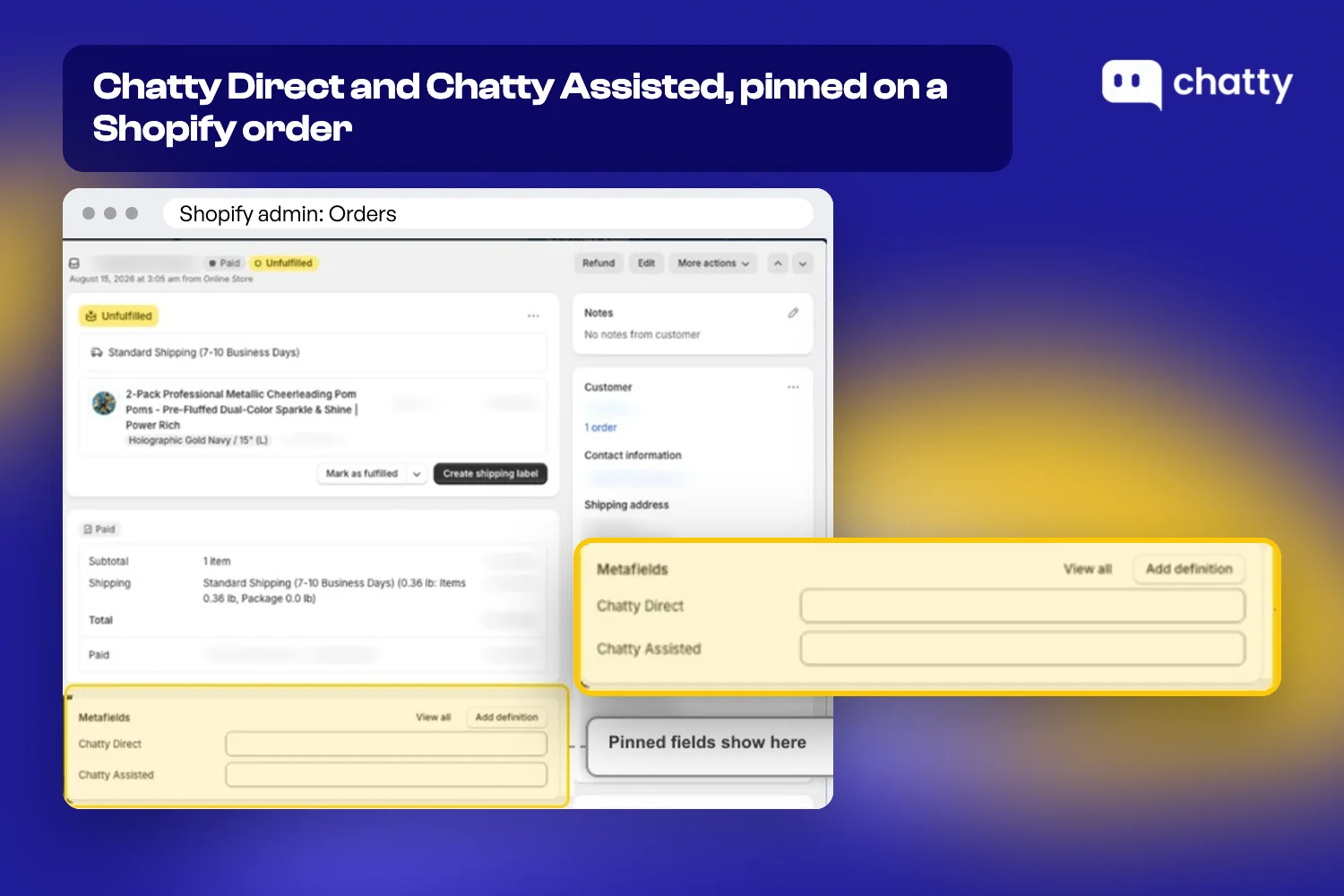
- Orders in Shopify admin. Chatty marks every order it assisted in Shopify, so you can check the return yourself. The Chatty Assisted and Chatty Direct fields sit on each order, and you can filter your order list by them in Shopify admin. Chatty's sales analytics shows the assisted revenue in one view.
Accuracy is the check the four questions skip. 92% of product answers were right on price, stock and details when we compared 300 real Chatty answers with each store's website in October 2026.
Published results from three Chatty stores show the order-level view in practice:
- BARABAS, a menswear brand, recorded $300K in AI-assisted revenue in 12 months.
- Stonehenge Health, a supplement brand, recorded $75K in assisted revenue over 7 months, and 11.36% of its chats converted to sales.
- Montana West, a western fashion store, made $41,115 in revenue from chat during peak season. Its chat revenue grew 171% while conversations grew 83%.
Judge an AI sales agent by the orders it touches
An AI sales agent recommends products, adds them to the Shopify cart, brings shoppers back and marks the orders it helped sell. Everything else on a vendor's listing is a claim about those four actions.
So skip the label and run the test. Check for live store data, a real cart action, a greeting on the right page and orders you can filter. Do it this week, on whatever tool you are evaluating, and you will know what kind of tool it is.
Bring your best salesperson to every shopper. See how Chatty AI Sales Agent works, then run the four checks on your own catalog.
Frequently asked questions
A chatbot answers questions, often from a script. An AI sales agent reads your live store data and acts toward a sale. It recommends a product, adds it to the cart, brings shoppers back to their cart and marks the orders it assisted.
An AI shopping assistant on your store is the pre-purchase part of an AI sales agent. It helps shoppers find, compare and choose products, then adds them to the cart. An AI sales agent also looks after customers after the order.
Our AI shopping assistant guide covers how to choose one.
No. An AI SDR is a B2B sales tool that finds leads, writes outreach email and books meetings for a sales team. An AI sales agent for ecommerce works on your storefront and sells to shoppers who are already on your site.
No, and it does not need to. A helpdesk manages tickets after a problem, such as returns and order changes. An AI sales agent works the storefront, and you can run the two side by side.
AI sales agents usually charge per conversation, per resolution or per seat, often with a base plan. Check what counts as a billable conversation and whether you can cap spending.
Chatty is one example. Your plan includes AI conversations, each extra one costs $0.40, and you set the monthly limit. See Chatty pricing.
Chatty is an AI sales agent rather than a scripted chatbot. It writes each answer from your store's data instead of following a fixed script, and it can take actions such as adding products to the cart and looking up an order. Your team also gets a live chat inbox for the conversations that need a person.
Ask ten real product questions in a trial and compare each answer with your product pages. Check which source the agent used for each answer, and set rules for when it hands the chat to your team. Repeat the check after you change prices, stock or policies.