












Chatty is an AI sales agent built for Shopify. Tidio is a customer service platform that runs on seven ecommerce platforms. Both put a chat widget on your store, and both answer shopper questions with AI.
Most comparisons of the two stop at a feature checklist. That misses the one thing that actually sets your bill, your upgrade path and the shape of both free plans: whether you are buying one product or three.
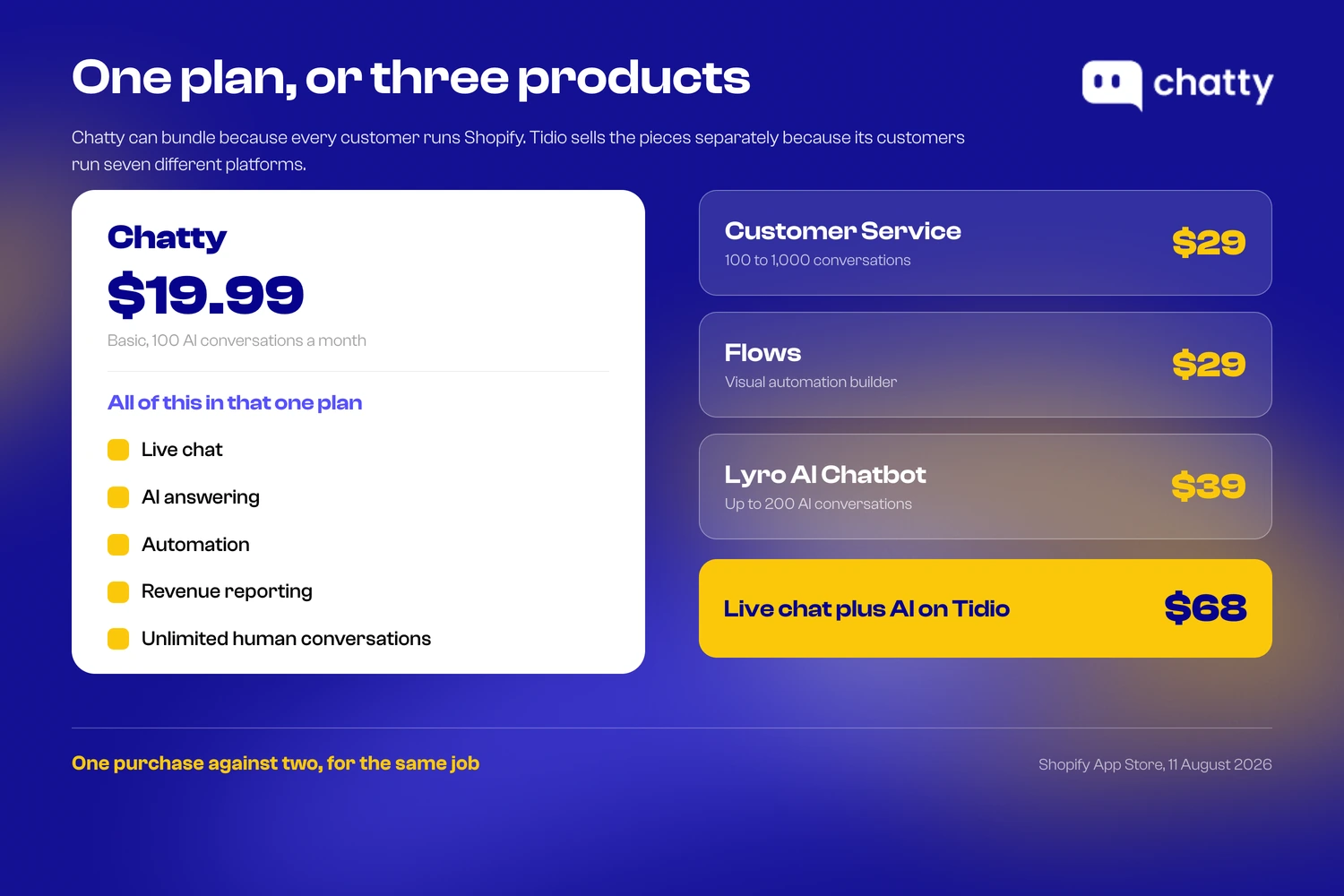
Chatty is one product. Live chat, AI, automation and revenue reporting are in all four of its plans, and the only thing that changes as you move up is how many AI conversations you get. Tidio is three products you buy separately, Customer Service at $29, Flows at $29, and the Lyro AI Chatbot at $39, and you assemble the setup you need.
The reason is the platform count. Chatty only serves Shopify stores, and they all want the same features, so it can put everything in one product. Tidio serves seven platforms whose customers want different things, so it has to sell the pieces separately. Every number below follows from that.
Chatty publishes this comparison, so read it accordingly. Every Tidio figure links to a Tidio page you can open, and where Tidio's model wins, this article gives the exact volume where it starts. Prices were re-verified on 11 August 2026, everything else on 10 August 2026.
- Chatty is one product. Tidio is three you combine. Chatty puts everything in all four plans and charges only for AI volume. Tidio sells Customer Service, Flows and Lyro separately.
- Same annual spend, 2.5 times the AI. Chatty Pro is $827.88 a year for 500 AI conversations a month. Tidio's bundle is $816.00 for 200. The gap is $11.88.
- At 100 AI conversations a month, Chatty costs $576.12 less a year. $19.99 on Chatty Basic against $68 on Tidio, which needs Customer Service at $29 plus Lyro at $39.
- Buying AI on its own? Tidio wins above 148 conversations. Lyro is a flat $39 up to 200. Chatty Basic plus $0.40 overage passes it at 148. Above 200 Tidio publishes no price.
- Chatty collects Shopify reviews 4.1 times faster. 35.7 a month since June 2022 against Tidio's 8.6 since July 2014. Five-star: 1,716 to 1,074. One-star: 18 to 50.
What is the difference between Chatty and Tidio?
Chatty works on Shopify only. Tidio works on seven platforms. That single fact decides how each one is sold, and it is why their price lists look nothing alike.
Tidio runs on Shopify, WooCommerce, WordPress, BigCommerce, Wix, Squarespace and Magento, and says it serves 300,000 businesses. Chatty runs on Shopify and nowhere else.
Here is why that changes the pricing. Every Chatty customer sells on Shopify, so every Chatty customer needs the same things: catalog sync, product cards, cart recovery, revenue reporting. Chatty can put all of it in every plan and charge for one thing only, the number of AI conversations you use.
Tidio cannot do that. A Wix consultancy, a WooCommerce store and a SaaS company each need a different piece of the product. Selling them one bundle would make most of them pay for parts they never open. So Tidio sells the pieces separately and you buy only what you need.
Why one platform lets Chatty bundle
Every Chatty customer has a Shopify catalog, a Shopify cart and Shopify orders. That makes catalog sync, product cards, add to cart and revenue attribution useful to all of them, so Chatty ships all of it on every paid tier and charges for AI volume alone.
It also fixes what the product is for. An AI sales agent is measured on whether conversations turn into orders, which is why Chatty reports attributed revenue as a standard feature rather than an analytics upgrade.
The consequence shows up in the free plan. Chatty's free tier carries 50 AI conversations a month, 200 trained products, one seat, and unlimited human conversations, and it renews rather than expiring. Human conversations are uncapped on every tier including Free.
Why seven platforms make Tidio sell the pieces separately
A Wix consultancy, a WooCommerce store and a SaaS company need different things from Tidio. Selling one bundle would make most customers pay for parts they never touch, so Tidio splits the product and prices each piece.
That model has real advantages. A store that wants live chat and no AI pays $29 and nothing more. A store that wants only automation buys Flows on its own. You never buy a capability you do not use.
It also sets a ceiling. Tidio's free plan carries live chat for 50 users, 10 seats, and 50 Lyro conversations for the lifetime of the account rather than per month. Ongoing AI means buying Lyro.
Chatty vs Tidio pricing: which one costs less in 2026?
Chatty's ladder runs Free at $0 for 50 AI conversations a month, Basic at $19.99 for 100, Pro at $68.99 for 500, and Plus at $199 for 1,000. Every tier bills $0.40 per AI conversation past its cap and includes unlimited human conversations, according to Chatty's pricing page.
Tidio's Shopify App Store listing runs Customer Service at $29 for 100 to 1,000 conversations, Flows at $29, and Lyro AI Chatbot at $39 for up to 200 AI conversations. Only Lyro meters AI, and Tidio defines a Lyro conversation as any interaction with at least one AI reply. Above 200 the Lyro card reads "Upgrade as you grow" and publishes no price.
The full cost curve, 50 to 1,000 AI conversations a month
Neither vendor publishes this table. It prices the same job on both products: live chat for the store plus AI answering, at the cheapest combination each one offers.
| AI conversations a month | Chatty | Tidio, Shopify App Store |
| 50 | $0 (Free) | $39 (Lyro; the free plan's 50 Lyro conversations are lifetime, not monthly) |
| 100 | $19.99 (Basic) | $68 (Customer Service $29 plus Lyro $39) |
| 200 | $59.99 (Basic plus 100 at $0.40) | $68 (at Lyro's published cap) |
| 300 | $68.99 (Pro) | Not published |
| 500 | $68.99 (Pro) | Not published |
| 1,000 | $199 (Plus) | Not published |
Two Chatty switch points fall out of the $0.40 overage. Basic stops being the cheapest Chatty option at 223 conversations a month, where $19.99 plus overage passes Pro's $68.99. Pro stops being cheapest at 825, where it passes Plus at $199. Between those points, buying overage beats upgrading.
One consequence is worth flagging because it works against Chatty. Chatty Plus costs $0.1990 per AI conversation, which is worse than Pro's $0.1380. Pro is the best value on Chatty's own ladder, and a store at 700 conversations pays less on Pro plus overage ($148.99) than on Plus ($199).
Running the numbers on a store doing 100 AI conversations a month
This is the entry case, a store that wants a live chat widget with AI answering behind it.
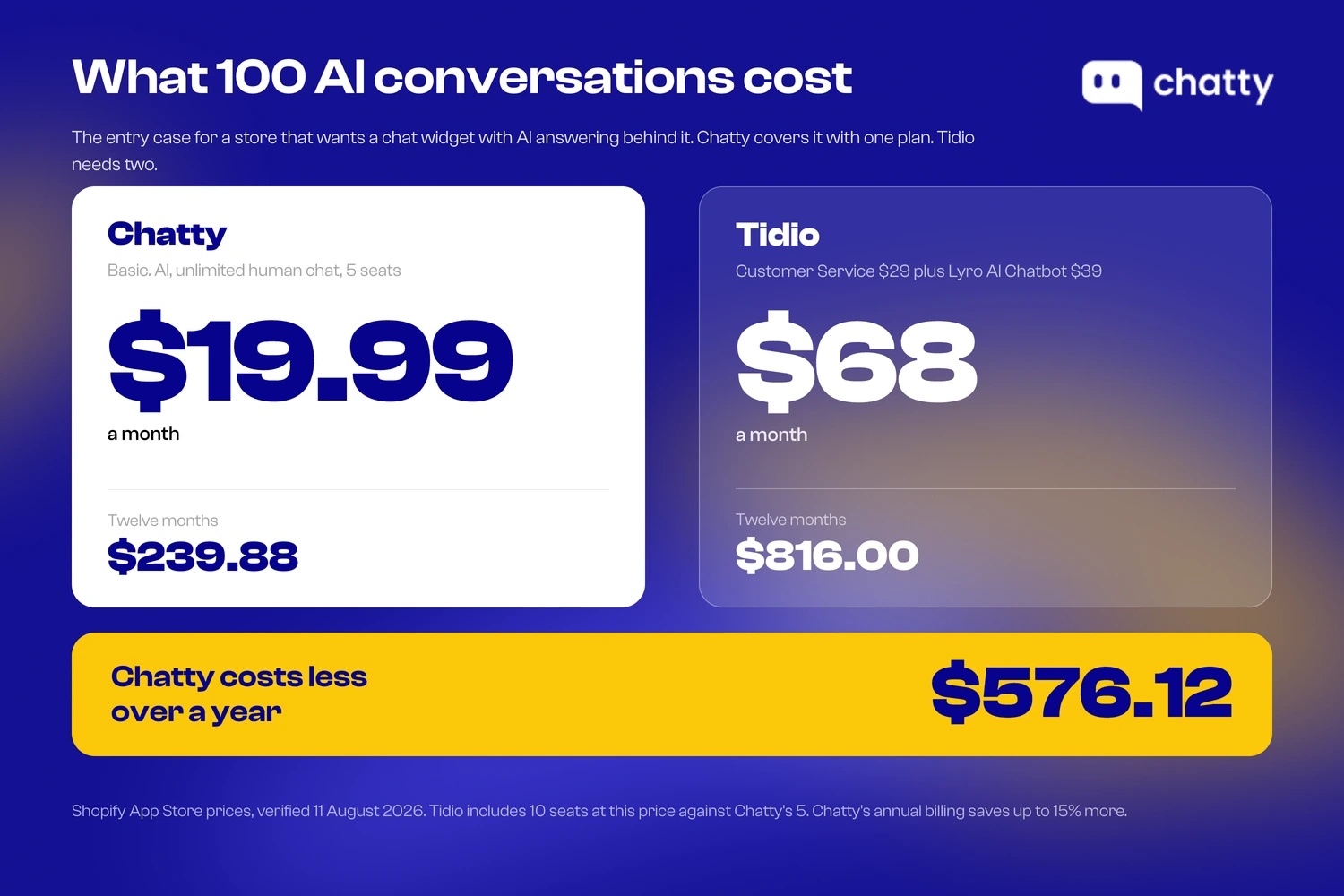
On Chatty that is Basic at $19.99 a month, which covers the 100 AI conversations, unlimited human conversations, 500 trained products and 5 seats. Twelve months costs $239.88.
On Tidio the same job needs two purchases. Customer Service at $29 covers the conversation volume, and Lyro at $39 covers the AI. That is $68 a month, or $816.00 over twelve months.
The gap is $576.12 a year, and Chatty's annual billing widens it further at up to 15% off. Tidio buys you more seats for that money, 10 against 5, which works out at $6.80 per seat against Chatty's $4.00.
Running the numbers on a store doing 500 AI conversations a month
This is where the two models separate hardest, and it is the comparison neither company runs.
Chatty Pro is $68.99 a month for 500 AI conversations, 8,000 trained products and 10 seats. Tidio's Customer Service plus Lyro bundle is $68 a month and covers 200 AI conversations. The monthly prices are 99 cents apart.
Over twelve months that is $827.88 on Chatty against $816.00 on Tidio, a difference of $11.88 a year. For that $11.88, Chatty includes 2.5 times the AI conversations. Per conversation the rates are $0.1380 and $0.3400.
Chatty's annual discount changes the sign of the difference. At up to 15% off, Pro costs $703.70 a year, which is $112.30 less than Tidio's bundle at monthly rates while still including 2.5 times the AI.
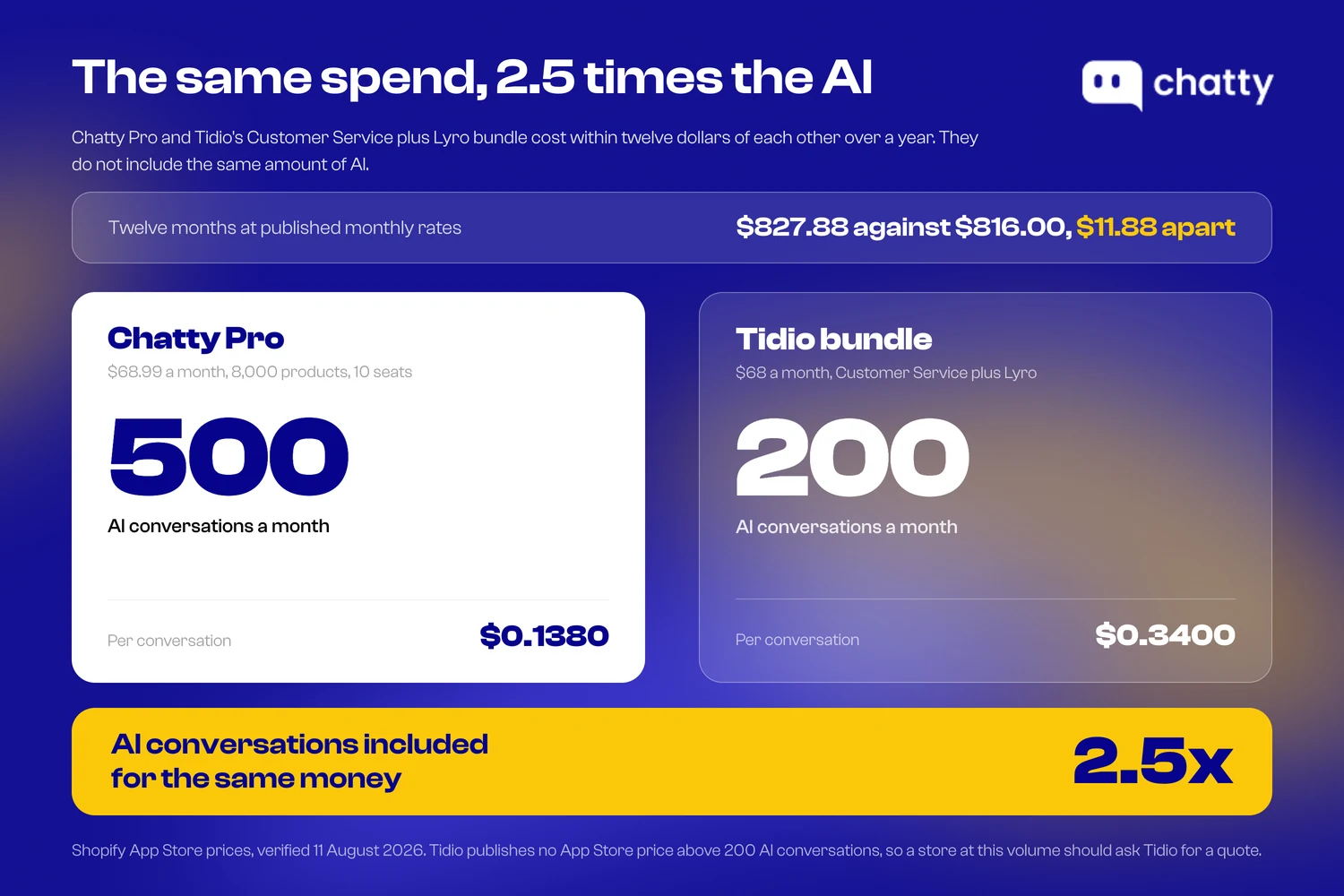
There is a real caveat here, and it is Tidio's to claim. Tidio does sell AI above 200 conversations, it just does not publish the price on its App Store card. A store at 500 conversations should ask Tidio for a quote rather than assume this table is the end of it.
At what volume does Tidio become cheaper?
Change the job from "live chat plus AI" to "AI only" and the answer flips. A store already happy with Tidio's free live chat can buy Lyro on its own at $39 for up to 200 conversations.
Against that, Chatty Basic costs $19.99 plus $0.40 for each conversation past 100. Solving $19.99 plus $0.40 times the overage against $39 puts the crossover at 148 AI conversations a month.
Below 148, Chatty is the cheaper way to buy AI. From 148 to Lyro's 200 cap, Tidio is. At 200 exactly, Chatty costs $59.99 and Lyro costs $39.
One warning is worth more than any table here. Tidio's own website lists different plans and prices from its Shopify App Store listing. It names them Starter, Growth, Plus and Premium, and sells Lyro as a usage add-on. Every Tidio figure in this article comes from the App Store cards, so the comparison stays inside one sales channel. Check which list you are billed under before you budget.
Which AI costs less per resolved conversation?
What a store actually buys is a resolved conversation, one the AI finished without a human, so that is the number to divide by rather than the raw conversation count. Multiplying each vendor's own published resolution rate by its own published price gives a number neither publishes.
State the caveat before the figures, because it decides how much weight they carry. These two resolution rates are not measured the same way. Chatty's come from four case studies it selected. Tidio's is a blended average with no published method. Neither is an independent benchmark, and both belong to the vendor quoting them.
| Plan and volume | Resolution rate used | Cost per resolved AI conversation |
| Chatty Pro, 500 a month | 96.6% (Decathlon) | $0.143 |
| Chatty Pro, 500 a month | 80% (Montana West, the lowest Chatty publishes) | $0.172 |
| Tidio Lyro alone, 200 a month | 64% (published average) | $0.305 |
| Tidio bundle, 200 a month | 64% (published average) | $0.531 |
| Tidio bundle, 200 a month | 50% (guaranteed floor) | $0.680 |
Chatty's worst published case is cheaper per resolved conversation than Tidio's best. That holds even comparing Chatty's full bundle price to Lyro bought on its own.
What can each vendor actually prove about its AI?
Chatty publishes four named stores, each on its own page. Stonehenge Health reports 99.9% resolution across 5,141 conversations, $75,000 attributed over seven months and an 11.36% chat-to-sale rate. Montana West reports 80% of conversations AI-handled and $41,115.15 attributed at 11.86%. Yoeleo Bike reports 98.94% resolution on technical compatibility questions and $29,586 assisted. Decathlon reports 96.6% resolution and 9% chat-to-sale on a 10,000-product catalog.
Across those four the mean resolution rate is 93.86%, the mean chat-to-sale rate across the three that report it is 10.74%, and the three with dollar figures total $145,701.15 in attributed revenue. Treat that as an aggregate of self-selected examples, not a sample of Chatty's customer base.
Tidio publishes one number. A Tidio press release reports a 64% average resolution rate with a 90% peak, stating no methodology, no sample size and no measurement date. Tidio also guarantees a 50% resolution floor to Tidio+ customers after 30 days.
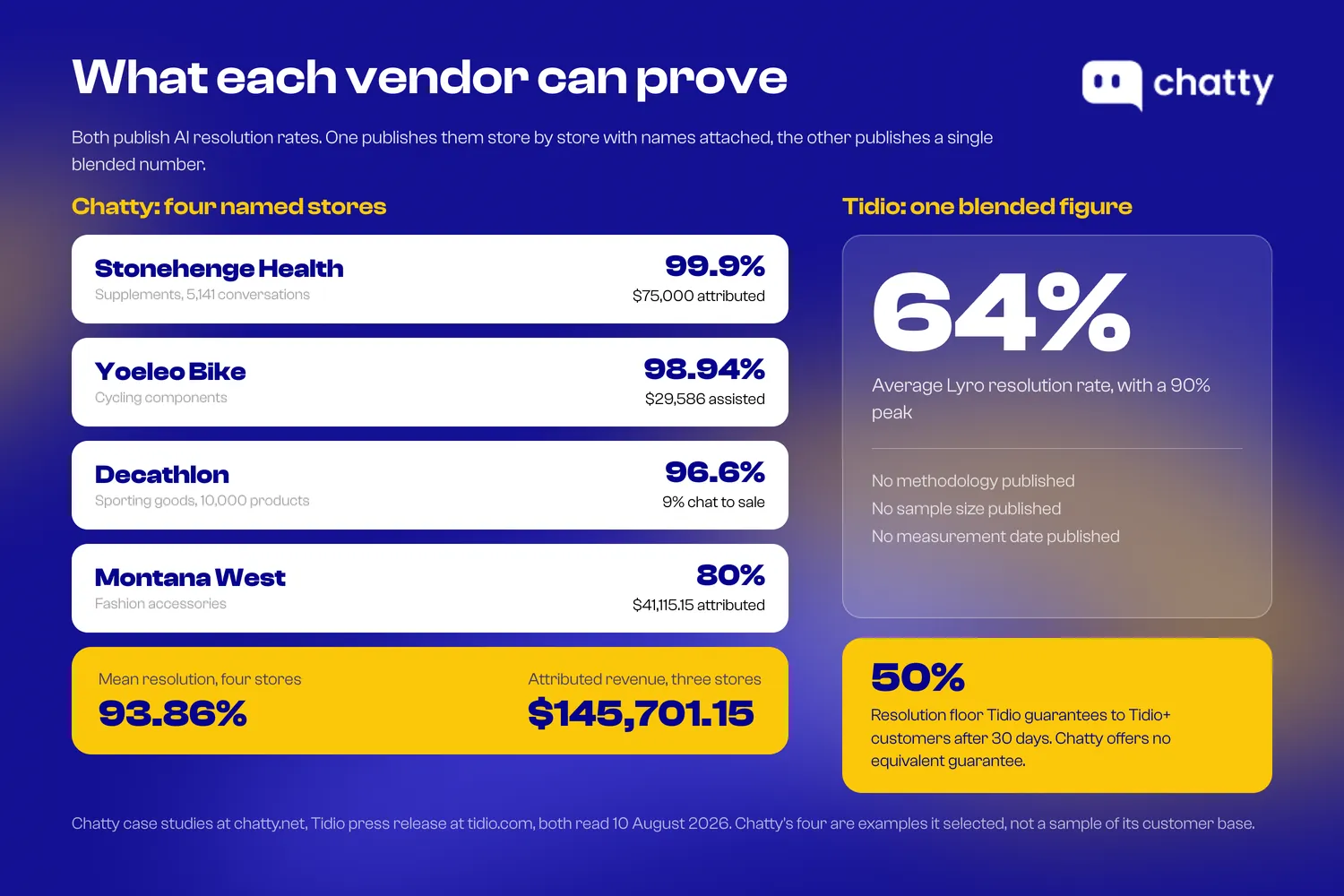
Those are different kinds of evidence and the guarantee is the stronger kind in one respect. A contractual floor has consequences attached, and Chatty offers no equivalent. Read the guarantee as a floor rather than a forecast, and read the case studies to find a store shaped like yours. A 98.94% resolution rate on bicycle compatibility questions tells you a lot about technical catalogs and very little about apparel returns.
Chatty vs Tidio features: what can each one do?
Most of these features are on both products. The rows where they differ nearly all trace back to the same thing: Chatty built deep on one platform, Tidio built wide across seven.
| Capability | Chatty | Tidio |
| AI included in base price | Yes, every tier including Free | No, Lyro sold separately from $39 |
| Human conversations | Unlimited on every tier | Capped, 50 users on free |
| Live chat plus AI, entry price | $19.99 | $68 |
| Cost per AI conversation, best tier | $0.1380 (Pro) | $0.1950 (Lyro alone), $0.3400 (bundle) |
| Revenue attribution | Yes | Yes, currency figures require Shopify |
| Product recommendations from live inventory | Yes | Yes |
| Add to cart inside the conversation | Yes | Yes, Shopify and WooCommerce |
| Payment taken inside the chat | No | No |
| Cart recovery | Yes, Pro and up | Yes |
| AI reads a product photo a shopper sends | Yes, suggests the closest products | Not documented |
| Products trained, entry paid tier | 500 (8,000 on Pro, 20,000 on Plus) | Not metered by product |
| Cart preview for agents | Not documented | Yes |
| Cancel, refund or change address from inbox | No, AI detects the intent only | Yes, agent executes it |
| Video calls | No | Yes |
| Live visitor list and typing preview | No | Yes |
| Desktop apps | No | Yes, macOS and Windows |
| Zapier, HubSpot, open API | No | Yes |
| Social channels on free plan | No, Basic and up | Yes |
| Seats at entry paid tier | 5 ($4.00 each) | 10 ($6.80 each) |
| Platforms | Shopify only | Seven platforms |
| Built for Shopify certification | Yes | No |
Most rows sit in both columns. Revenue attribution, product recommendations from live inventory, cart recovery and add to cart inside the conversation are on both products, so any article selling those as Chatty differentiators is out of date.
Four things are Chatty-only: Built for Shopify certification, unlimited human conversations on every tier, AI in the base plan, and reading a product photo a shopper sends so the AI can suggest the closest catalog matches.
Tidio's list is longer, and the entry that matters most is order actions. An agent can cancel an order, issue a refund or change a shipping address without leaving the inbox, which Tidio's Shopify page groups with cart preview and order history. Chatty's AI recognises that intent and hands it to a human. Tidio also has video calls, the live visitor list and typing preview, desktop apps, and Zapier, HubSpot and open API access.
One caveat on the revenue row. Tidio puts currency figures in its Sales panel only on a Shopify-integrated project, where it reports sales assisted, average order value and order count on a seven-day window. Everywhere else it reports interactions and click-through rate instead, per Tidio's Analytics documentation. On Shopify, the platform this comparison is about, both products report revenue in full. Feature lists move as the products ship, so Chatty keeps a side-by-side comparison current.
Chatty vs Tidio reviews from customers
Which rates higher on Shopify?
Both apps rate near the top of the category, and the raw ratings are close enough that the derived numbers say more.
| Chatty | Tidio | |
| Rating | 4.9 | 4.8 |
| Reviews | 1,788 | 1,249 |
| 5-star share, and count | 96%, about 1,716 | 86%, about 1,074 |
| 1-star share, and count | 1%, about 18 | 4%, about 50 |
| Listed on Shopify | 9 June 2022 | 14 July 2014 |
| Months listed to 10 August 2026 | 50.0 | 144.9 |
| Reviews per month | 35.7 | 8.6 |
| Built for Shopify | Yes | No |
Neither listing displays the bottom three rows, and they change the reading. Tidio has been collecting Shopify reviews for eight years longer, so comparing 1,788 against 1,249 is not a like-for-like count. Divide by the time each has been listed and Chatty is collecting reviews 4.1 times faster, at 35.7 a month against 8.6.
The absolute counts behind the percentages point the same way. Chatty holds roughly 1,716 five-star Shopify reviews against Tidio's 1,074, and about 18 one-star against 50, in a third of the time on the platform.
One thing cuts the other way and belongs in the same paragraph. Tidio's presence beyond Shopify is far larger, at 4.6 across 1,880 reviews on G2 and 4.7 on Capterra. Reading only the Shopify App Store flatters Chatty. Figures come from the Chatty and Tidio listings, checked on 10 August 2026.
What do merchants say about each AI?
To answer that properly, we read every review on both Shopify App Store listings instead of taking a sample. That is 1,784 reviews for Chatty and 1,237 for Tidio.
We then kept only the last 24 months, so both sets describe the products as they are today. That leaves 1,084 reviews for Chatty and 582 for Tidio. Inside those, 117 Chatty reviews and 127 Tidio reviews talk about the AI. As a share, that is 10.8% for Chatty and 21.8% for Tidio.
Tidio merchants talk about the AI twice as often, but this says nothing about how good either AI is. It comes from how each company sells it. Tidio gives its AI a name, Lyro, and charges for it on a separate line, so merchants see it as its own product and review it directly. Chatty includes the AI in the plan, so merchants review the whole app and mention the AI along the way.
What Chatty merchants say
One point comes up more than any other. Chatty's staff set the AI up for you. Merchants say what they want, and the team configures it.
A merchant writing in July 2026 described exactly what the team built for their skincare store. They set a friendly persona, added "automated greeting hooks that instantly pitch our fast Canadian shipping," and put in "strict boundaries to ensure the AI doesn't give out unauthorized medical advice." Other merchants describe the same relationship from a different angle. When the bot gives a bad answer, they tell support, and support rewrites how it behaves.
The second point is about the questions the AI actually handles. The same few come up again and again: order status, returns, sizing, order tracking and promotions. A merchant in July 2025 called the AI "surprisingly accurate in handling queries about orders, returns, sizing, and even promotions."
The third point is a warning, and it appears in the good reviews as often as the bad ones. The AI is not useful on day one. You have to build the FAQ and the question database first. A March 2025 review says it plainly: "It takes a lot of tweaking, but once you build a thorough FAQ section and question database, the AI chatbot is very knowledgeable."
Now the failures, which matter more than the praise when you are choosing. In August 2025 a merchant gave three stars because the AI missed a product that was already in the catalog. In their words the product "was in there exactly as the customer wrote it," and the AI still did not find it. In November 2025 another merchant gave one star, saying the AI failed in front of shoppers and they had to join the chat themselves to save the orders.
What Tidio merchants say
The main point here is a different one. Tidio merchants talk about how much work Lyro removes from their team.
They often put a number on it. The clearest example is from August 2025: "Lyro handles 70-80% of the Chat tickets, so those are conversations we never even have to touch."
The second point is that merchants train Lyro themselves. No review describes Tidio doing it for them. One merchant in October 2025 even used another AI to prepare the training file: "I used Chat GPT to help create the .csv file for FAQ's for our business in the required format."
The strongest review of AI answer quality in either set belongs to Lyro, not to Chatty. A merchant writing in March 2026 sells products that have to fit inside fixed packaging, so shoppers constantly ask whether an item will fit. They wrote that Lyro answered those questions "accurately and provided instant product suggestions, resulting in customers placing orders." Chatty has no review that specific.
Lyro's weak point is a different kind of problem from Chatty's. It is not accuracy, it is memory. An August 2025 reviewer put it this way: the bot "could be smarter, don't really follow up the conversation previous context and don't improvise."
One complaint appears only on the Tidio side. Three merchants say they ran out of AI conversations. Lyro stops at 200 a month, and once a store passes that number the questions go to live chat instead. One merchant explained what that is like in practice: "Once the limitation is reached, these questions go into a Live Conversation, which is not met if you don't have the team set up for this."
Should you choose Chatty or Tidio?
Three questions settle this faster than any table.
1. Will you sell anywhere other than Shopify in the next 12 months? If yes, choose Tidio. Chatty does not run on WooCommerce, WordPress, BigCommerce, Wix, Squarespace or Magento, and no amount of Shopify depth reaches a platform it does not support.
2. Are you buying live chat plus AI, or AI on its own? Live chat plus AI favors Chatty at every volume Tidio publishes, from $19.99 against $68 at 100 conversations to 2.5 times the AI for the same annual spend at 500. AI on its own favors Lyro between 148 and 200 conversations a month.
3. Do your agents need to act on orders from the inbox? Refunds, cancellations and address changes from inside the conversation are Tidio capabilities with no Chatty equivalent. If your team lives in that workflow, Tidio is the better tool and the pricing argument does not override it.
If neither product fits, the wider field of Tidio alternatives covers more ground than a head-to-head can.
FAQ
Chatty is cheaper for live chat plus AI at every volume Tidio publishes a price for. At 100 AI conversations a month, Chatty Basic is $19.99 and the same setup on Tidio costs $68, because Customer Service is $29 and Lyro AI Chatbot is $39. Over twelve months that is $239.88 against $816.00.
Tidio is cheaper if you buy AI on its own and run more than 148 AI conversations a month. Lyro covers up to 200 for a flat $39, while Chatty charges $0.40 for each conversation past its Basic cap of 100.
Chatty Pro is $68.99 a month for 500 AI conversations. Tidio's Customer Service plus Lyro bundle is $68 a month for 200. Over twelve months that is $827.88 against $816.00, a difference of $11.88 a year for 2.5 times the included AI.
Per conversation, Chatty Pro works out at $0.1380 and the Tidio bundle at $0.3400.
Chatty is an AI sales agent for Shopify and Tidio is a customer service platform for seven platforms. In practice that shows up in how each one is sold. Chatty is one product. Its four plans all include the same features, and the only thing that changes between them is how many AI conversations you get. Tidio is three products, Customer Service, Flows and Lyro, and you buy the ones you need.
Chatty can put everything in one product because it only supports Shopify. Tidio has to split the product up because it supports seven platforms and many kinds of business. That one choice explains the price curve, the seat counts and the feature spread.
No. Chatty runs on Shopify only. It does not support WooCommerce, WordPress, BigCommerce, Wix, Squarespace or Magento, and no plan or add-on changes that.
Tidio supports all of those platforms. If any storefront you run sits outside Shopify, Tidio is the tool that covers it.
There is no reliable evidence that either AI answers better. We read every review on both Shopify App Store listings and compared the ratings. On Chatty, reviews that mention the AI average 4.89 stars against 4.92 for reviews that do not. On Tidio the same two figures are 4.69 and 4.75. Neither gap is large enough to separate the products.
What differs is what each vendor can prove. Chatty publishes four named stores with resolution rates and dollar figures. Tidio publishes one blended 64% average with no stated method, plus a 50% floor it guarantees contractually to Tidio+ customers.
Yes. Tidio's Analytics Sales panel reports sales assisted, average order value and order count, crediting a purchase made within seven days of a conversation to the agent, flow or Lyro bot that handled it.
Those currency figures require the project to be integrated with Shopify. On other platforms the same panel reports product card answers, interactions and click-through rate instead.