








Last updated October 12, 2026. Every price and rating below was checked that day on the vendor's own pricing page and Shopify App Store listing.
Zipchat is an AI chat agent for Shopify, and its reviews are excellent. You are probably not here to escape a bad app.
Merchants who look around usually have a question about the bill. Zipchat counts every AI reply, so a long, helpful chat costs more than a short one.
Its alternatives count something else: conversations, visitors, products or tickets. That unit decides what a busy month costs, so this guide groups ten Shopify tools by it.
Zipchat alternatives and competitors at a glance
Each row shows what the tool bills for and its one catch. Ratings come from each app's Shopify App Store listing on October 12, 2026:
| Tool | Best for | What you pay for | Entry price | Shopify App Store rating | The one catch |
|---|---|---|---|---|---|
| Zipchat (for reference) | Stores that want one AI agent on chat, email, WhatsApp and Instagram | Each AI reply | Free (120 replies/mo); Starter $80/mo for 750 | 4.9 (207 reviews) | Every outbound AI message counts, so long chats cost more |
| Chatty | Shopify stores where shoppers ask about products before they buy | AI conversations; human chats are unlimited | Free (50 AI conversations/mo); Basic $19.99/mo for 100 | 4.9 (1,877 reviews) | Its Helpdesk has no SLA policies, macros or automation rules |
| Tidio | Small teams that want chat, AI and Flows in one app | Human conversations, Lyro AI conversations and Flows visitors, each priced separately | Free; Lyro $39/mo on its listing | 4.8 (1,354 reviews) | Three meters to watch instead of one |
| VanChat | Stores that like per-reply billing but want a lower rate | Each AI reply | Free (100 replies/mo); Starter $39/mo for 500 | 4.9 (119 reviews) | Still per reply, so long chats still cost more |
| Wizybot | Stores that sell through WhatsApp and Instagram comments | AI messages, plus AI replies to social comments | Free (30 AI messages); Basic $149.99/mo | 4.7 (167 reviews) | No paid step between Free and $149.99 |
| Rep AI | Stores with steady traffic that want proactive selling | Site visitors | Free (100 visitors/mo); Starter $104/mo for 10,000 | 4.6 (118 reviews) | A traffic spike raises the bill even if nobody opens the chat |
| SmartBot | Busy stores with a small catalog | Products the AI learns; AI chats are unlimited on paid plans | Starter $30/mo for up to 500 products | 4.7 (458 reviews) | The free plan's 300 AI chats are lifetime, not monthly |
| Chizy | Busy stores with a small catalog | Products the AI learns; AI chats are unlimited | Free (up to 200 products); Starter $19/mo for 1,000 | 5.0 (134 reviews) | Launched September 2025, so its track record is short |
| MooseDesk | Support-first stores that want unlimited AI replies | Products the AI learns, team members and tickets | Free (100 products); Starter $19/mo for 500 | 5.0 (483 reviews) | Ticket management starts on Growth at $49/mo |
| Gorgias | Support teams that work order issues as tickets | Tickets, plus each AI automated interaction | Starter $10/mo for 50 tickets | 4.3 (704 reviews) | Two meters: a busy month raises both tickets and AI interactions |
| Shopify Inbox | New stores that want free chat with an AI agent | Nothing; the app is free | Free | 4.6 (5,810 reviews) | Personalized replies need the shopper to sign in with Shop |
- Compare Zipchat alternatives by what they count, not by entry price. Zipchat counts AI replies. Its alternatives count conversations, site visitors, catalog size or tickets, and that unit decides what a busy month costs.
- Zipchat is well liked, so this is a choice about fit. It holds 4.9 stars from 207 Shopify reviews. Since January 2025, only 5 reviews gave it one or two stars, and none of them were about price.
- The same store pays from $0 to about $360 a month. A store with 10,000 visitors, 300 AI chats and 400 products pays $19 on Chizy, $68.99 on Chatty, $80 on Zipchat and $104 on Rep AI.
- Long chats raise the bill only on per-reply tools. At 3.5 AI replies per chat, Zipchat rises from $80 to $178 for the same store. Per-conversation and per-catalog tools do not move.
- Shopify Inbox is the free baseline to beat. It is free, built by Shopify, and now includes an AI agent that learns from your catalog and policies.
Why merchants look for a Zipchat alternative
Zipchat is not a weak app. Its Shopify listing shows 4.9 stars from 207 reviews, and 96% of them are five stars. Reviews posted in 2026 average 4.85 across 96 reviews.
We read all 207 Zipchat reviews on October 12, 2026. Since January 2025, merchants have left only 5 one- or two-star reviews. None of them are about price.
The complaints that do exist fall into three groups:
- Support response time. Two of the five, from February and May 2026, say support was slow. In May 2026 a paying merchant wrote that the team takes "more than one week responding and trying to solve problems for paying customers."
- AI that would not unlearn. In March 2026 a niche store wrote that shoppers were "put off" by the AI's replies, and corrections did not stop it. A November 2025 reviewer saw the same thing: "older training data was sometimes retained despite every effort to re-educate it."
- No conversation export. The same November 2025 reviewer left because "there's no way to export conversation data to help with email or phone handling."
Price is the quieter reason. Zipchat's own pricing FAQ says "each outbound AI message counts as one reply." Even happy reviewers notice the cost. One five-star review from January 2025 calls it "relatively expensive for a small shop like ours."
What a Zipchat alternative costs for the same store
List prices hide the real question. So we priced one store under every tool, using each vendor's monthly list prices on October 12, 2026.
The store gets 10,000 visitors and 300 AI chats a month, and it sells 400 products. Its AI sends about 2.5 replies per chat, which is the ratio Zipchat itself uses (750 replies for "around 300 conversations").
| Tool | Bills per | Where this store lands | You pay per month |
|---|---|---|---|
| Shopify Inbox | Nothing | Free | $0 |
| Chizy | Product | Starter, because Free stops at 200 products | $19 |
| MooseDesk | Product + team member | Starter, because Free stops at 100 products | $19 |
| SmartBot | Product | Starter (up to 500 products, unlimited AI chats) | $30 |
| VanChat | AI reply | Starter $39 (500 replies) + 250 extra at $0.09 | $61.50 |
| Chatty | AI conversation | Pro (500 AI conversations), cheaper than Basic plus 200 extra at $0.40 | $68.99 |
| Zipchat | AI reply | Starter (750 replies) | $80 |
| Rep AI | Visitor | Starter (10,000 visitors, up to 1,000 products) | $104 |
| Wizybot | AI message | Basic (2,750 AI messages) | $149.99 |
| Gorgias | Ticket + automated interaction | Basic $60 (300 tickets) + 300 interactions at $0.90 to $1.00 | about $330 to $360 |
Now change one thing at a time, and the order changes with it:
- Longer chats. At 3.5 AI replies per chat, Zipchat needs two extra packs of 250 replies and rises to $178. VanChat rises to $88.50. Every other tool stays where it was.
- A bigger catalog. At 3,000 products, SmartBot moves to Growth at $100, Chizy to $69 and MooseDesk to $49. VanChat and Rep AI need much larger plans, at $249 and $368. Chatty stays on Pro, which trains on up to 8,000 products.
Two notes keep this fair. Tidio is left out because its price for 300 Lyro chats comes from a calculator, not a list price. Our Tidio alternatives guide prices it for a similar store.
Rep AI's own site also sells a separate support agent, at $49 a month for 10,000 sessions. The table counts only its sales agent.
If this metering logic is new to you, our guide to AI chatbot pricing walks through each model.
Zipchat alternatives that bill per conversation
These two count a whole chat once, however many messages it holds. Your cost tracks how many people talk to you, not how much the AI says:
Chatty: AI that sells from your Shopify catalog
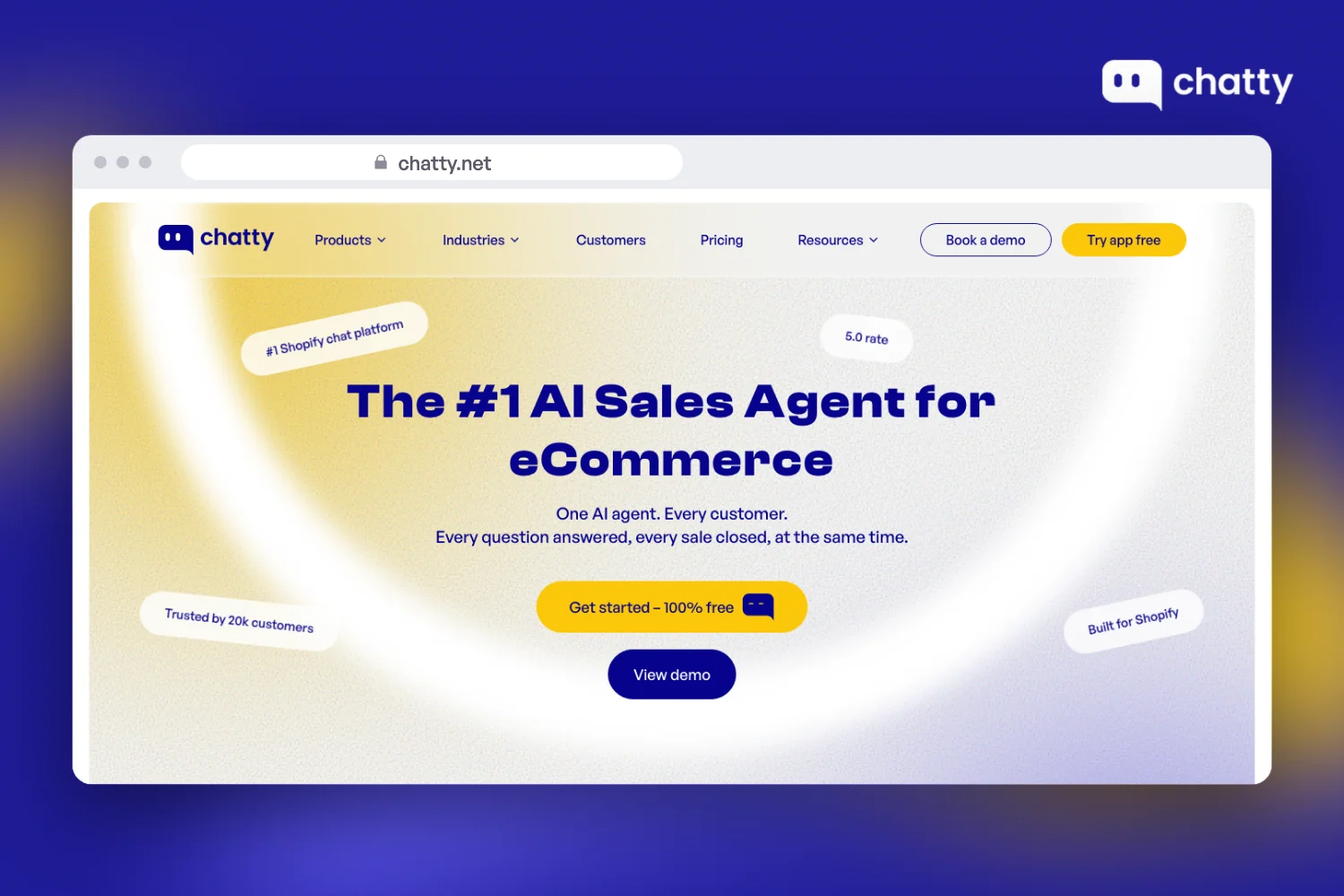
Chatty is the app we build, so weigh this section with that in mind. It counts an AI conversation once, when it ends, no matter how many replies the AI sends. A chat your team answers by hand never counts.
Its AI learns your Shopify products, custom answers, URLs and files. It recommends products as cards with an Add to cart button, which puts the item in the shopper's real Shopify cart.
Basic adds AI order tracking. Pro adds the AI shopping assistant, proactive chats and abandoned cart reminders.
Chatty also includes a Helpdesk on every plan, including Free. It turns support emails into tickets with a priority, an assignee and a status. Here is how it lines up:
- Best for: Shopify stores where shoppers ask about products before they buy, and you want long, detailed chats to cost the same as short ones.
- Not a fit if: your team runs on SLA policies, macros and automation rules. Chatty's Helpdesk has none of those, so a dedicated helpdesk will serve you better.
- Pricing: Free includes 50 AI conversations a month, reset every cycle. Basic is $19.99 for 100, Pro $68.99 for 500 and Plus $199 for 1,000. Extras cost $0.40 each, and you can set a spending limit in the app.
- Rating: 4.9 from 1,877 reviews, with 96% at five stars. Many reviews name the support staff who helped them.
If you are weighing the two apps head to head, read our Chatty vs Zipchat comparison. The full plan table lists every limit per plan.
Tidio: chat, AI and Flows priced as separate parts
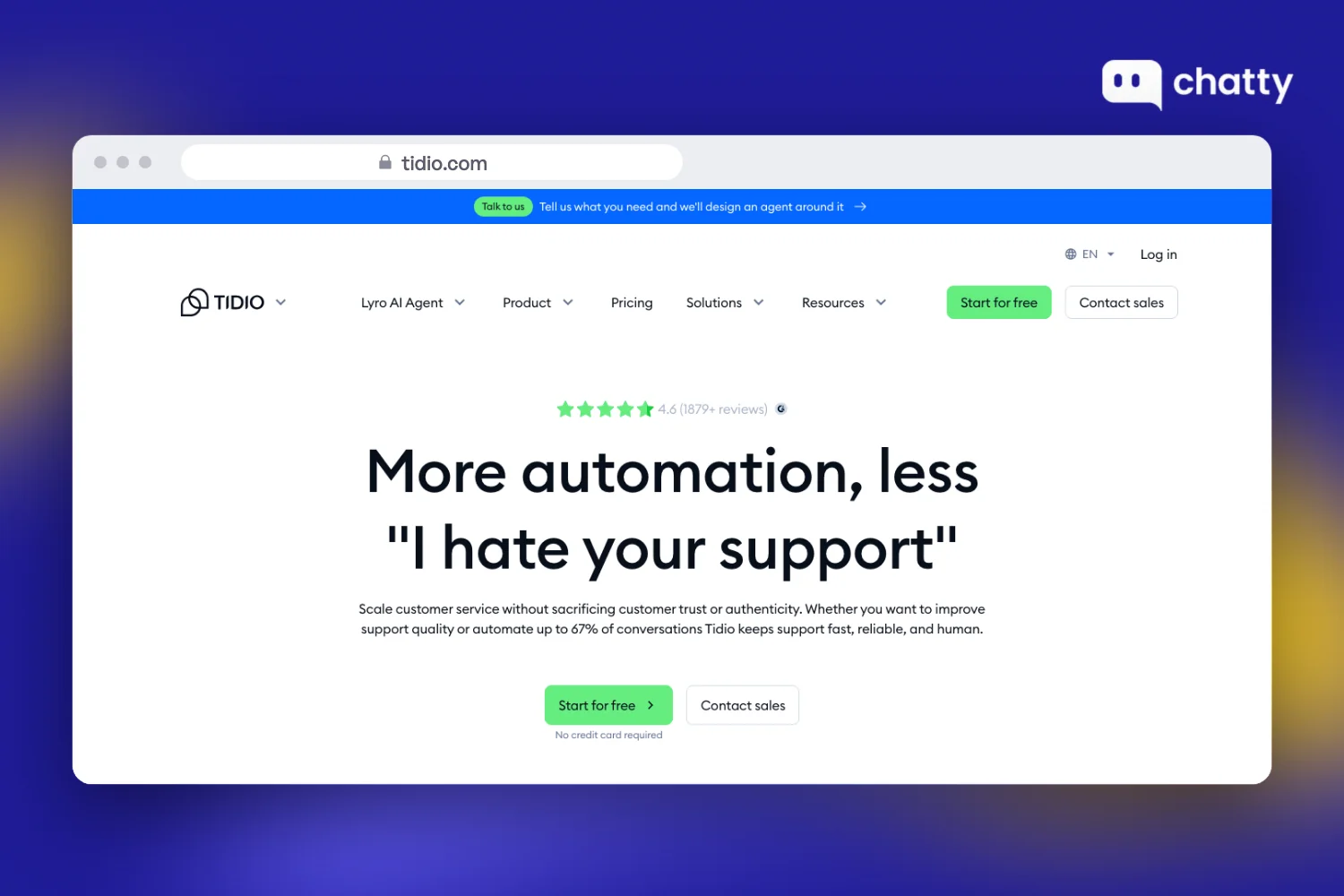
Tidio counts conversations too, but in two separate meters. A Lyro conversation is one the AI handles, and a billable conversation is one where your team replies. Flows, its automation builder, is priced on its own.
Here is where it fits:
- Best for: small teams that still answer many chats by hand and want automation flows in the same app.
- Not a fit if: you want one number to forecast. A busy month can push human chats and AI chats onto bigger tiers at once.
- Pricing: its Shopify listing sells Customer Service at $29 a month for 100 conversations, Flows at $29 and Lyro at $39. Tidio's own pricing page sells bundled tiers instead, from $24.17 a month billed yearly.
- Rating: 4.8 from 1,354 reviews.
- The catch: three meters instead of one. Price your human and AI volume separately before you compare.
Zipchat alternatives that bill per AI reply or message
These two keep Zipchat's unit. They suit stores whose chats are short, and they differ from Zipchat on rate and channels:
VanChat: per-reply billing at a lower rate
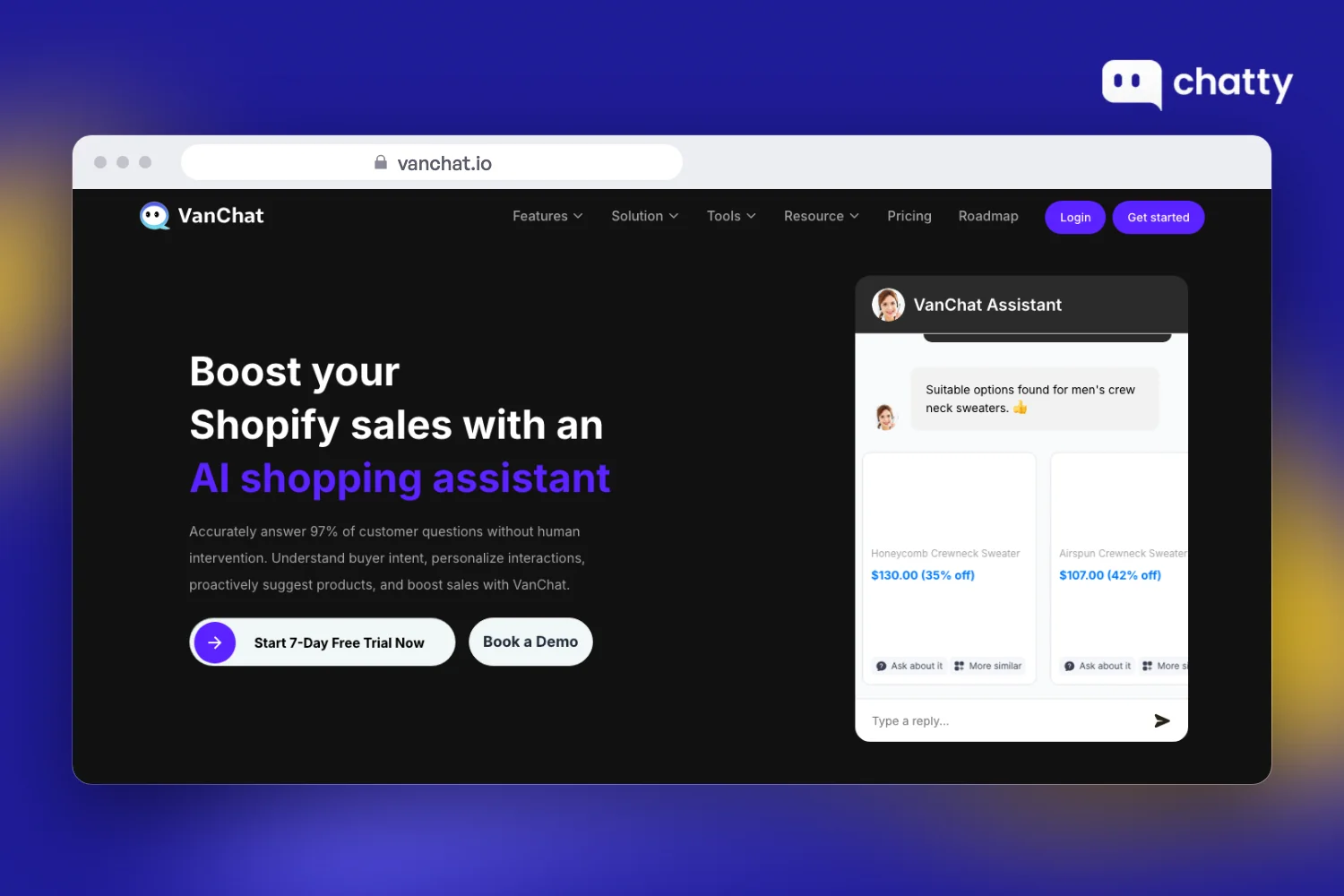
VanChat is a sales-focused AI agent for Shopify. It now bills per AI reply, like Zipchat, but extra replies cost $0.09 each instead of packs. Visitors are unlimited on every plan.
Here is where it fits:
- Best for: stores that are happy with per-reply billing and want a cheaper rate per reply.
- Not a fit if: your catalog is large, because each plan also caps the products the AI learns.
- Pricing: Free covers 100 AI replies a month and 100 products. Starter is $39 for 500 replies and 1,000 products, Pro $149 for 2,500 and Growth $249 for 5,000, on VanChat's pricing page.
- Rating: 4.9 from 119 reviews.
- The catch: it is still a per-reply meter, so long chats raise the bill here too.
Wizybot: AI messages plus social comments
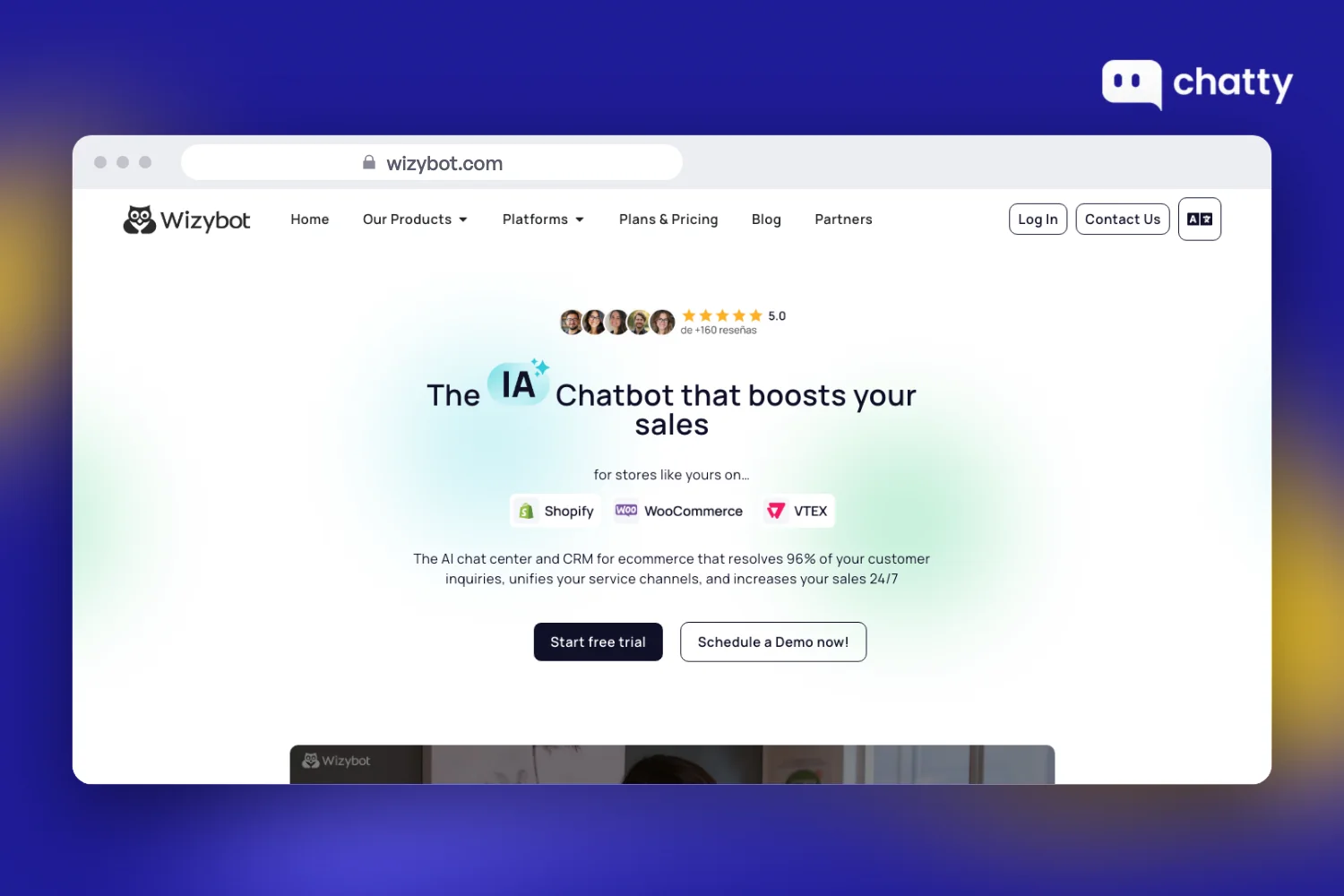
Wizybot counts AI messages and AI replies to social media comments as two separate allowances. It pairs the chatbot with a CRM inbox and WhatsApp marketing flows.
Here is where it fits:
- Best for: stores that sell through WhatsApp and Instagram and want AI to reply to comments as well as chats.
- Not a fit if: you only need website chat, since the entry paid plan bundles channels you may not use.
- Pricing: Free includes 30 AI messages and 30 AI comments. Basic is $149.99 a month for 2,750 AI messages and 5,000 AI comments, then $0.07 per message and $0.05 per comment, on Wizybot's pricing page.
- Rating: 4.7 from 167 reviews.
- The catch: there is no paid step between the free plan and $149.99.
A Zipchat alternative that bills per visitor: Rep AI
Visitor billing ignores chat activity. You pay for traffic that sees the widget, which suits steady traffic and punishes spikes.
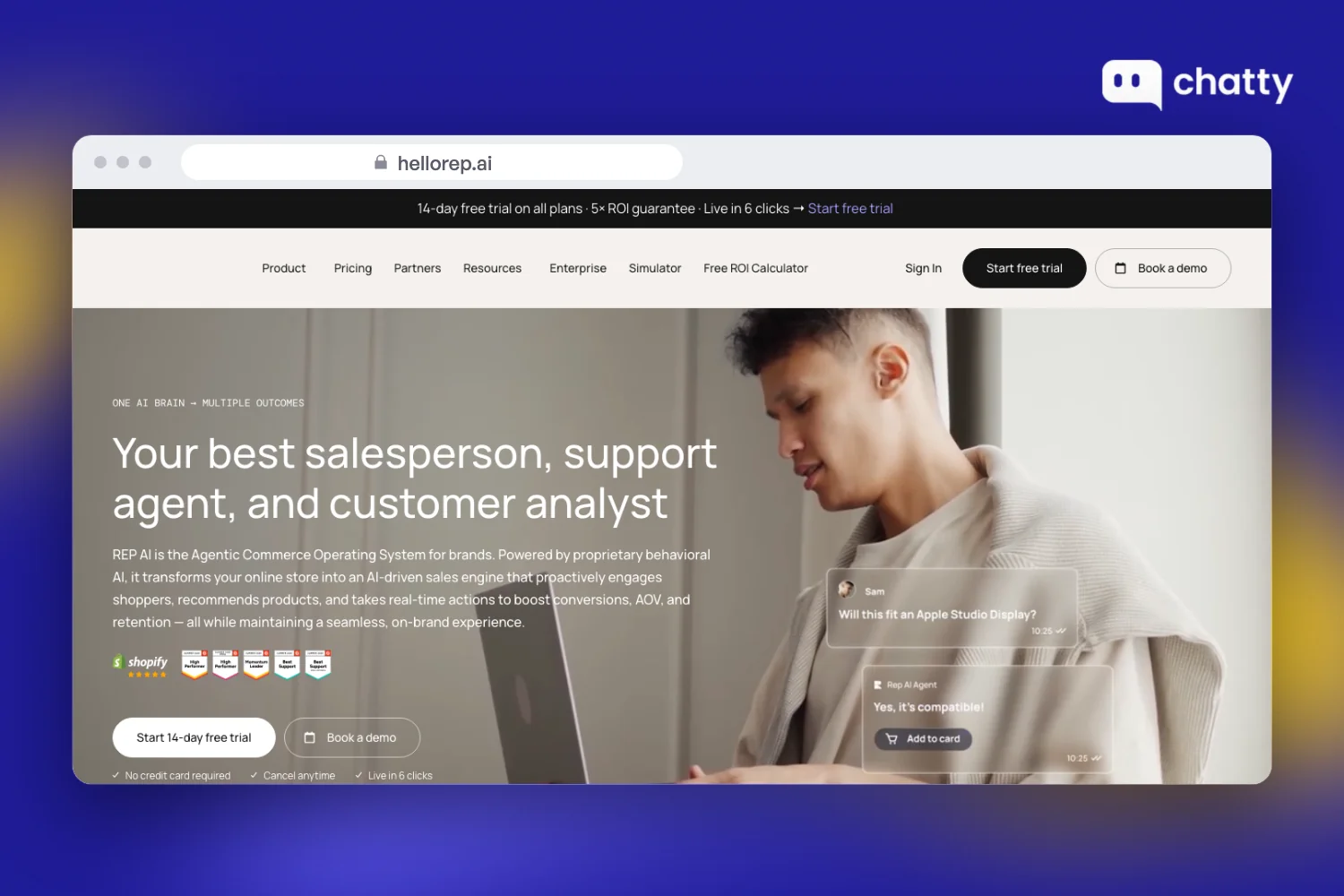
Rep AI watches shopper behavior and opens a chat when someone hesitates. Its price follows your monthly visitors, not your chats.
Here is where it fits:
- Best for: stores with steady traffic that want the AI to start conversations on its own.
- Not a fit if: your traffic swings with seasons or ads, because the bill follows every visitor.
- Pricing: on its Shopify listing, the free plan covers 100 visitors a month. Starter is $104 for 10,000 visitors and 1,000 products, Basic $209 for 25,000 and Standard $368 for 50,000. Extra visitors cost $12 per 1,000. Rep AI's own site sells the support agent separately.
- Rating: 4.6 from 118 reviews.
- The catch: a spike in visitors raises the bill even if none of them opens the chat.
Zipchat alternatives that bill by catalog size
These three give unlimited AI replies and price by how many products the AI learns. For a busy store with a small catalog, they cost the least here:
SmartBot: unlimited AI chats on paid plans
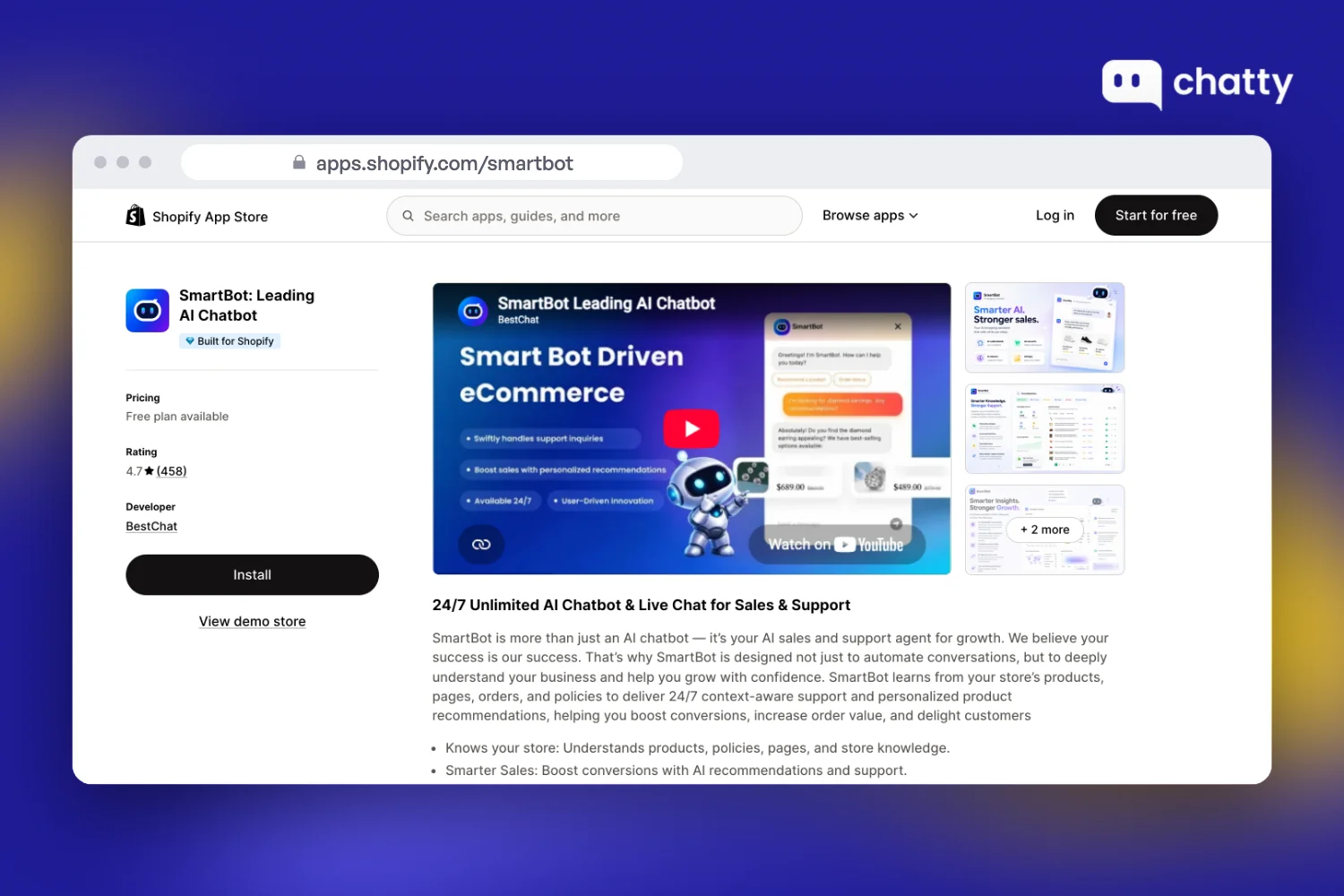
SmartBot is an AI chatbot for Shopify built by BestChat. Its Starter plan includes unlimited AI chats, and the plans above it step up by the number of products the AI supports.
Here is where it fits:
- Best for: stores with heavy chat volume and a catalog under a few thousand products.
- Not a fit if: you want to stay on a free plan, because its 300 free AI chats are lifetime, not monthly.
- Pricing: Starter is $30 a month for up to 500 products, Growth $100 for 3,000 and Pro $300 for 20,000. Prices come from its Shopify App Store listing.
- Rating: 4.7 from 458 reviews.
- The catch: bestchat.com shows a different, chat-capped price list for its BestChat app, so confirm you are reading the SmartBot plans.
Chizy: priced purely on product count
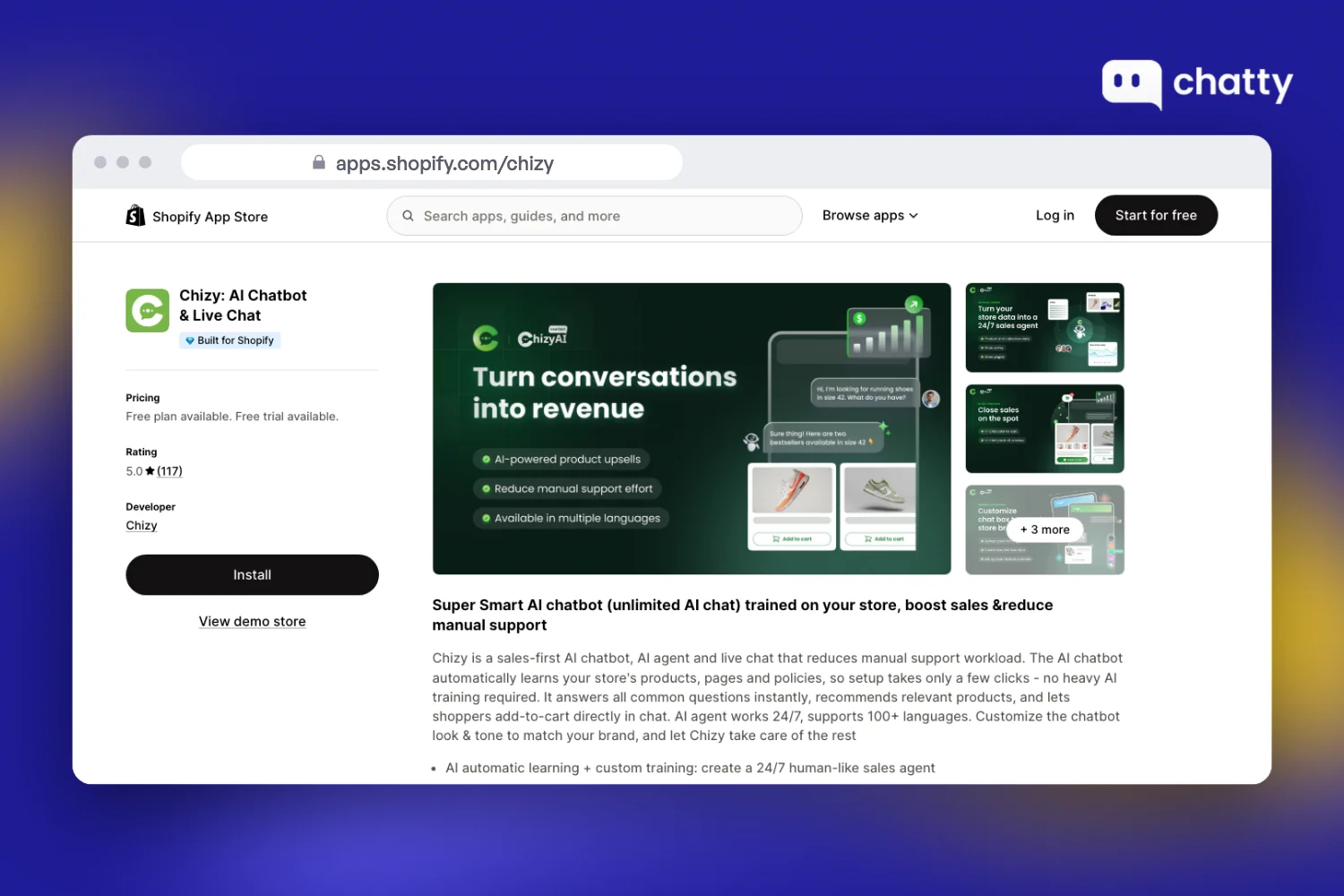
Chizy is a sales-first AI chatbot with unlimited AI chats on every plan, including Free. Shoppers can browse products and add them to cart inside the chat.
Here is where it fits:
- Best for: small and mid-size catalogs where chat volume is high and hard to predict.
- Not a fit if: you want a long track record before you switch.
- Pricing: Free covers up to 200 products. Starter is $19 for 1,000, Growth $69 for 5,000 and Scale $199 for 25,000, on its Shopify App Store listing.
- Rating: 5.0 from 134 reviews.
- The catch: it launched in September 2025, so all of its reviews are recent.
MooseDesk: unlimited AI replies with a helpdesk
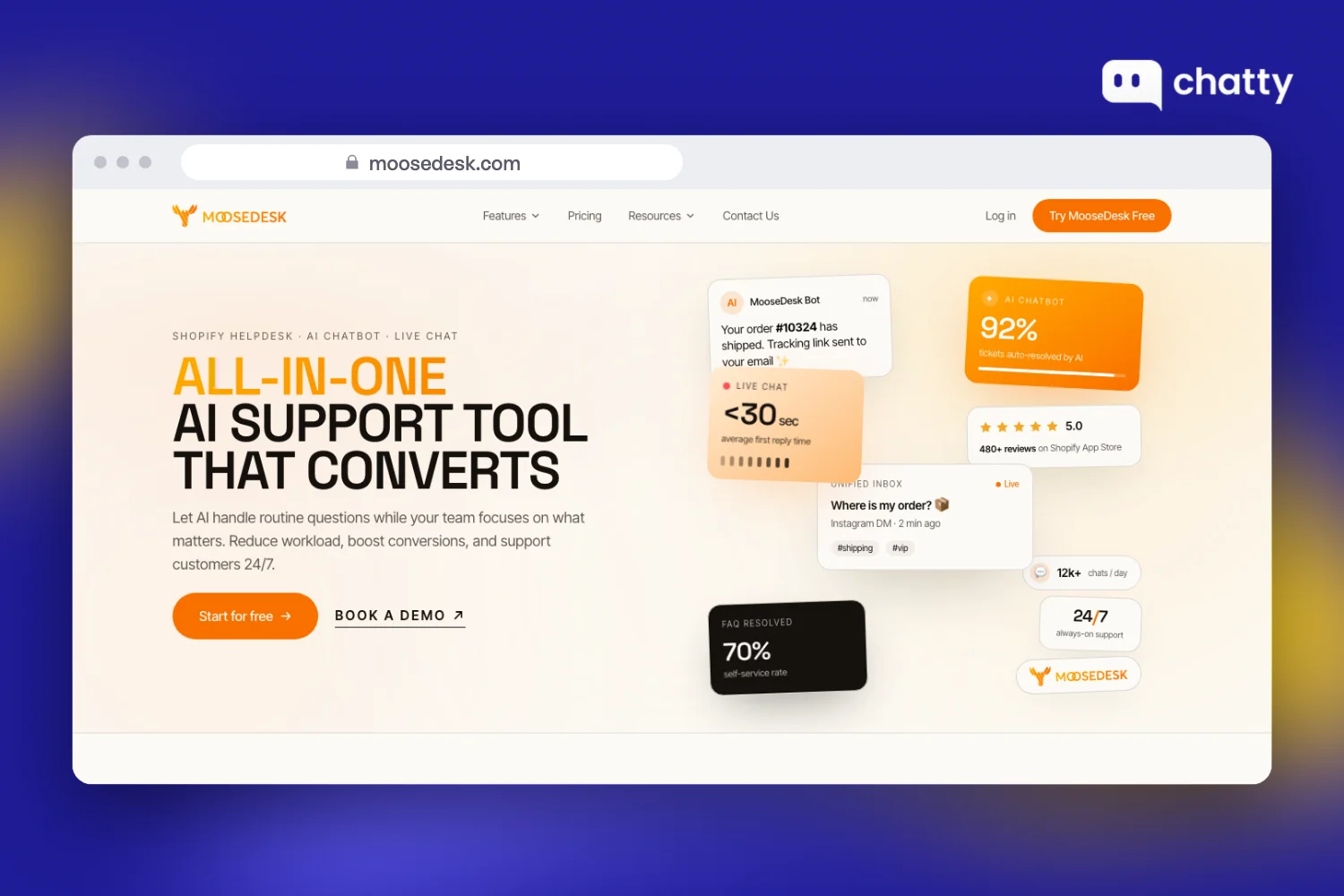
MooseDesk is a support helpdesk with an AI chatbot. Every plan has unlimited AI replies, and plans step up by products, team members and tickets.
Here is where it fits:
- Best for: stores whose chats are mostly order and policy questions after the purchase.
- Not a fit if: you want an AI built mainly to sell before the purchase.
- Pricing: Free covers 100 products and 1 team member. Starter is $19 for 500 products, Growth $49 for 5,000 products and 300 tickets, and Business $249, on MooseDesk's pricing page.
- Rating: 5.0 from 483 reviews.
- The catch: ticket management and extra email channels start on Growth.
A Zipchat alternative that bills per ticket: Gorgias
Ticket-based tools organize support requests rather than open sales chats. If most of your volume arrives after the order, this model fits better.
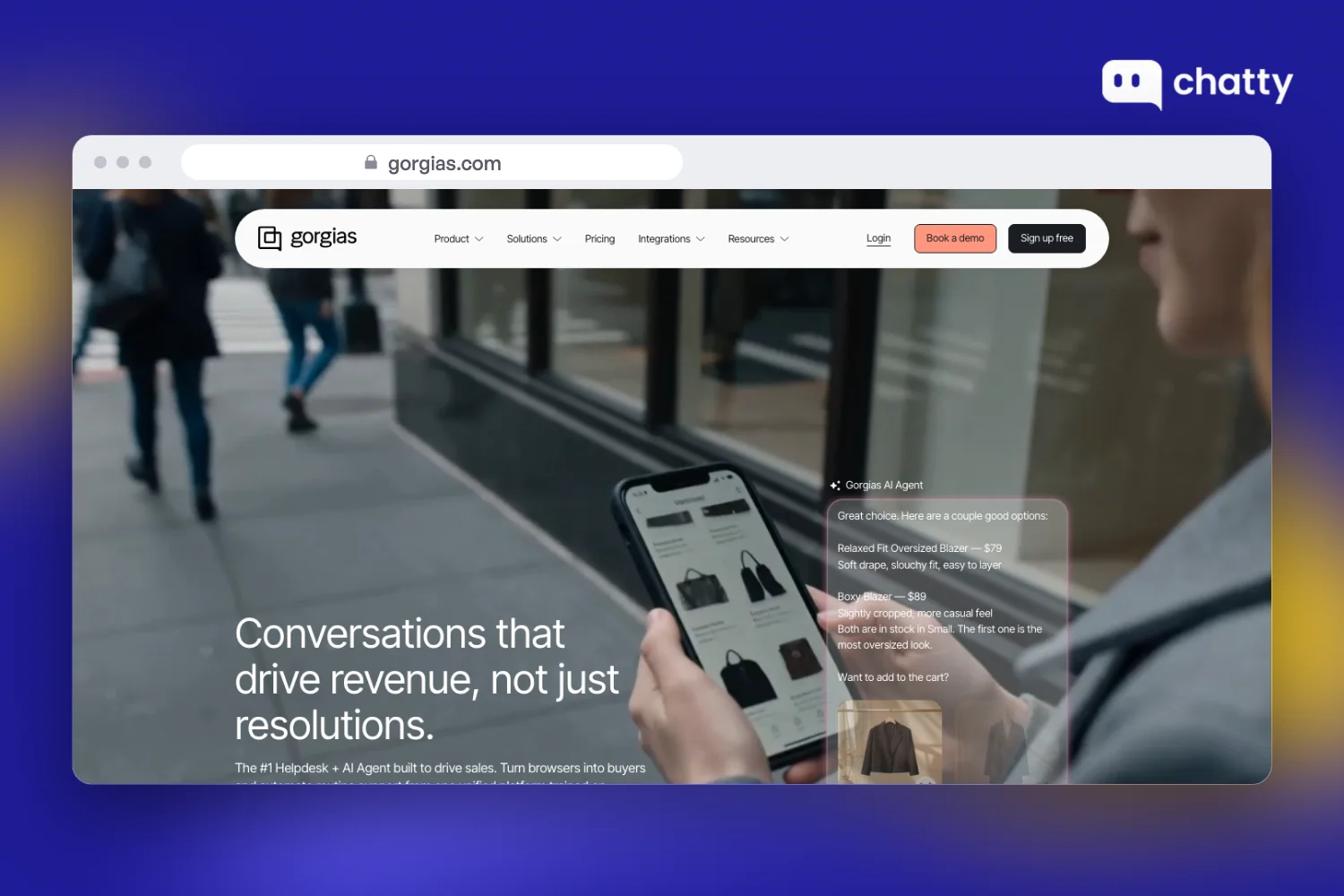
Gorgias pulls Shopify order data into each ticket, and agents work email, chat and social from one place. On Basic and up, its AI Agent can run actions such as cancelling an order or applying a discount.
Here is where it fits:
- Best for: support teams with several agents who handle order questions across email, chat and social.
- Not a fit if: most of your chats are pre-sale product questions.
- Pricing: Starter $10 a month for 50 tickets, Basic $60 for 300, Pro $360 for 2,000. The AI Agent adds $0.85 to $1.00 per automated interaction, by plan, on Gorgias's pricing page.
- Rating: 4.3 from 704 reviews, with 10% at one star.
- The catch: two meters. A busy month raises both your ticket count and your AI interactions.
Shopify Inbox: the free Zipchat alternative to beat
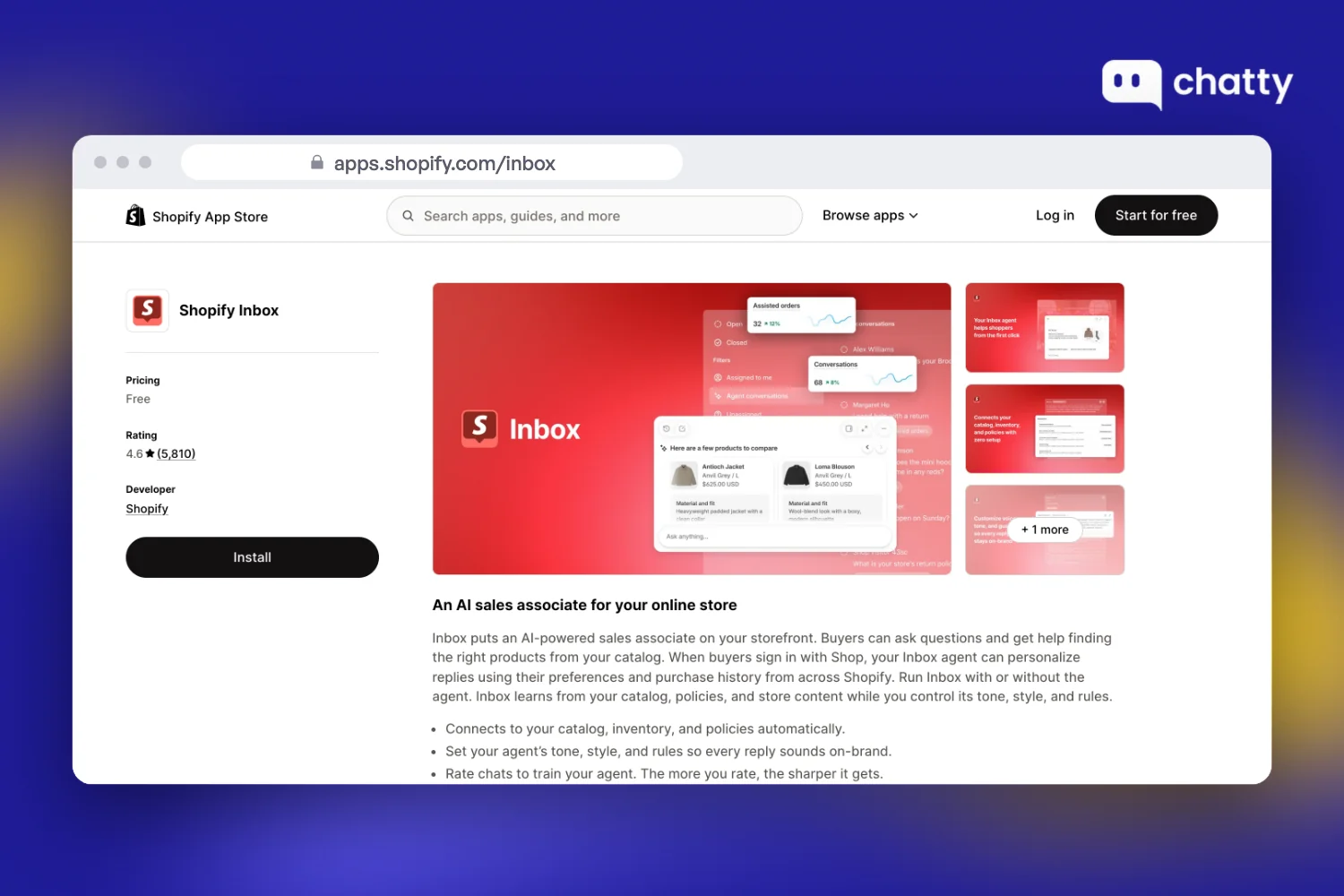
Shopify Inbox is Shopify's own chat app, and it now puts an AI sales associate on your storefront. It learns from your catalog, policies and store content, and you set its tone and rules.
Any paid tool on this list has to beat it:
- Best for: new stores that want free chat with AI and no extra bill.
- Not a fit if: you need email tickets. Its App Store category is Chat, not Helpdesk, so plan on a separate tool for email.
- Pricing: free on its Shopify App Store listing.
- Rating: 4.6 from 5,810 reviews.
- The catch: the agent personalizes replies with Shop preferences and purchase history only when the buyer signs in with Shop.
Which Zipchat alternative fits your store
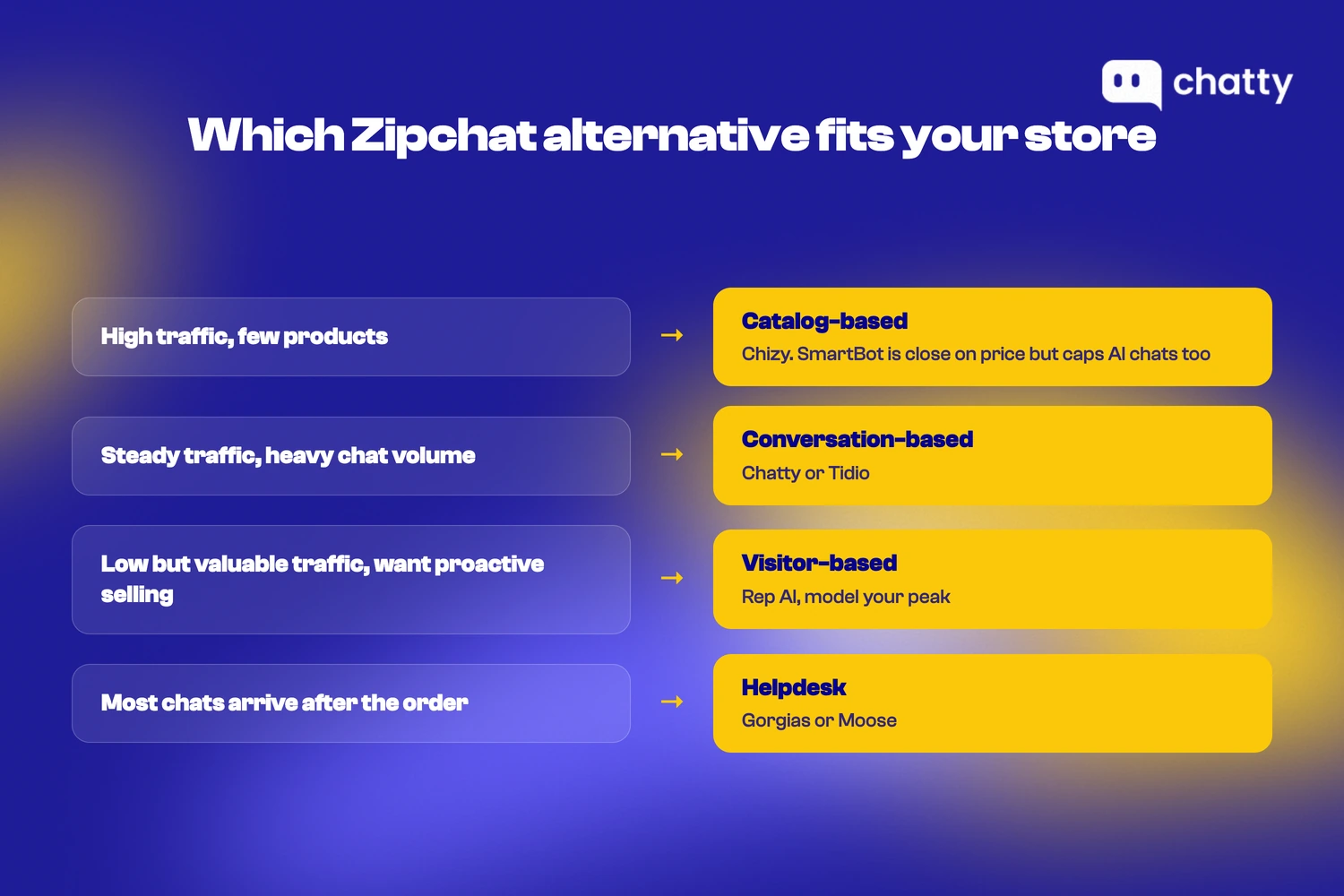
Pick your unit first, then your tool:
- Short chats and you like Zipchat's model: stay per reply, with Zipchat or VanChat.
- Long, detailed product chats: go per conversation, with Chatty or Tidio, so a thorough chat costs the same as a short one.
- High chat volume and a small catalog: go catalog-based, with Chizy, SmartBot or MooseDesk.
- Steady traffic and proactive selling: Rep AI, but model your peak month first.
- Most chats arrive after the order: a helpdesk such as Gorgias or MooseDesk.
Before you commit, run three checks:
- Pull two numbers from Zipchat: your monthly conversations and your replies per conversation. Price both on each vendor's page.
- Find out what happens at the limit: an extra pack, a per-unit fee you can cap, or a forced upgrade.
- Ask the AI ten real questions from your inbox during the free trial, on your real catalog.
For more no-cost options, see our roundup of free chatbot options for Shopify.
FAQ
It depends on what you want to stop paying for. Zipchat bills per AI reply. Chatty and Tidio bill per conversation, Rep AI bills per site visitor, and SmartBot, Chizy and MooseDesk bill by catalog size with unlimited AI chats.
Take a store with 10,000 visitors, 300 AI chats and 400 products. At monthly list prices checked October 12, 2026, it pays $19 on Chizy, $68.99 on Chatty, $80 on Zipchat and $104 on Rep AI.
On its Shopify listing, checked October 12, 2026, Zipchat has a Free plan with 120 AI replies a month. Starter is $80 a month for 750 replies, Pro $300 for 3,000 and Scale $600 for 6,000. Billed yearly on zipchat.ai, the same plans cost $64, $240 and $480 a month.
Each outbound AI message counts as one reply. Extra replies cost $49 per pack of 250.
They bill on different units, so volume hits them differently. Zipchat counts every AI reply, so more chats and longer chats both raise the bill. Rep AI counts site visitors, so chat volume does not change the price but traffic does, at $12 for each extra 1,000 visitors.
Rep AI's own site now sells its support agent separately from its sales agent. At 10,000 sessions a month, the sales agent is $104 and the support agent is $49.
Zipchat is a single AI agent billed per reply, and it covers chat, email, WhatsApp and Instagram on every plan. Tidio sells human chat, Lyro AI and Flows as three separately priced parts, so you pay for each part you use.
Pick Zipchat if AI does almost all the talking. Pick Tidio if your team still answers many chats by hand and you want automation flows. Our Tidio alternatives guide prices it out in detail.
Yes. Shopify Inbox is free and now includes an AI sales associate. MooseDesk's free plan has unlimited AI replies for up to 100 products, and Chizy's free plan covers up to 200 products.
Chatty's Free plan includes 50 AI conversations a month that reset every cycle, plus unlimited human chats.
Chatty has four plans, checked on October 12, 2026. Free is $0 with 50 AI conversations a month. Basic is $19.99 for 100, Pro is $68.99 for 500, and Plus is $199 for 1,000.
On paid plans, each extra AI conversation costs $0.40, and you can set a spending limit in the app. Human conversations are unlimited on every plan, and charges appear on your Shopify invoice.
Yes, for many stores. Zipchat holds 4.9 stars from 207 reviews on the Shopify App Store, and its 2026 reviews average 4.85.
It suits stores that want one AI agent on chat, email, WhatsApp and Instagram, and whose chats stay short.