







 Blog
 Free tools
 Help center




The best chatbot for customer support depends on where your customers ask and how big your team is. For a Shopify store whose chats are about products and orders, pick Chatty, or Gorgias if your team works orders as tickets. For a large enterprise with complex ticket systems, pick Zendesk AI.
For SaaS teams already on Intercom, pick Intercom Fin. For a small team that wants simple automation, pick Tidio or Crisp. For Instagram and Messenger DMs, pick Manychat or Chatfuel.
A chatbot for customer support is software that answers routine customer questions through chat, using FAQs, product information, order details and policies. It hands the conversation to a person when an issue needs one.
- Chatty answers from your own Shopify data: products, prices, stock, discounts and shipping.
Chatty is the AI sales agent for Shopify stores. It recommends the right product, brings shoppers back to their cart and shows you every sale it helped make.
- Rule-based chatbots and AI-driven chatbots require fundamentally different evaluation criteria.
Rule-based bots answer only the questions in their scripts. AI chatbots understand intent and can improve from past conversations, so test each type on different things.
- Freshchat pairs a no-code AI chatbot builder with one inbox for every digital channel.
Freshchat brings WhatsApp, Instagram, and other channels into one inbox. Its bots use AI intent detection, hand conversations to an agent when needed, and connect to Freshdesk, CRMs, and 1,000+ apps.
- Tawk.to keeps live chat and ticketing free, with no per-seat charges.
Tawk.to gives you live chat and ticketing at no cost. Its AI Assist add-on, which answers FAQs automatically, starts at $29/month.
- Drift, the B2B sales chatbot, is being replaced by 1mind inside Salesloft.
Salesloft, which owns Drift, says it has transitioned from Drift to 1mind (checked October 28, 2026). Confirm Drift is still available before you plan around it.
What is a customer support chatbot?
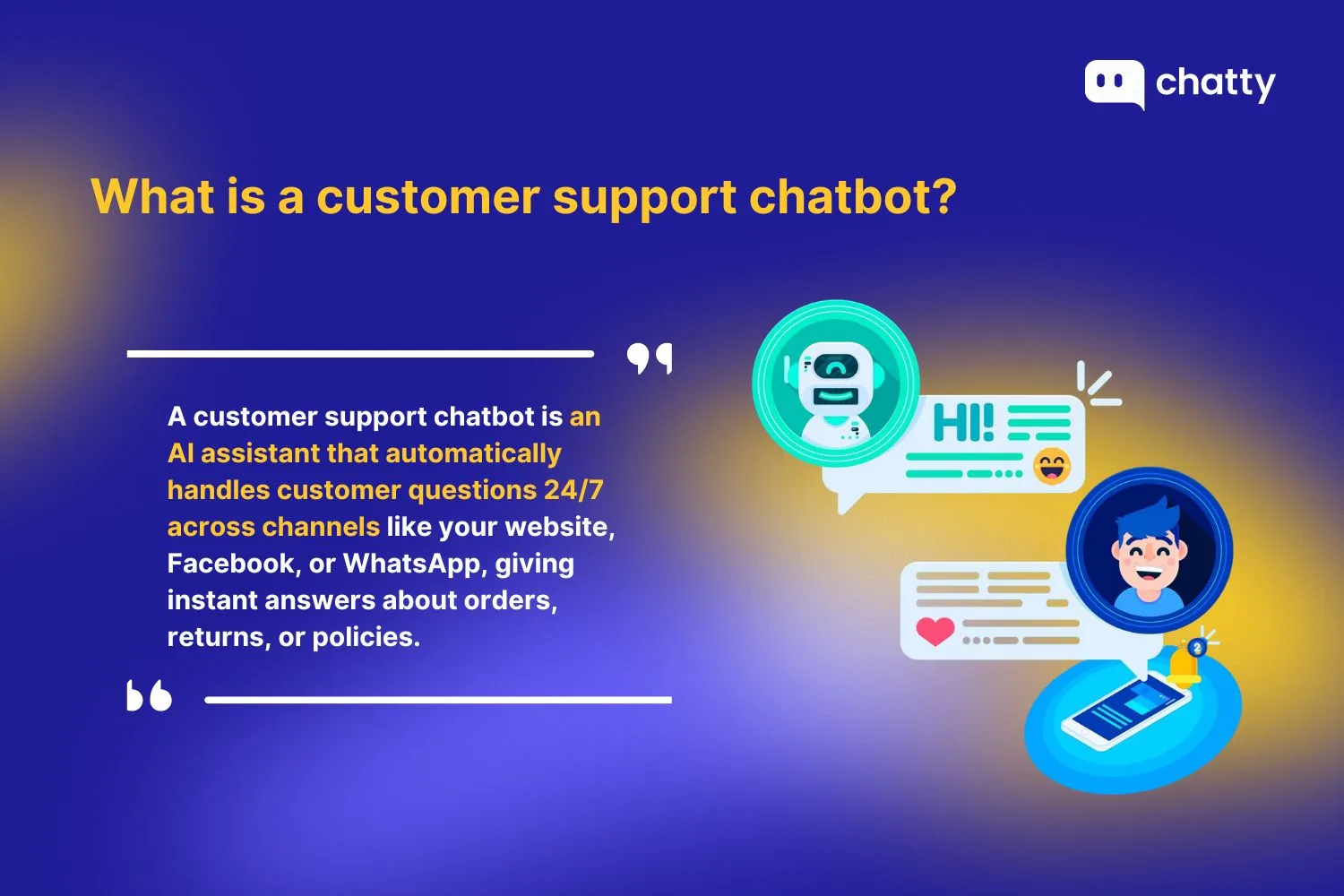
A customer support chatbot is an AI assistant that automatically handles customer questions across channels like your website, Facebook, or WhatsApp. It works 24 hours a day so customers can get quick answers about orders, returns, or store policies without waiting for a live agent.
There are two main types of chatbots:
- Rule-based chatbots: follow pre-set scripts and answer simple questions such as “Where is my order?” or “What are your business hours?”
- AI-driven chatbots: use Natural Language Processing (NLP) to understand intent, recognize emotions, and reply in a more natural, human-like way. Some even learn from past conversations to improve accuracy over time. For example, an AI chatbot can help a shopper choose the right product, check stock or start a return. Your team keeps its time for the issues that need a person.
The 2026 customer support chatbots compared
| Chatbot App | Best For | AI Capability | Multichannel Support | Pricing | Highlight Feature |
| Zendesk AI | Large enterprises with complex ticket systems | Advanced: ticket routing, summarization, contextual replies | Chat, Email, Social | $19 to $115/agent/mo billed yearly, plus $1.50 to $2.00 per AI resolution | Enterprise-grade AI automation for ticket management |
| Intercom Fin | SaaS & DTC brands using Intercom | Advanced: contextual LLM trained on help center & CRM | Intercom, Zendesk, Salesforce, HubSpot | $0.99 per Fin outcome | AI replies with confidence scoring & smooth routing |
| Ada | Regulated industries (finance, healthcare, tech) | Advanced: Reasoning Engine™ + multilingual NLP | Web, Chat, Voice | Quote-based | Multilingual, compliant AI automation |
| LivePerson | Large enterprises (finance, telecom, retail) | Advanced: NLP + sentiment + bring-your-own-LLM | Voice, Chat, Social, Web | Quote-based | Unified voice + chat AI orchestration |
| Drift | B2B enterprises focusing on lead generation | Advanced: GPT-powered chat & smart routing | Web, Chat, CRM, Email | Quote-based; Salesloft is moving Drift to 1mind | Conversational marketing & instant meeting booking |
| HubSpot Chatbot | HubSpot CRM users | Rule-based bots free; AI Customer Agent on Professional and Enterprise | Website, Facebook Messenger | Free; AI agent from $90/seat/month | Native CRM integration with automated lead qualification |
| Zoho SalesIQ | SMBs using Zoho CRM | Strong: choice of AI models, including OpenAI, Claude and Gemini | Website, WhatsApp, Facebook, Instagram, LINE, WeChat | Free for 3 operators, then per operator | Chatbot builder with a choice of AI models |
| Chatty | Shopify stores where most chats come before the order | Strong: trained on your Shopify store, recommends products and replies in the shopper’s language | AI on your store; WhatsApp, Messenger, Instagram and email land in the same inbox | Free to $199/month | AI sales agent that recommends products and adds them to the cart |
| Gorgias | E-commerce stores using Shopify/Magento/WooCommerce | Moderate: AI reply suggestions & intent automation | Email, Chat, SMS, Social | $10 to $900/month, plus $0.90 to $1.00 per AI interaction | Unified inbox with deep e-commerce integrations |
| Re:amaze | eCommerce brands with multiple stores | Moderate: automation workflows & triggers | Email, Chat, SMS, Social | $29 to $69/agent/month | Unified inbox for multi-brand eCommerce |
| Heyday | Retailers & eCommerce brands | Moderate: NLP + product recommendations | Web, Social, Messaging Apps | Custom quote | Omnichannel retail automation |
| Freshchat | Mid-sized SaaS & e-commerce brands | Strong: AI intent detection & bot handoff | Web, WhatsApp, Instagram, Email | Free; $19 to $79/agent/month billed yearly | No-code chatbot builder with omnichannel inbox |
| Tidio | Small teams needing simple automation | Moderate: Lyro AI agent, 75% average resolution rate per Tidio | Chat, Email, Messenger, Instagram | Free; from $24.17/month, Plus from $300 + usage | Drag-and-drop visual flow builder |
| Crisp | Startups & SMBs needing simple all-in-one chat | Moderate: workflow automation + co-browsing | Chat, Email, Social | Free to $295/month | Real-time co-browsing and shared inbox |
| Tawk.to | Small businesses needing free live chat | Basic: AI Assist replies FAQs automatically | Web, Messaging | Free (AI Assist $29/month) | 100% free live chat and ticketing suite |
| HelpCrunch | Small to midsize SaaS & eCommerce | Basic: limited AI chatbot | Chat, Email, Social | $15 to $620/month | Unified email + live chat + helpdesk in one suite |
| Kommunicate | Businesses needing hybrid AI + human chat | Moderate: Kompose AI builder with live handoff | Web, WhatsApp, Instagram, Telegram | $40 to $200/month (30-day trial) | Hybrid AI + human support in one inbox |
| Chatfuel | Businesses active on Meta (FB/IG/WhatsApp) | Moderate: ChatGPT, NLP & keyword automation | Facebook, Instagram, WhatsApp | From $18/month (free trial) | Fast social media automation via Flow Builder |
| Manychat | Marketers & eCommerce teams on social DMs | Moderate: AI Intents, Flows & Assistant | FB, IG, WhatsApp, Telegram, SMS | Free; from $17/month by active contacts | Omnichannel automation for Meta & Telegram |
| Botpress | Developers needing custom chatbot control | Advanced: LLM, translation, custom code | Web, WhatsApp, Slack, Instagram | Free; $150 to $750/month billed yearly | Open-source AI chatbot platform with deep customization |
Prices were checked on each vendor’s pricing page on October 28, 2026, except Manychat (third-party review) and Zoho SalesIQ (priced by region). Quote-based tools publish no price.
Top 20 chatbots for customer support in 2026
The list is grouped by the team each tool fits, not ranked. Enterprise support comes first, then B2B and CRM, eCommerce, small teams, social DMs and developers. Chatty is the AI sales agent for Shopify stores, so it sits in the eCommerce group.
1. Zendesk AI: enterprise-grade ticket automation
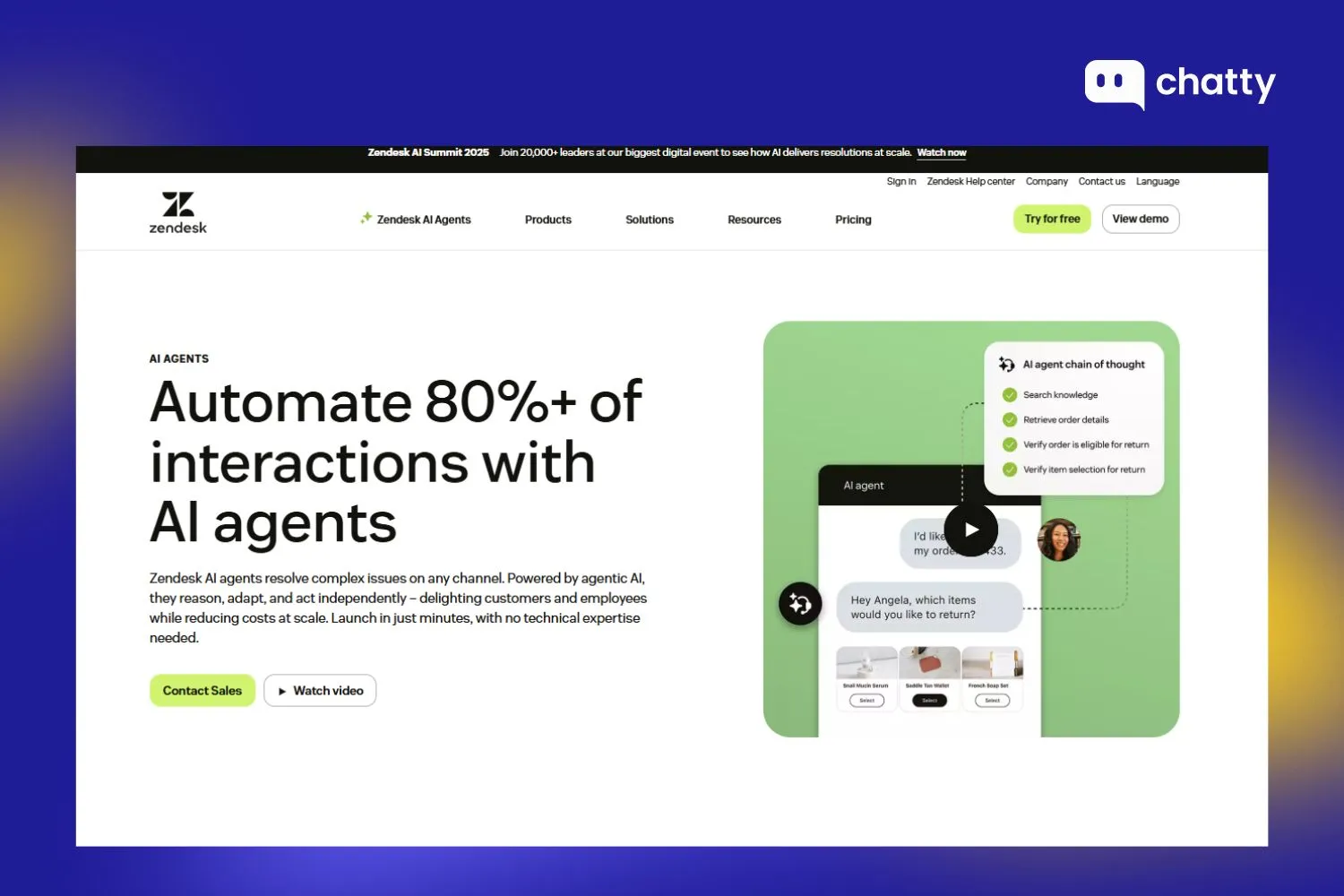
Zendesk AI is the AI layer of Zendesk’s support platform. It routes tickets, summarizes conversations and answers from your knowledge base, so agents spend less time on each ticket.
Its strength is scale. Zendesk AI is built for teams that handle very large ticket volumes across email, chat and social media, and it keeps replies consistent in tone.
Key Features
- AI ticket classification and auto-routing.
- Conversation summarization and suggested replies.
- Advanced analytics for agent productivity.
- Multi-channel integration (chat, email, social).
- Smart knowledge base search.
Limitations:
- Higher learning curve for setup.
Pricing: Support Team from $19/agent/month billed yearly ($25 monthly), Suite plans $55 to $115/agent/month billed yearly, Enterprise by quote. AI agent resolutions beyond the included ones cost $1.50 to $2.00 each, and Copilot is $50/agent/month (Zendesk pricing, checked October 28, 2026).
Best Fit
- Mid to large enterprises managing complex support operations.
- Teams needing automation with human-like precision.
2. Intercom Fin: instant AI from your help center
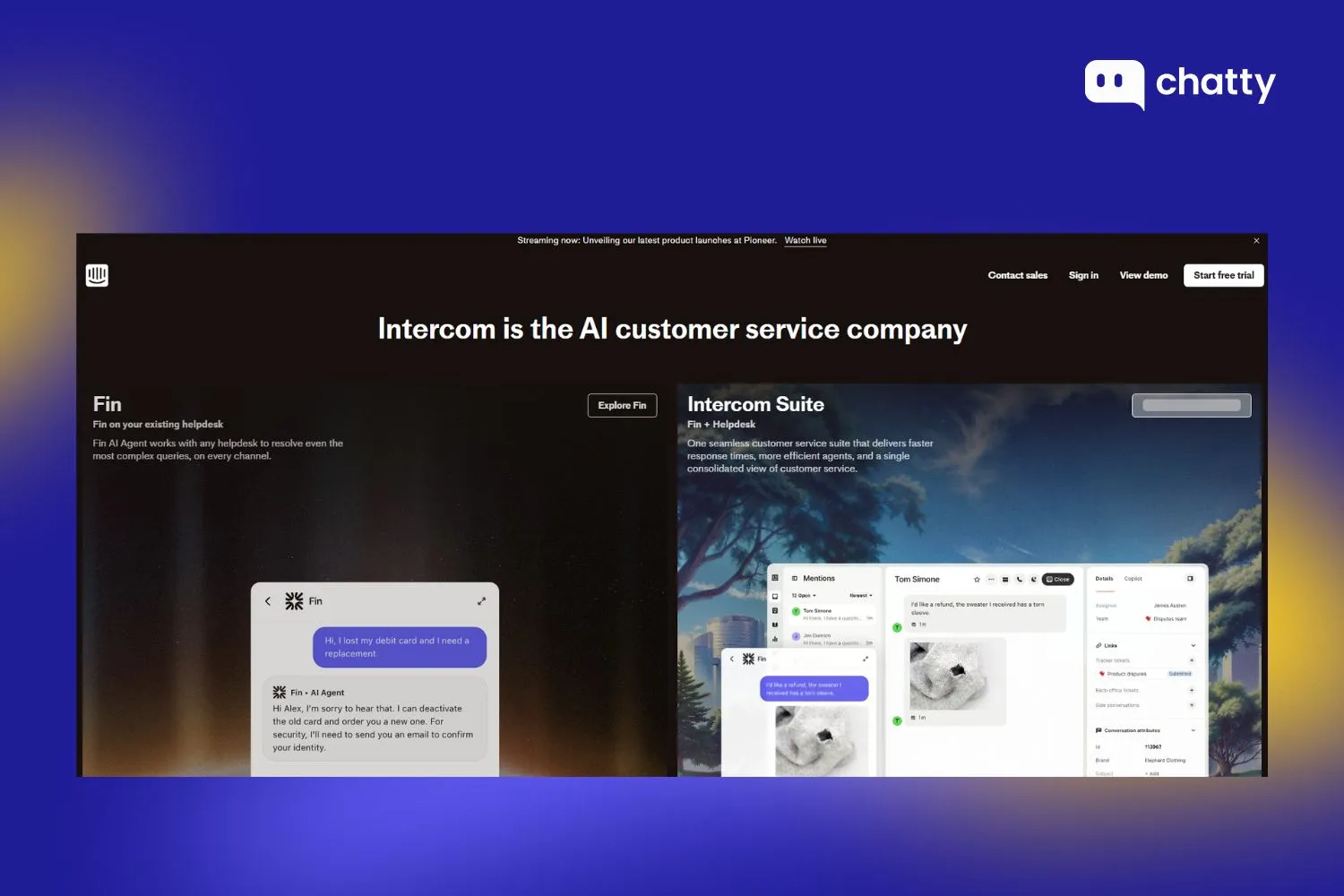
Intercom Fin is an AI support assistant built directly into the Intercom platform. It answers from your existing help center, CRM data and chat history, and resolves FAQs, order issues and account questions on its own.
Fin works best inside Intercom. It learns from past conversations and routes complex issues to a human agent. Intercom says Fin averages a 76% resolution rate across 12,000+ customers (Fin, checked October 28, 2026).
Key Features
- Contextual answers powered by your help center and CRM.
- AI intent detection and auto-routing.
- Self-learning and analytics dashboard.
- Enterprise-grade security (SOC 2, GDPR).
- Works with Intercom, Zendesk, Salesforce, and HubSpot.
Limitations:
- Expensive at higher volumes.
- Limited LLM fine-tuning or model choice.
Pricing: $0.99 per outcome, with a 50-outcome monthly minimum on non-Intercom helpdesks; 14-day free trial (Fin pricing, checked October 28, 2026).
Best Fit
- Growth-stage SaaS and DTC brands using Intercom.
- Teams automating complex multi-channel support.
3. Ada: multilingual AI for regulated industries
Ada is an AI-powered platform built to automate customer support for global, regulated industries like finance, healthcare, and tech. Its Reasoning Engine™ combines NLP, machine learning and large language models to understand intent and find answers.
It can also take actions, such as account updates or refunds. Ada helps companies give consistent, compliant service in many languages without adding agents.
Key Features
- AI Reasoning Engine™ for intelligent, safe responses.
- 30+ prebuilt integrations (Shopify, APIs, CRMs).
- Multilingual chat and voice automation.
- Generative Knowledge Hub for fast, accurate answers.
- Secure authentication and single sign-on support.
Limitations:
- Opaque pricing model.
- Mixed user reviews on reliability.
Pricing: Quote-based; pricing depends on ticket volume and team size.
Best Fit: Enterprises in finance, healthcare, or tech needing compliant, multilingual AI support.
4. LivePerson: voice + chat AI for enterprises
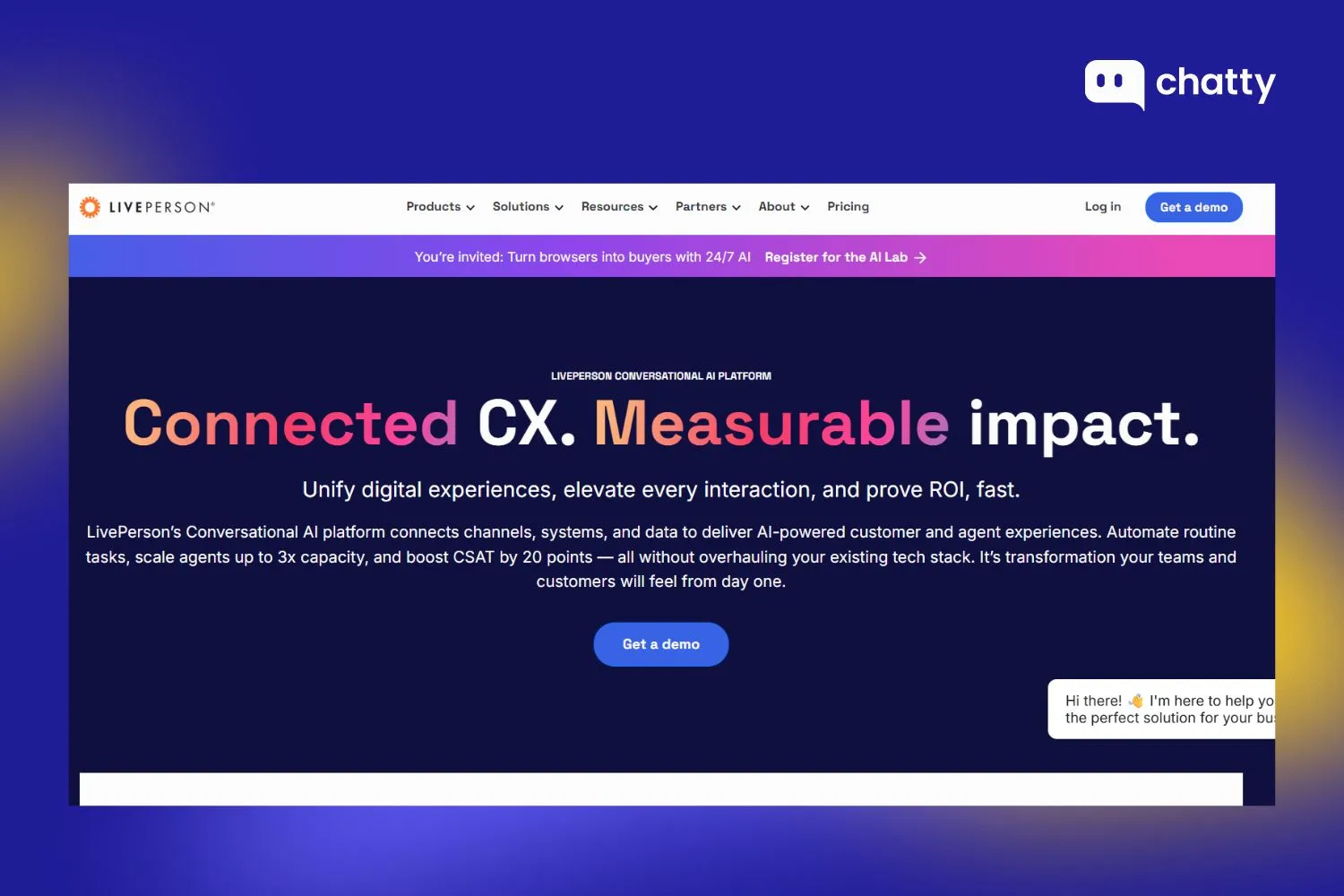
LivePerson is a conversational AI platform built for large enterprises that want to unify chat and voice experiences across every channel. It automates routine tasks and works alongside the systems you already run, with analytics that tie conversations to business results.
Key Features
- Unified voice and messaging AI with NLP and sentiment analysis.
- Bring-your-own LLM (OpenAI, Anthropic, Gemini).
- 30+ enterprise integrations (CRM, analytics, contact center tools).
- Real-time insights with conversational analytics dashboards.
- Built-in security, compliance, and data encryption.
Limitations:
- Complex setup and interface.
- No transparent pricing.
Pricing: Quote-based, depending on usage and scale.
Best Fit: Large enterprises in finance, telecom, or retail needing omnichannel AI engagement.
5. Drift: AI for B2B lead generation
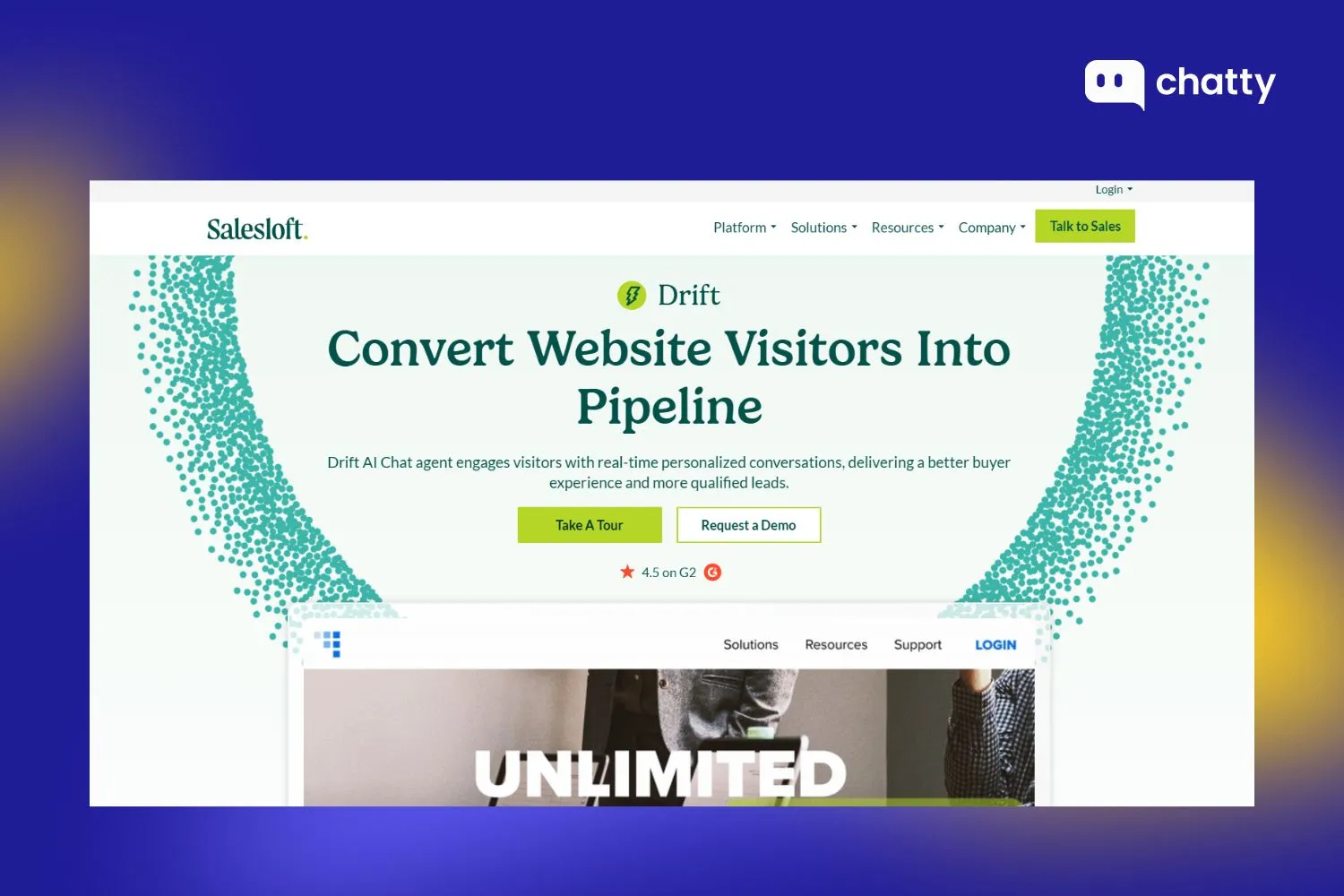
Drift is an AI-powered chatbot built for conversational marketing, sales, and support. It engages website visitors in real time, answers questions and books meetings on the spot. It uses NLP and machine learning to tailor each chat to the visitor.
Key Features
- Real-time conversations and meeting scheduling.
- Smart chat routing and AI-suggested replies (GPT integration).
- Deep CRM and marketing integrations (HubSpot, Salesforce, Zapier).
- AI engagement scoring for better lead prioritization.
- Conversation analytics for insights and optimization.
Limitations:
- Steep learning curve for new or non-technical users.
- High cost; advanced AI features are limited to enterprise plans.
- Less flexible for support or multi-language chat use.
Pricing: No public price. Salesloft’s Drift page now says “We’ve transitioned from Drift to 1mind” (checked October 28, 2026). Ask Salesloft whether Drift is still sold before you shortlist it.
Best Fit: B2B sales teams and enterprises focused on high-value lead conversion.
6. HubSpot Chatbot: native automation for HubSpot users
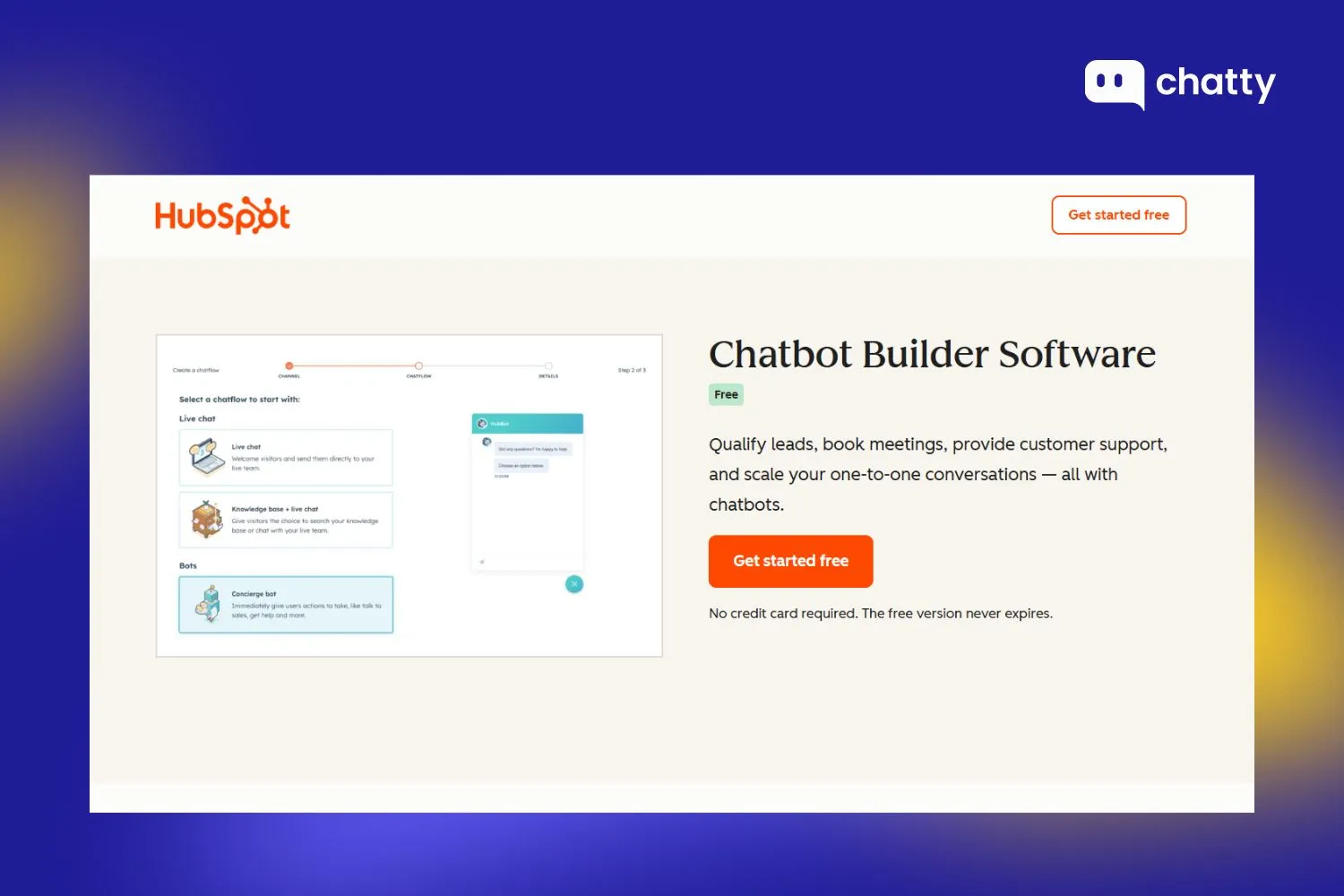
HubSpot Chatbot helps businesses automate lead qualification, meeting booking, and basic customer support directly through their website or Facebook Messenger. It’s simple: a no-code chat builder lets you create guided conversation flows. Integrated with HubSpot’s Smart CRM, it enables personalized interactions using customer data.
The free chatbot builder is rule-based. HubSpot’s AI Customer Agent, which answers questions across chat, email and forms, needs Service Hub Professional or Enterprise.
HubSpot Chatbot connects directly to HubSpot’s marketing, sales and service tools. Every chat is logged in the CRM, so your team sees it next to the rest of the customer record.
Key Features
- Drag-and-drop chat builder (no coding needed).
- Automatic lead qualification and meeting booking.
- Full CRM integration for personalized replies.
- Built-in live chat for handover to your team.
- Customizable website chat widget.
Limitations:
- Free bots are rule-based; the AI agent needs a paid Service Hub plan.
- Rule-based bots run on the website and Facebook Messenger.
Pricing: Free plan available. The AI Customer Agent needs Service Hub Professional (from $90/seat/month) or Enterprise (from $150/seat/month). AI use also draws on HubSpot Credits (HubSpot pricing, checked October 28, 2026).
Best Fit
- HubSpot CRM users wanting built-in chatbot automation.
- Marketing teams seeking unified lead management.
- Small to mid-sized businesses using HubSpot tools.
7. Zoho SalesIQ: affordable CRM-linked chatbot
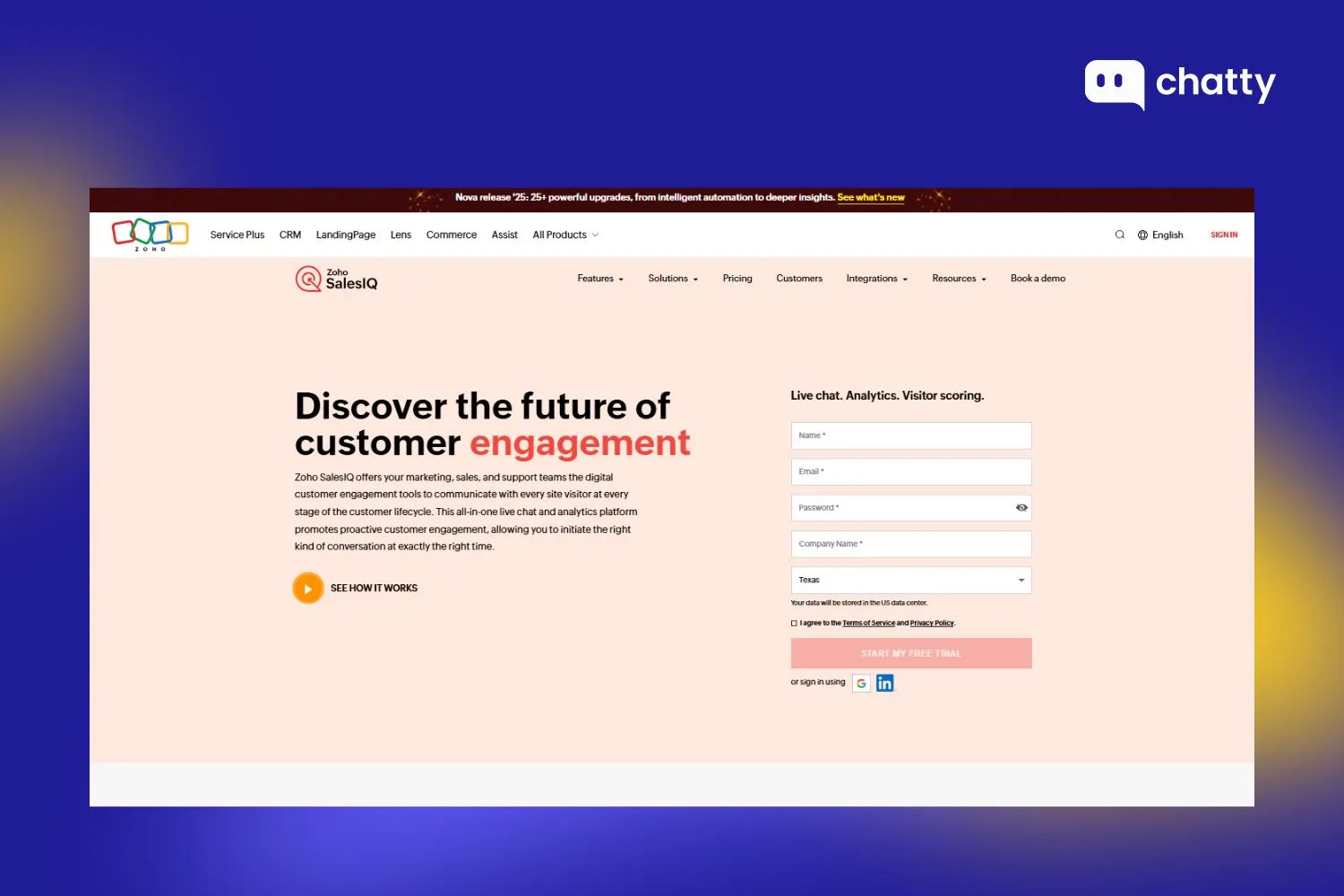
Zoho SalesIQ combines live chat, chatbot automation, and CRM integration to help businesses engage visitors and convert them into leads. It’s especially popular among small and mid-sized companies for its affordability and ease of use. The platform allows teams to automate FAQs, share help-desk articles, and provide real-time support across multiple channels without technical complexity.
Key Features:
- Drag-and-drop Flow Builder for custom chatbots.
- AI replies from a choice of models, including OpenAI, Anthropic Claude and Google Gemini.
- Live chat handover with routing rules.
- Multi-channel support (Website, WhatsApp, Facebook, Instagram, LINE, WeChat).
- Deep integration with Zoho CRM and Google Analytics.
Limitations:
- Limited marketing tools on social channels.
- Not ideal for large, complex chatbot flows.
Pricing:
Free plan for 3 operators; paid plans are priced per operator and vary by region, so check Zoho SalesIQ pricing for your currency.
Best fit:
- Small to mid-sized businesses needing affordable chat automation.
- Companies already using Zoho CRM.
- Teams wanting integrated live chat and AI support.
8. Chatty, the AI sales agent for Shopify
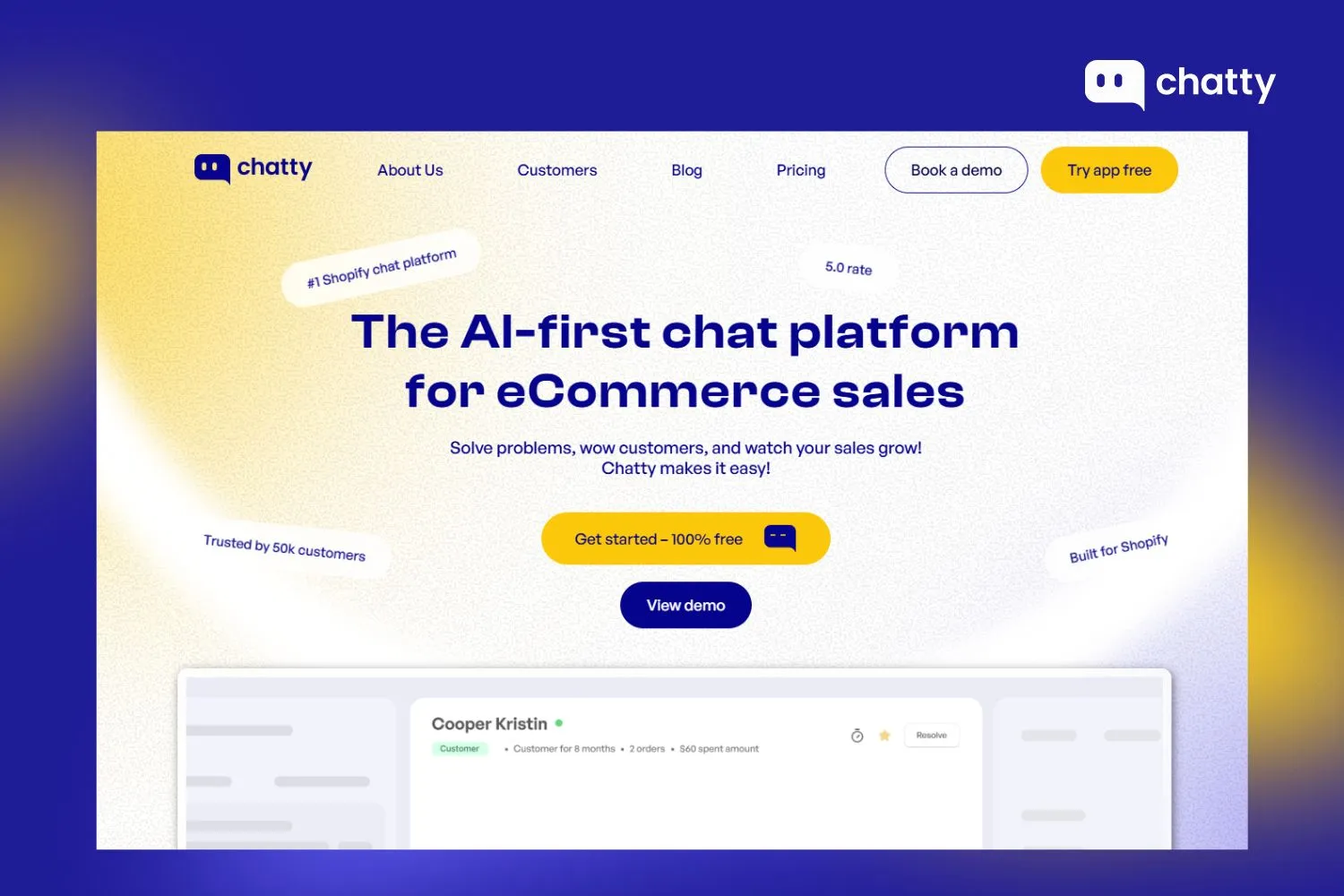
Chatty is the app we build, so weigh this section with that in mind.
On a Shopify store, many support chats come before the order: does this fit, is it in stock, when will it arrive? A slow or wrong answer there costs a sale, not just a ticket.
Chatty is the AI sales agent for Shopify stores. AI chatbot and live chat are two standout features of Chatty. The AI chatbot answers from your own Shopify data, and with live chat your team takes over from the AI and closes the sale.
92% of product answers were right on price, stock and details when we compared 300 real Chatty answers with each store's website in October 2026.
Key Features
- Store data: products, prices, stock, discounts and shipping, synced from Shopify.
- One inbox: email, Messenger, Instagram and WhatsApp land in the same inbox as your store chat.
- Where it helps: It helps shoppers in the search bar, on product pages, in chat and at the cart.
- Proactive messages on every plan, and abandoned cart reminders on Pro and Plus.
- Sales analytics: Chatty marks every order it assisted in Shopify, so you can check the return yourself.
- FAQ page for your store.
- Chatty Helpdesk is in early access: request it and we turn it on for your store.
- Mobile app for live chat anywhere.
Limitations:
- AI reply limit on lower plans.
Pricing: Free plan available; paid plans run from $19.99/month to $199/month, with a 7-day trial. Your plan includes AI conversations. Each AI reply over the plan costs $0.075, up to the monthly cap you set.
Best for: a Shopify store where most chats happen before the order and the team wants to turn more chats into sales. Trade-off: refunds and cancellations stay in Shopify admin, and AI replies on Instagram, Messenger and WhatsApp need Pro or Plus.

9. Gorgias: unified inbox for Shopify brands
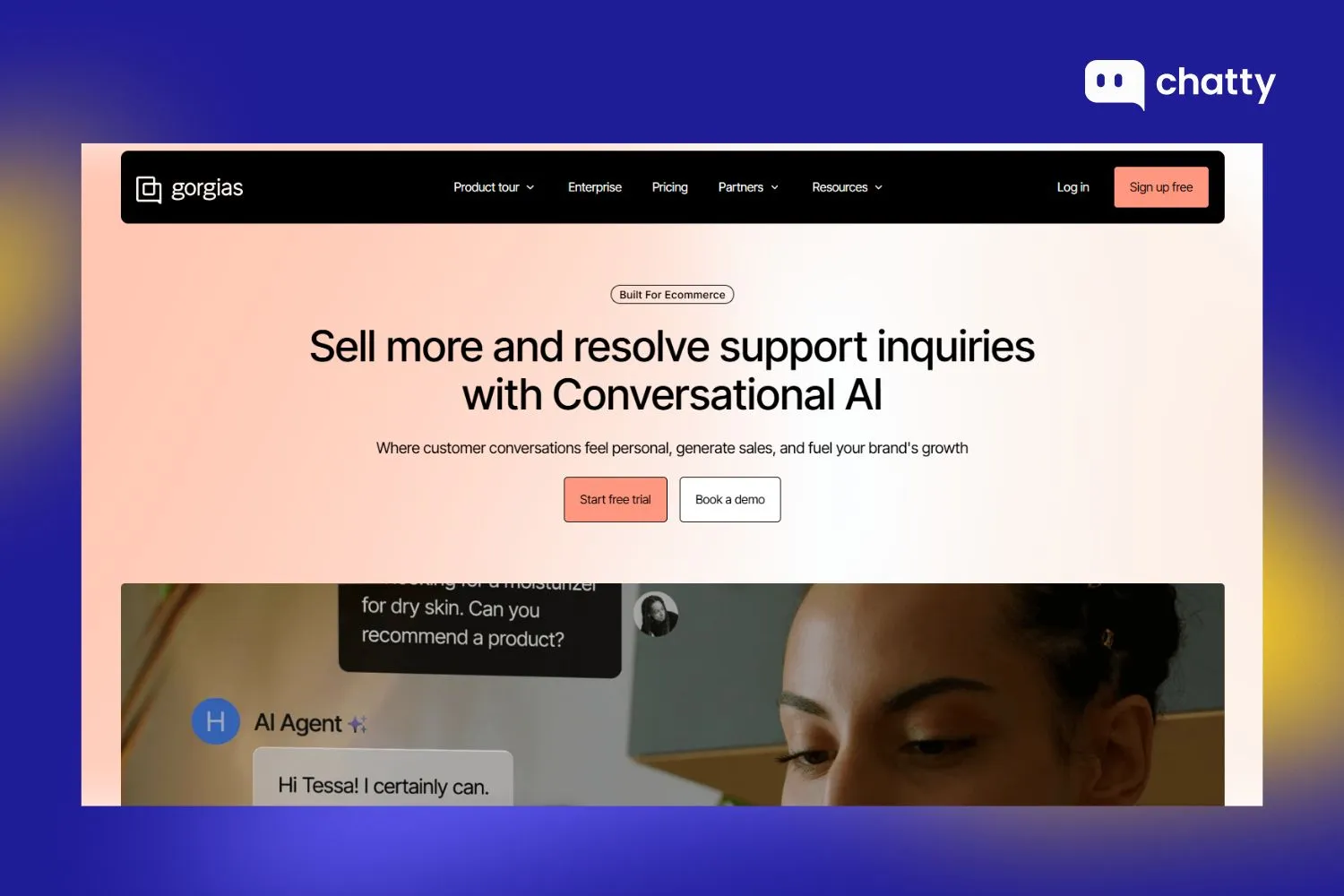
Gorgias is a helpdesk designed for e-commerce brands that want faster, smarter customer support. It brings email, chat, social, and SMS into one simple dashboard, so teams can reply quickly and with full context. With deep Shopify, Magento, and WooCommerce integrations, agents can view orders, issue refunds, and manage tickets without switching tools.
That saves time and cuts errors, and support can help sell too.
Key Features
- Unified inbox for all customer channels.
- AI-suggested replies and intent-based automations.
- Shopify, Magento, and WooCommerce integrations.
- Context cards with live order and loyalty data.
- Macros and rules to automate repetitive tasks.
Limitations:
- Cost scales fast with ticket volume.
- Limited AI chatbot customization.
Pricing: Free trial; paid plans from $10 to $900/month billed monthly, plus $0.90 to $1.00 per AI agent interaction. Enterprise is by quote (Gorgias pricing, checked October 28, 2026).
Best Fit:
- E-commerce teams using Shopify or similar platforms.
- Brands wanting to boost support speed and sales together.
10. Re:amaze: unified messaging for eCommerce
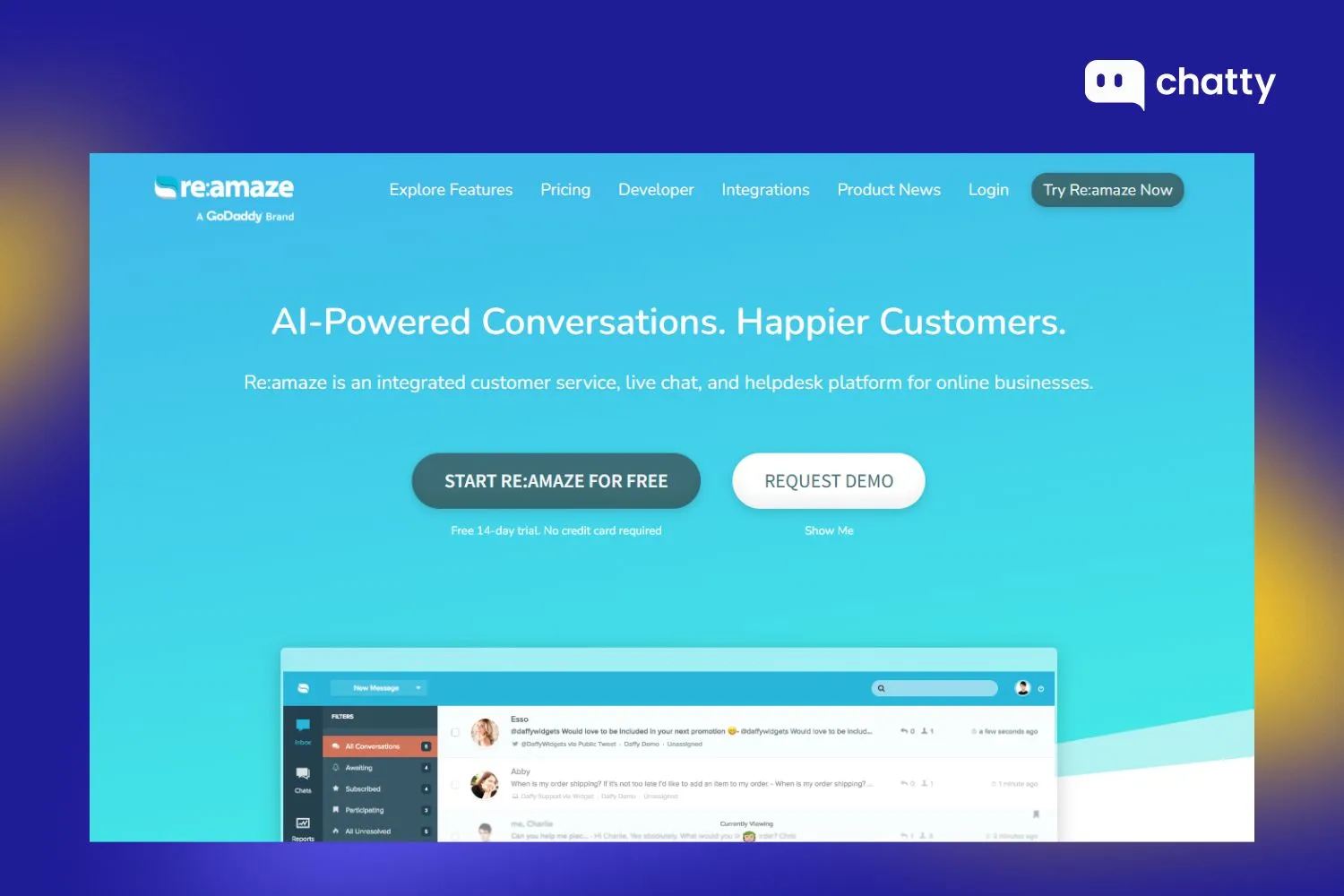
Re:amaze is a multichannel customer messaging and helpdesk platform designed for eCommerce, SaaS, and digital brands. It unifies email, live chat, SMS, and social messaging into one dashboard, helping teams manage all customer interactions efficiently. With strong eCommerce integrations, it’s ideal for online retailers needing to balance live chat and automation without complex setup.
Key Features:
- Unified inbox across email, chat, SMS, and social channels.
- Shopify, WooCommerce, and BigCommerce integrations.
- Smart automation workflows and proactive chat triggers.
- Built-in FAQ and self-service tools.
- Multi-brand management from a single account.
Limitations:
- Limited AI depth and advanced automation.
- Pricing scales quickly with team size.
Pricing: Free trial available; paid plans start from $29/month to $69/month per agent.
Best fit:
- Mid-sized eCommerce brands needing unified customer messaging.
- Retailers managing multiple brands or channels.
- Teams combining live chat with automation.
11. Heyday: AI for retail and social commerce
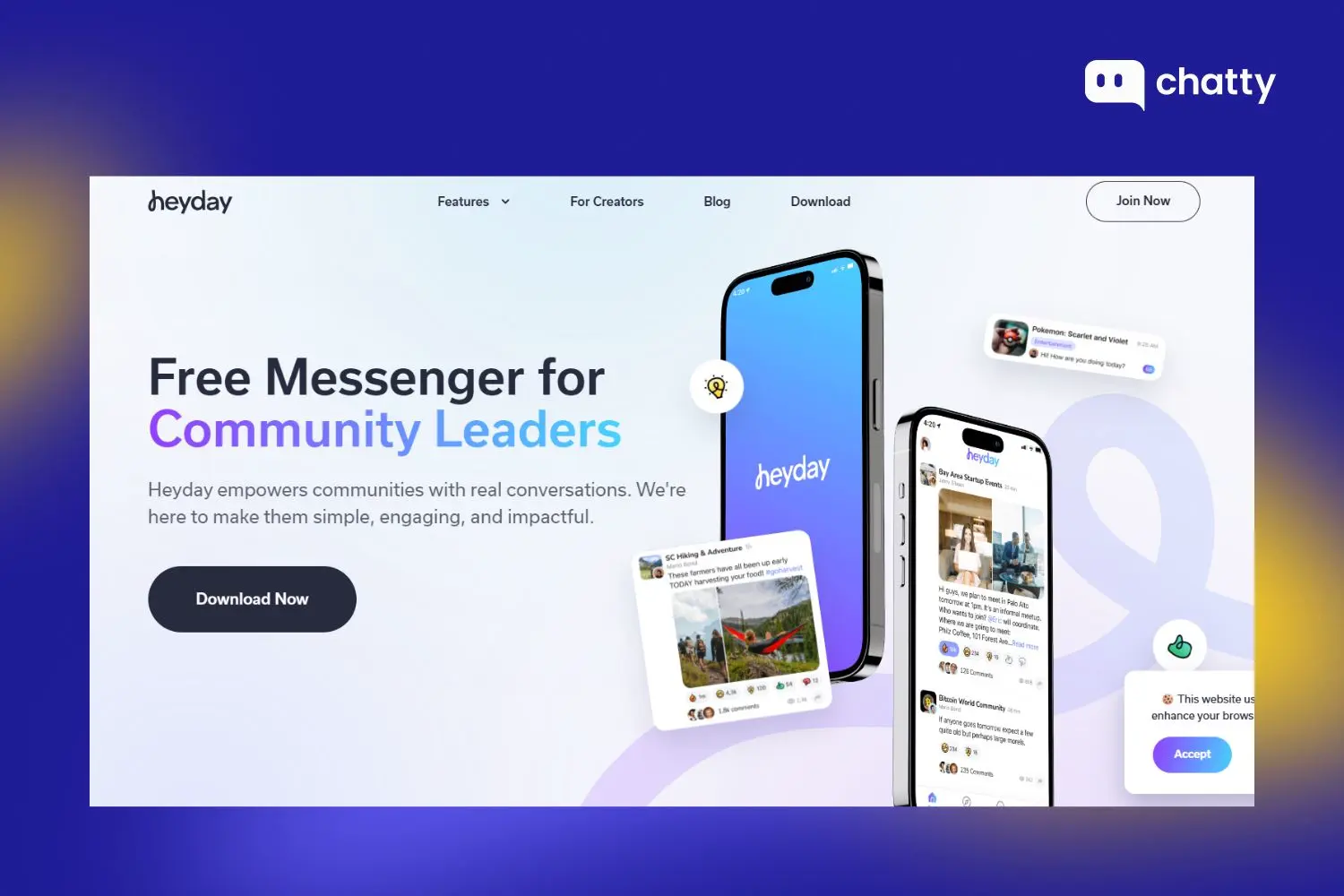
Heyday AI is designed for retailers and e-commerce brands that want to blend automation with personalized service. Using natural language processing and machine learning, it understands customer intent, answers FAQs, tracks orders and manages returns in real time.
It connects websites, social media and messaging apps. A customer can start a chat on Instagram and finish it on your website without repeating themselves.
Key Features
- Omnichannel chat (web, social, and messaging apps).
- E-commerce and CRM integration.
- Automated product recommendations.
- 24/7 support with smooth human handoff.
- Real-time analytics and multilingual support.
Limitations:
- Limited customization and integrations.
- Analytics less advanced than the top competitors.
Pricing: Custom quotes only (contact sales).
Best Fit: Retailers and online brands seeking scalable AI that enhances conversions and automates repetitive support with minimal setup.
12. Freshchat: AI simplicity for scaling support
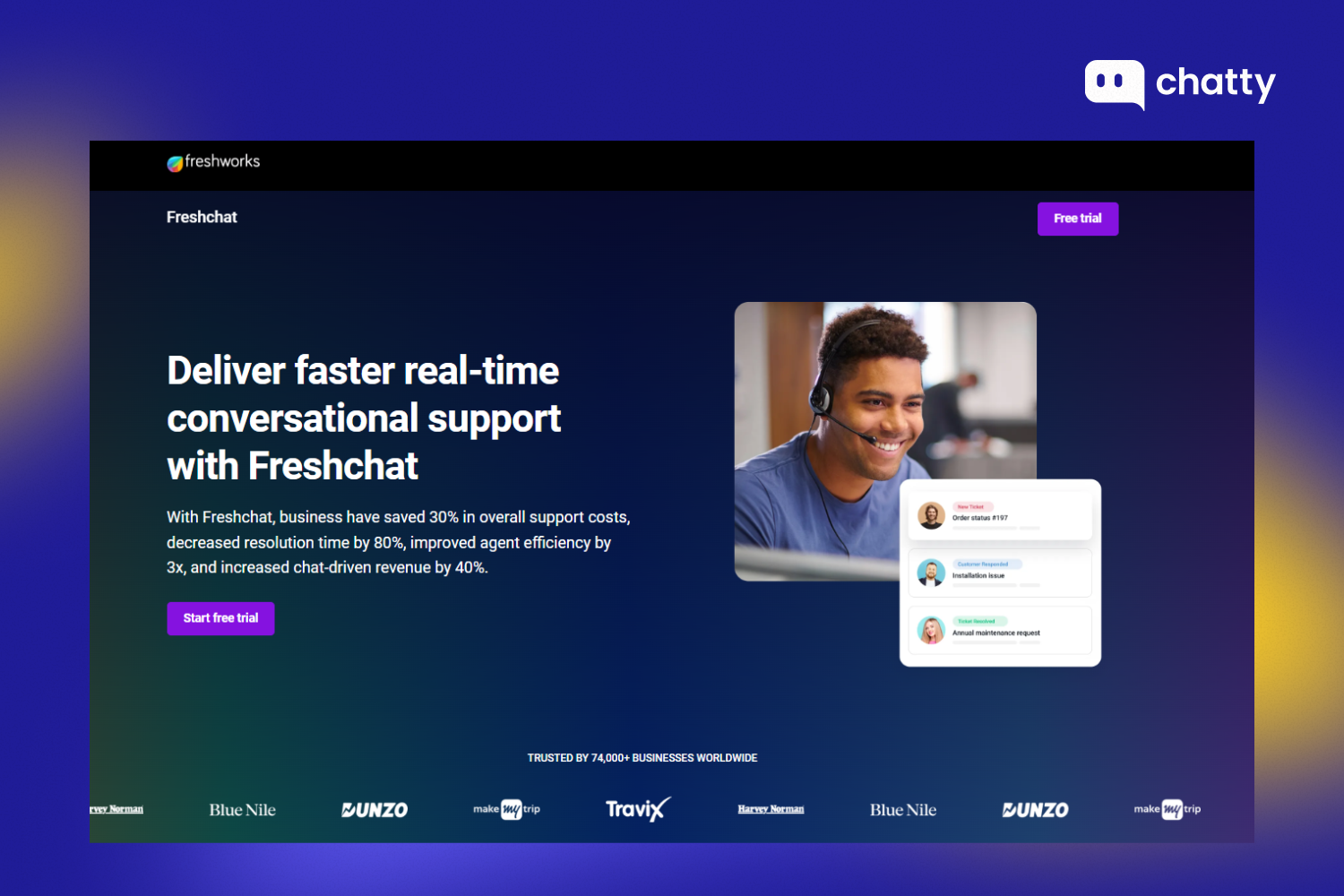
Freshchat helps businesses deliver fast, real-time customer conversations across web, mobile, and messaging apps. It brings all your chats from WhatsApp, Instagram, and other channels into one inbox, so agents can respond quickly and personally. Its AI bots hand a chat to a person when they cannot answer.
Key Features
- Unified inbox for all digital channels.
- No-code chatbot builder with AI intent detection.
- Bot-to-agent handoff.
- Deep integration with Freshdesk, CRMs, and 1,000+ apps.
- In-depth analytics for faster, smarter support.
Limitations:
- Advanced AI features need higher tiers.
- Bot setup can feel complex.
Pricing: Free plan for up to 10 agents; paid plans from $19 to $79 per agent/month billed yearly (Freshchat pricing, checked October 28, 2026).
Best Fit:
- Mid-sized SaaS, e-commerce, and tech support teams.
- Brands wanting unified messaging and quick automation.
13. Tidio: visual flow builder for small teams
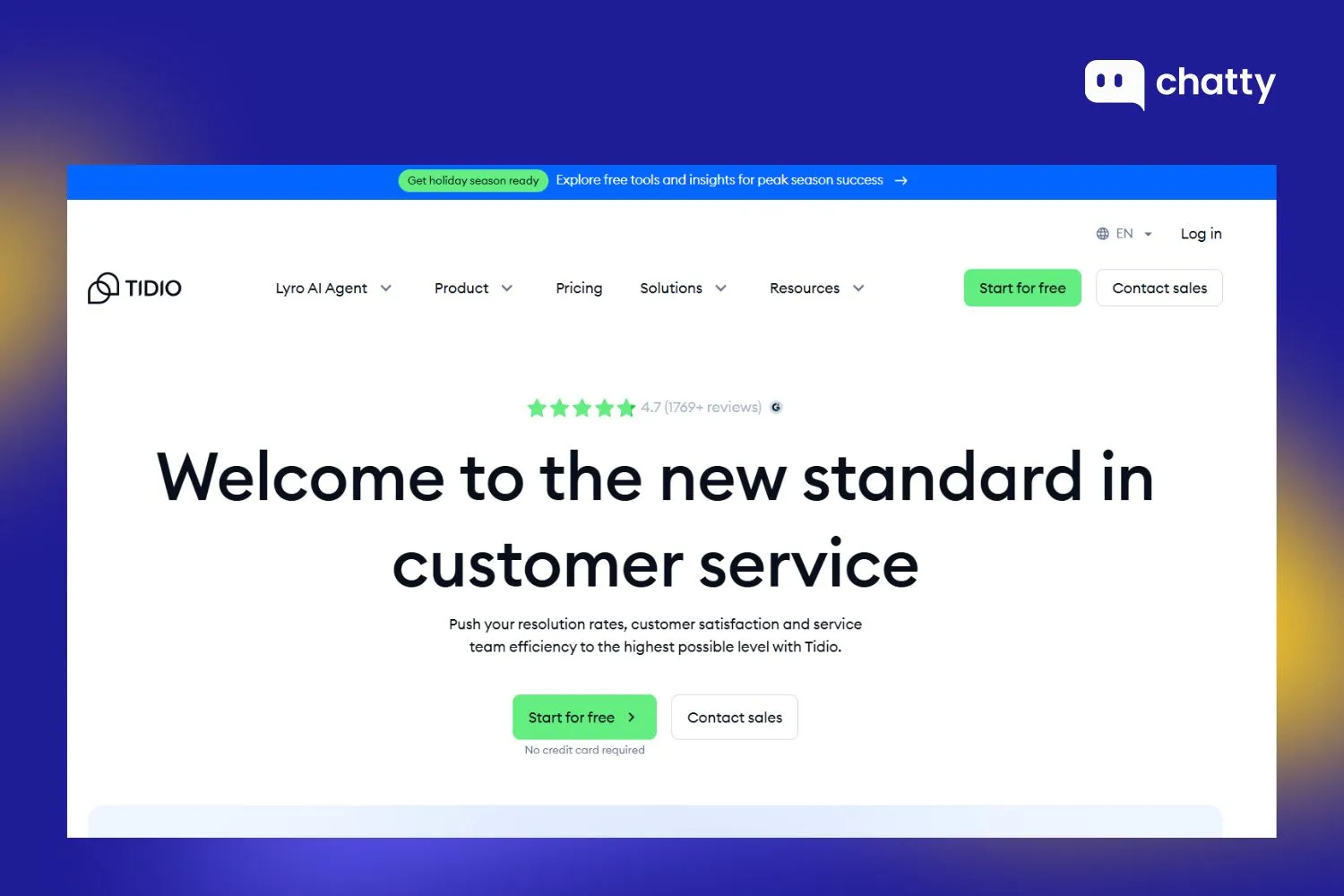
Tidio is an all-in-one customer service suite designed for small teams that want to combine live chat, automation, and AI in one place. Its AI agent, Lyro, answers repetitive questions so your team spends its time on the harder conversations. Tidio says its customers average a 75% resolution rate with Lyro.
Tidio’s visual flow builder suits non-technical teams. You can design chatbot conversations, collect leads or trigger automated messages without code. It has over 120 integrations, including Shopify, Messenger and Instagram.
Key Features
- Lyro AI agent for 24/7 automated responses.
- Drag-and-drop chatbot flow builder.
- Unified inbox for live chat and email.
- Help desk for ticket management.
- 120+ integrations.
Limitations:
- Lyro is billed separately from the base plan, from $32.50/month for 50 conversations, per Tidio’s pricing page.
Pricing: Free plan available. Starter is $24.17/month, Growth starts at $49.17/month, Plus starts at $300/month plus usage, and Premium is by quote (Tidio pricing, checked October 28, 2026).
Best Fit
- Small to midsize ecommerce or service teams.
- Businesses wanting simple automation without coding.
14. Crisp: lightweight AI for startups
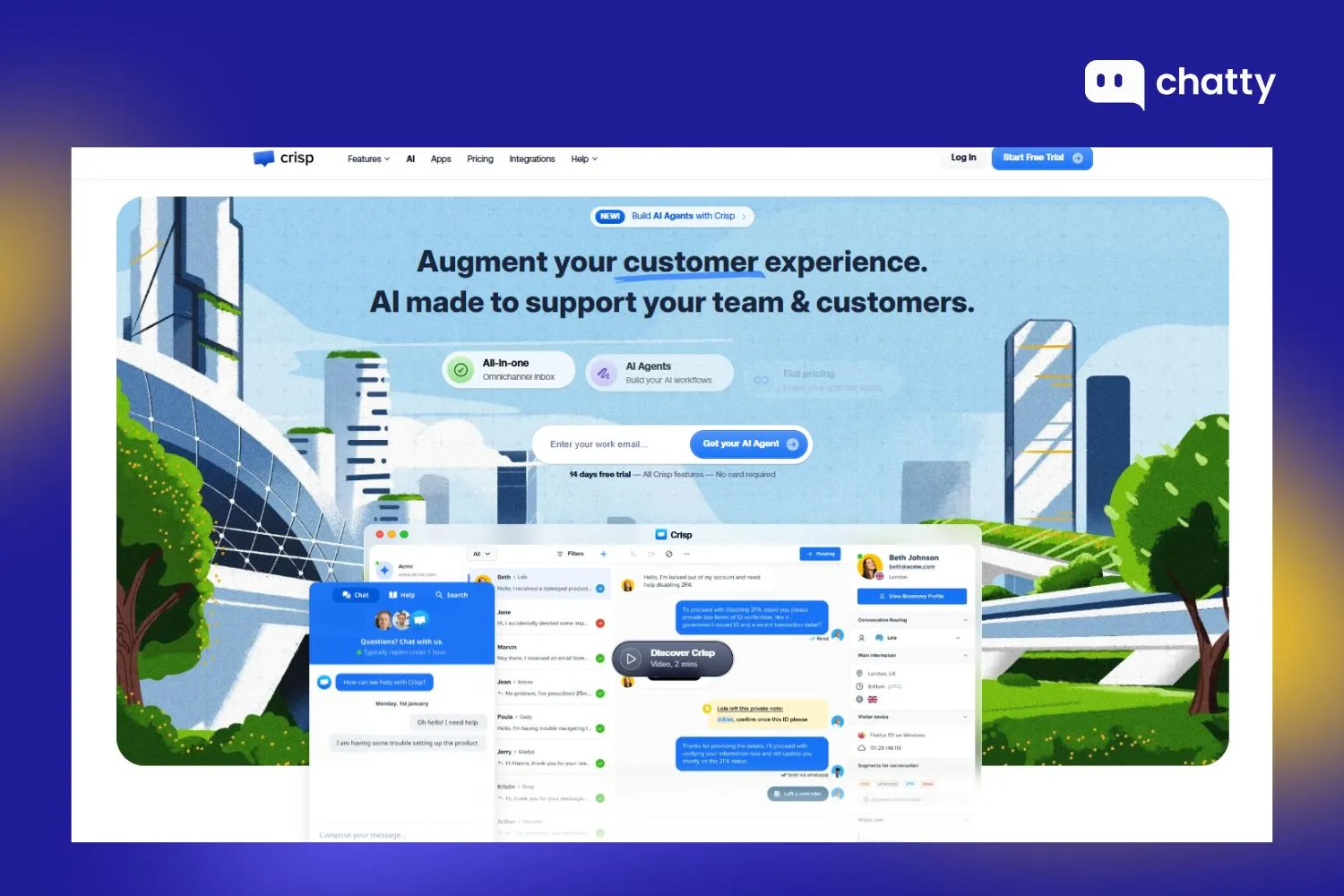
Crisp is a lightweight customer messaging and AI chat platform built for startups and SMBs. It unifies live chat, email, and social messaging into a single shared inbox, enabling teams to collaborate in real-time. Setup is quick and co-browsing is built in, without enterprise-level cost or setup.
Key Features
- Unified inbox for chat, email, and social channels.
- AI chatbot and workflow automation builder.
- Real-time co-browsing, video, and screen sharing.
- 100+ integrations (HubSpot, Slack, Shopify, Zapier).
- Built-in CRM and knowledge base for faster replies.
Limitations:
- Limited advanced AI and analytics.
- Costs rise quickly at scale.
Pricing: Free plan available; paid tiers from $45 to $295/month per workspace (Crisp pricing, checked October 28, 2026).
Best Fit: Startups and SMBs wanting affordable, collaborative customer chat tools
15. Tawk.to: free live chat for small businesses
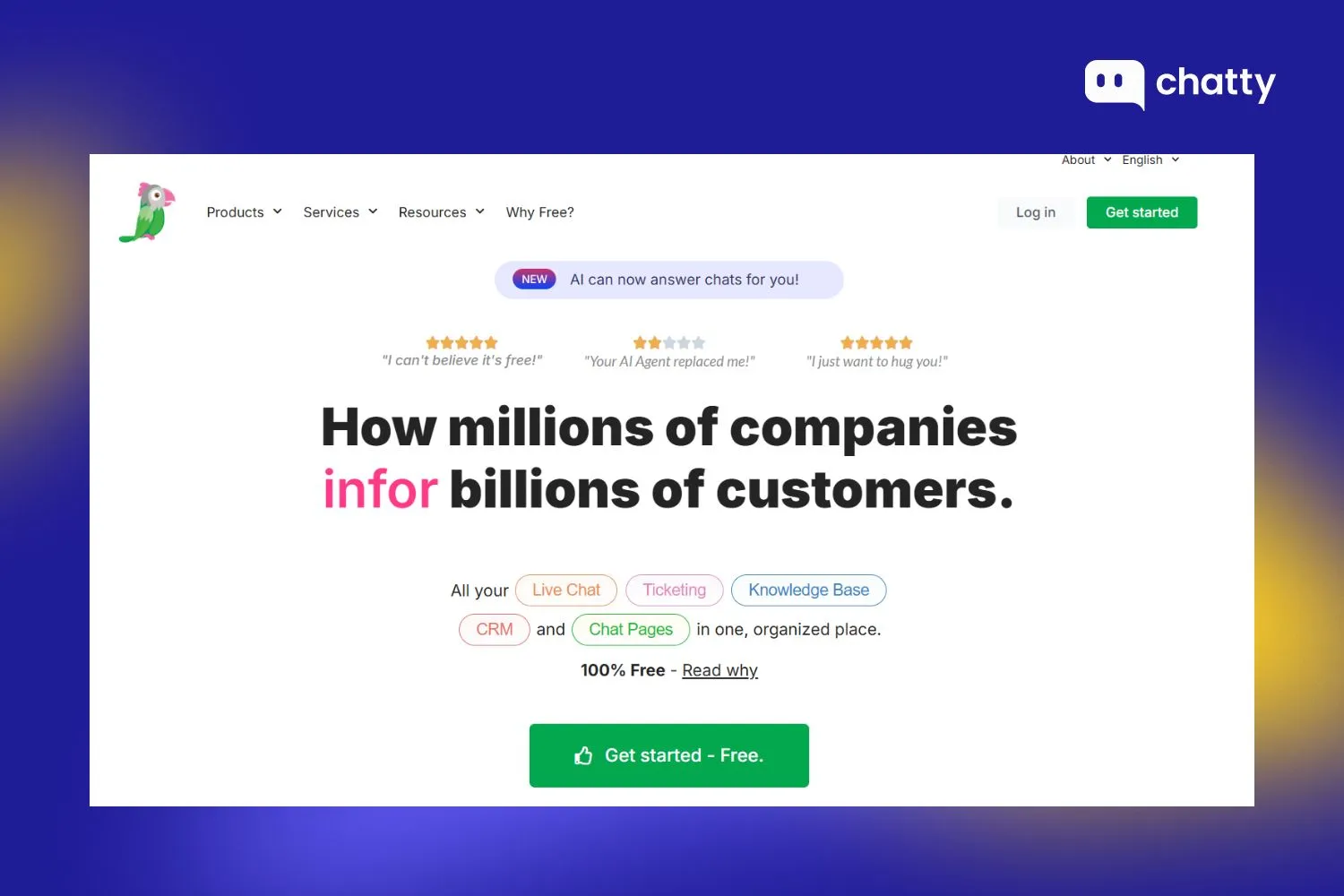
Tawk.to is a free live chat and AI-powered support platform built for small businesses that want to connect with customers easily and affordably. The company says more than 1.7 billion people interact with a tawk.to widget each month (tawk.to). It helps teams answer questions, organize conversations, and give instant support from one dashboard.
Businesses can monitor visitor activity in real time, collaborate across teams, and manage live chat, tickets, and a knowledge base in one place. Its new AI Assist feature lets the bot reply automatically, providing 24/7 coverage without extra staffing costs.
Key Features
- Free live chat, ticketing, and knowledge base.
- Real-time visitor monitoring.
- AI Assist for automated responses.
- Team collaboration and assignment tools.
- Multi-channel access (web, messaging, and more).
Limitations:
- Limited customization and integrations.
Pricing: Free; AI Assist from $29/month (tawk.to pricing page, checked October 28, 2026).
Best Fit: Small businesses needing cost-free, always-on customer support.
16. HelpCrunch: all-in-one support suite
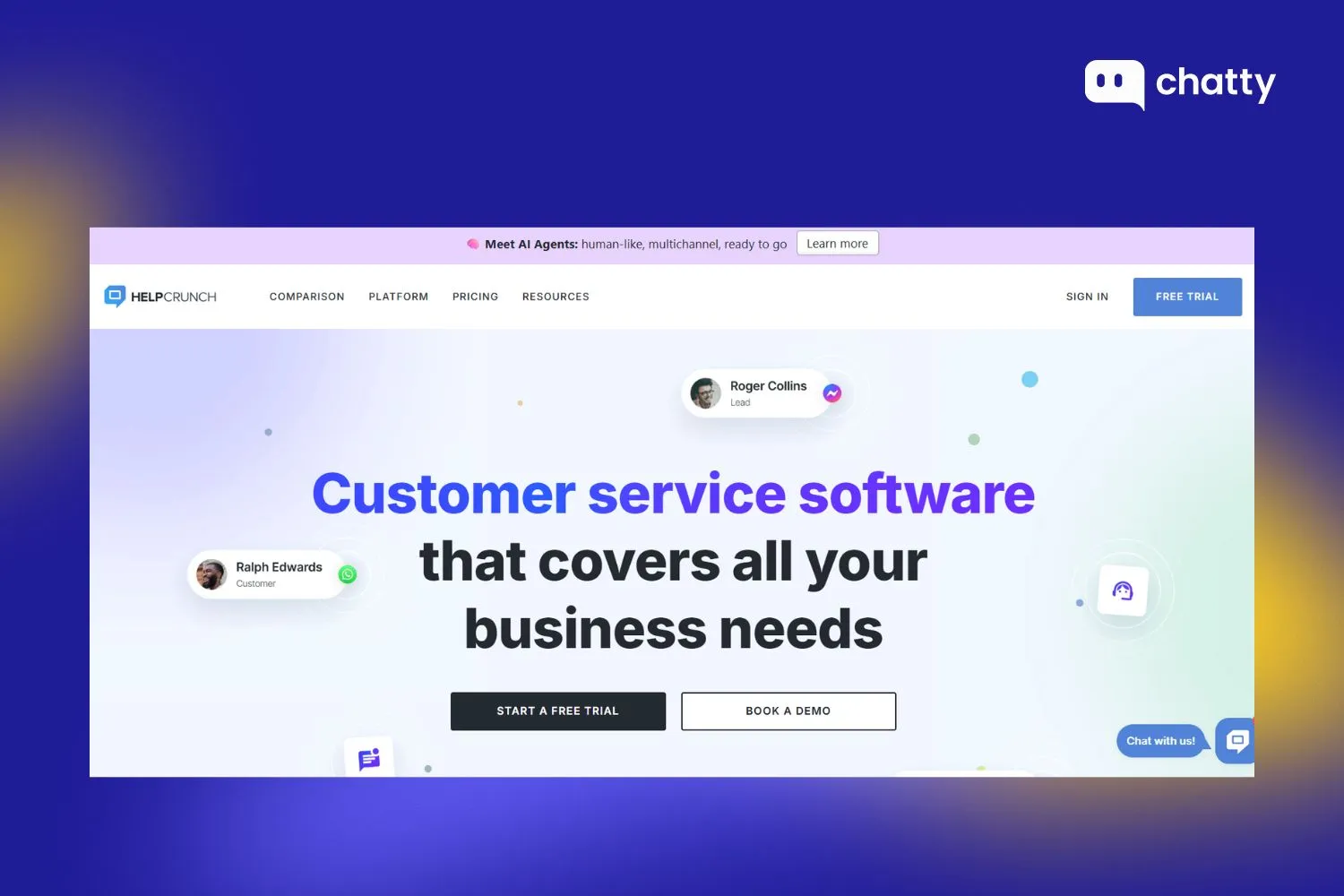
HelpCrunch is an all-in-one customer communication platform that combines live chat, email marketing, and help desk tools in one dashboard. It helps teams manage customer support, onboarding, and engagement from a single workspace.
It is designed mainly for SaaS and e-commerce businesses, and your team switches between fewer tools. The chatbot is basic, but HelpCrunch is easy to use, easy to customize and good value for smaller teams.
Key Features:
- Customizable live chat widget with proactive messages.
- Shared inbox for email, chat, and social channels.
- Knowledge base builder for self-service support.
- Email automation and targeted popups.
- Integrations with Zapier, Stripe, and Google Sheets.
Limitations:
- Limited AI chatbot capabilities.
- Occasional integration bugs.
Pricing: No free plan available; paid plans start from $15/month to $620/month.
Best fit: Small to midsize SaaS and e-commerce teams wanting an all-in-one support and engagement tool.
17. Kommunicate: hybrid AI + human chat
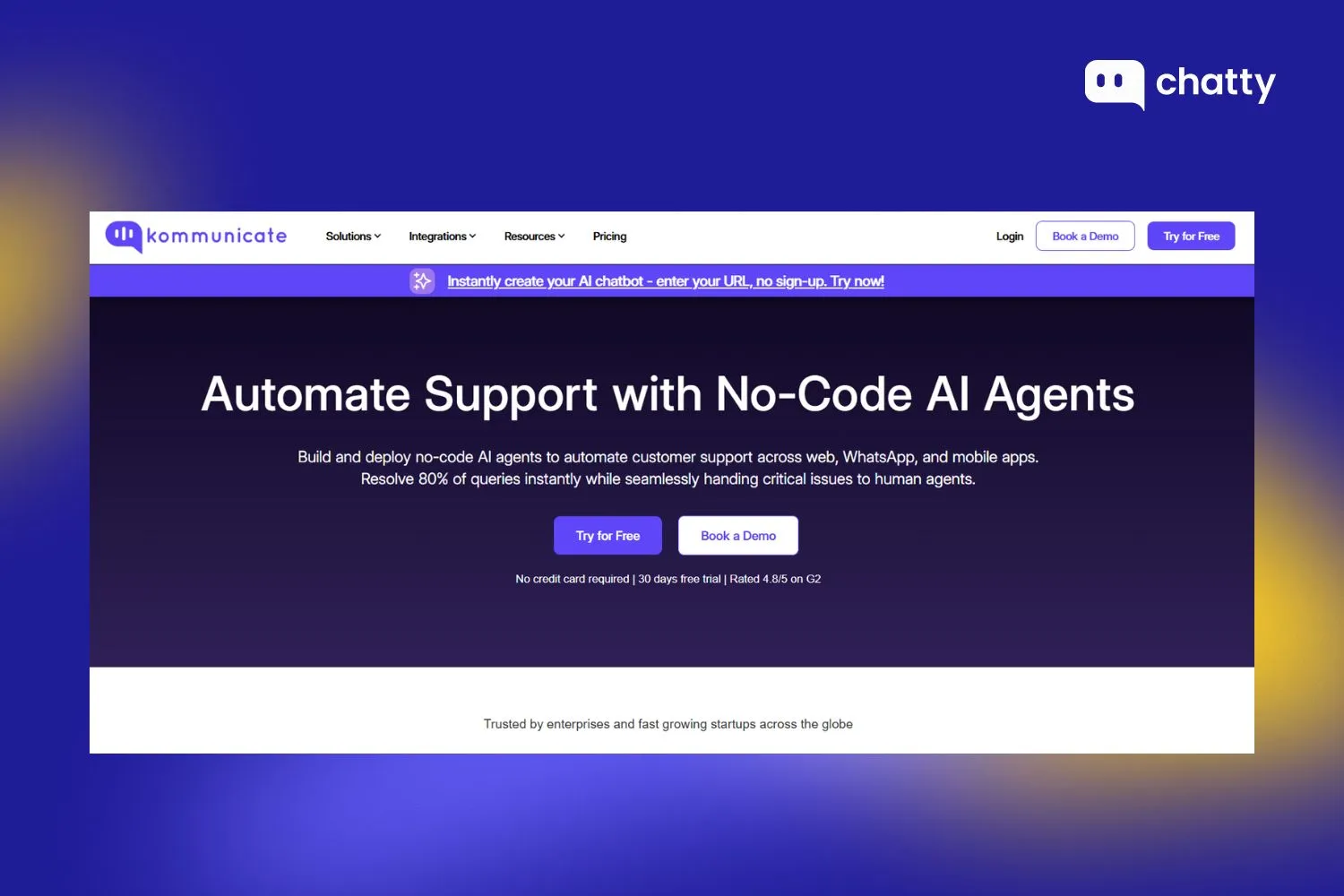
Kommunicate is a customer support automation platform combining AI chatbots and human agents in one unified inbox. Its no-code Kompose Builder lets teams design chatbots with drag-and-drop simplicity for websites, apps, WhatsApp, and more.
When the bot cannot answer, a live agent takes over in the shared inbox. The aim is 24/7 support across channels without a complex setup.
Key Features:
- Kompose no-code chatbot builder.
- Shared team inbox for live chat.
- Omnichannel support: Web, WhatsApp, Instagram, Telegram.
- Integrations with Zendesk, Freshdesk, and Google Analytics.
- AI Email Automation, Agent Assist, and Campaign Messaging.
Limitations:
- Limited customization for complex workflows.
- Basic analytics.
Pricing: No free plan, but a 30-day free trial. Paid plans run from $40/month to $200/month, and Enterprise is by quote (Kommunicate pricing, checked October 28, 2026).
Best fit: Businesses wanting hybrid AI + human support across multiple channels.
18. Chatfuel: automation for Facebook Messenger
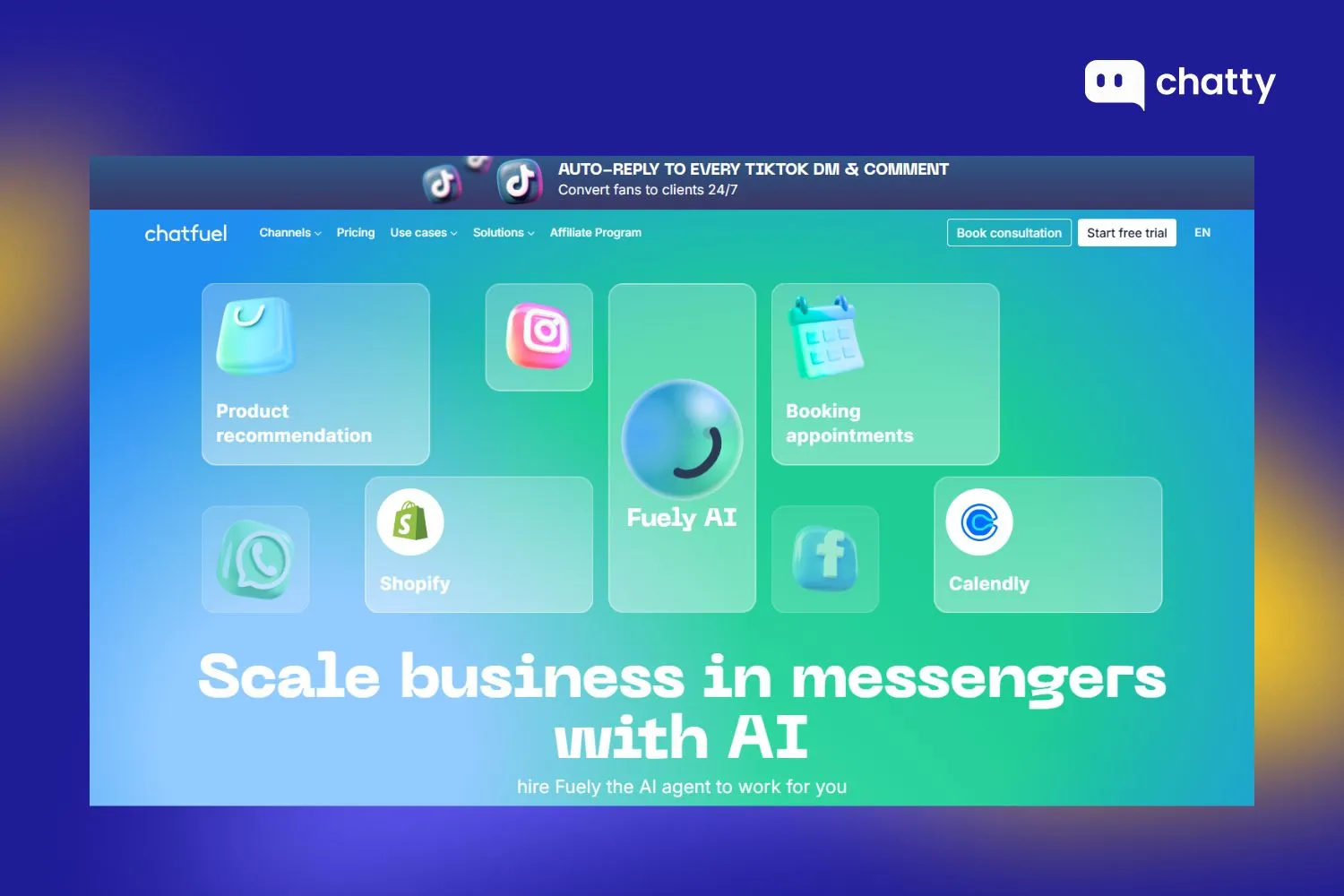
Chatfuel is a no-code chatbot builder that automates communication on Facebook, Instagram, and WhatsApp. Its Flow Builder lets anyone design chat automations quickly, which helps businesses that answer a lot of social messages. The platform excels in automating sales, lead capture, and customer service directly within Meta channels.
Chatfuel integrates with ChatGPT, Zapier and Shopify. It suits teams that want faster replies on social channels without coding.
Key Features:
- Drag-and-drop Flow Builder.
- ChatGPT, Shopify, Zapier & Make integrations.
- Built-in live chat and mobile inbox.
- Automated replies for Facebook & Instagram comments.
- Audience segmentation & WhatsApp API support.
Limitations:
- No multi-channel flow duplication.
- Limited multilingual functionality,
Pricing: No free plan, but every plan starts with a free trial. Business is $18/month billed yearly, and the Agency plan starts at $90/month (Chatfuel pricing, checked October 28, 2026).
Best fit:
- Businesses active on Facebook, Instagram, or WhatsApp.
- Marketers needing fast automation for social campaigns.
- Small and mid-sized teams seeking AI-driven chat engagement.
19. Manychat: social DM automation
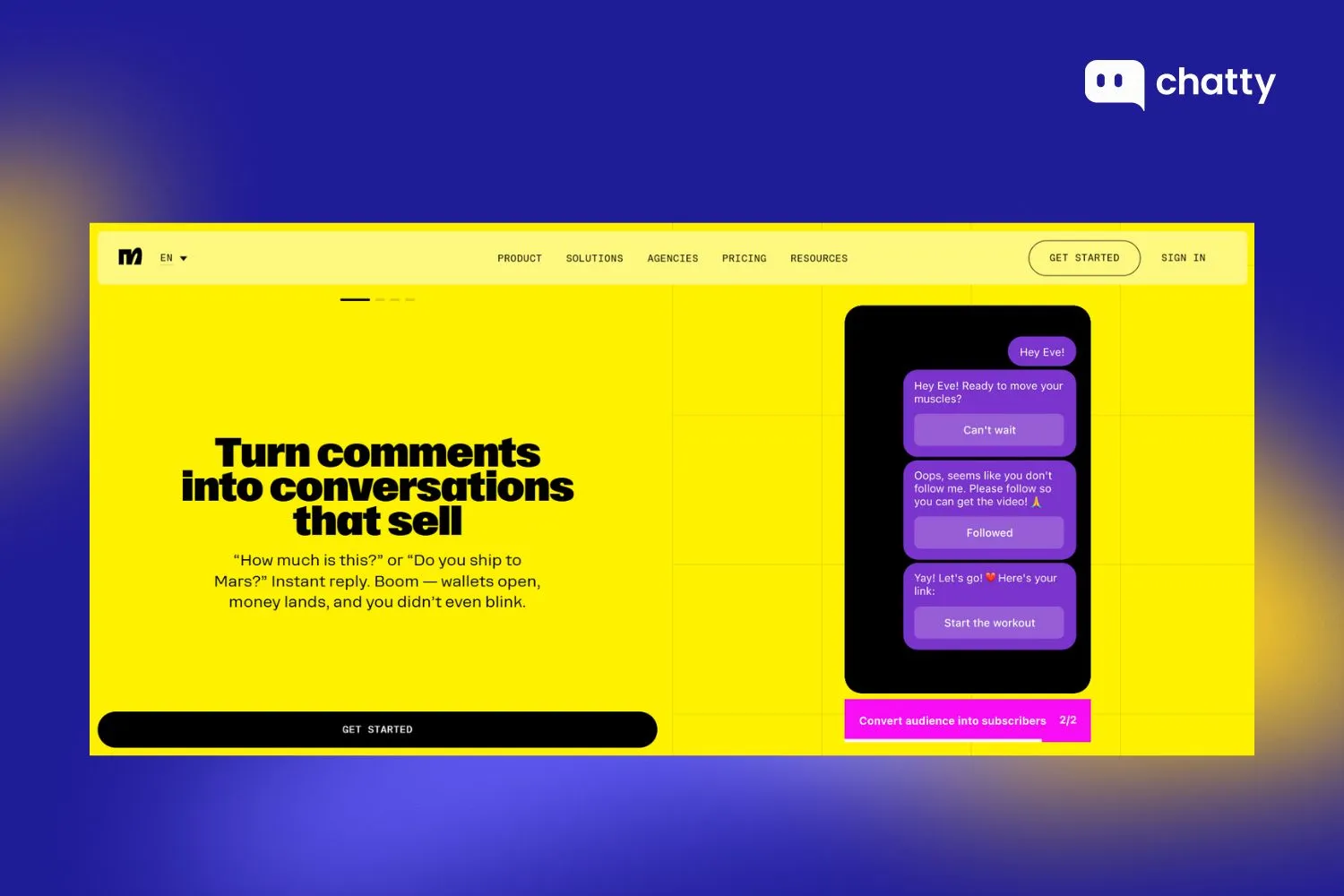
Manychat is a platform for automating customer conversations across Facebook, Instagram, WhatsApp, Telegram, and SMS. Its drag-and-drop Flow Builder lets you build a chatbot fast, with no coding. It is designed for marketers and eCommerce brands that run lead capture and sales through social DMs.
With AI-powered tools like Intents, AI Steps, and a Flow Builder Assistant, Manychat automates support and marketing replies at a low price. It’s ideal for teams seeking omnichannel reach with smart automation.
Key Features:
- Visual Flow Builder with AI Assistant.
- Keyword & intent-based automation.
- Growth Tools for audience engagement.
- Built-in Live Chat and Inbox Pro.
- Integrations with Zapier, HubSpot, and Google Sheets.
Limitations:
- Separate setup per channel.
- AI add-ons can be limited.
Pricing: Free plan available. Since March 2026, paid plans start at $17/month and rise with your active contacts (ChatBot.com review of Manychat pricing). Confirm on Manychat’s own pricing page, which blocks automated checks.
Best fit:
- eCommerce and marketers managing multi-channel DMs.
- Small businesses needing easy automation for Meta apps.
- Agencies offering conversational marketing solutions.
20. Botpress: open-source chatbot for developers
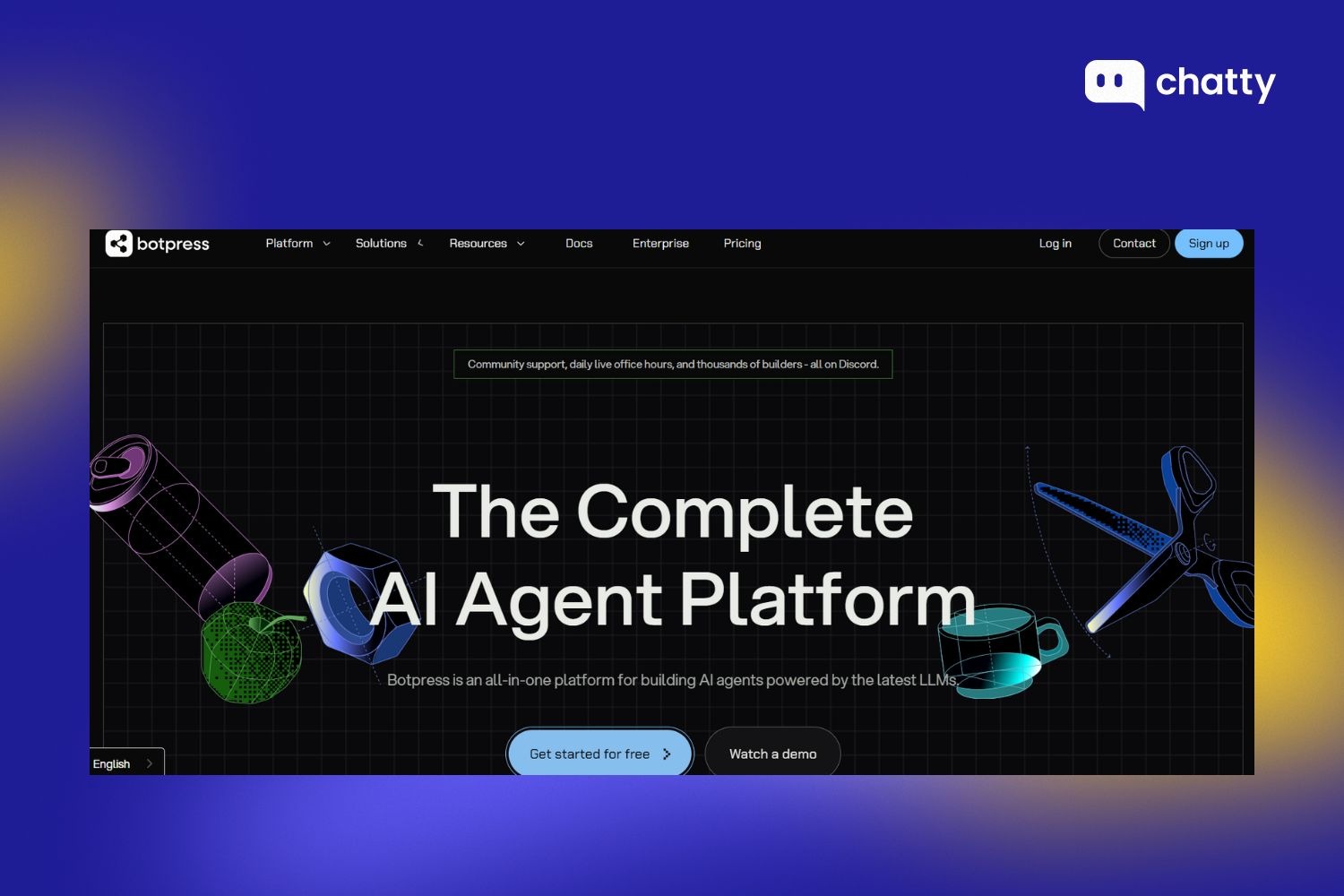
Botpress is an open-source platform built for developers who want complete control over chatbot automation. It combines an intuitive flow builder with advanced AI capabilities like intent detection, translation, and knowledge-base integration.
Teams can deploy bots across 10+ channels, including websites, WhatsApp, Slack and Facebook, and customize every detail. It fits teams that want to build their own support bot rather than configure a ready-made one.
Key Features:
- Visual Flow Builder with AI-assisted logic generation.
- Advanced AI Agents (Knowledge, Personality, Translator, etc.).
- Built-in live chat and Zendesk integration.
- Multi-channel publishing (Web, WhatsApp, Instagram, Slack).
- Execute custom code or API calls via JavaScript.
Limitations:
- Steeper learning curve for beginners.
- Basic analytics on lower plans.
Pricing: Free plan available; Plus is $150/month and Team is $750/month, both billed yearly, and Enterprise is by quote (Botpress pricing, checked October 28, 2026).
Best fit: Developers and tech teams needing full control and deep AI customization.
Guide to choose the right chatbot for customer service
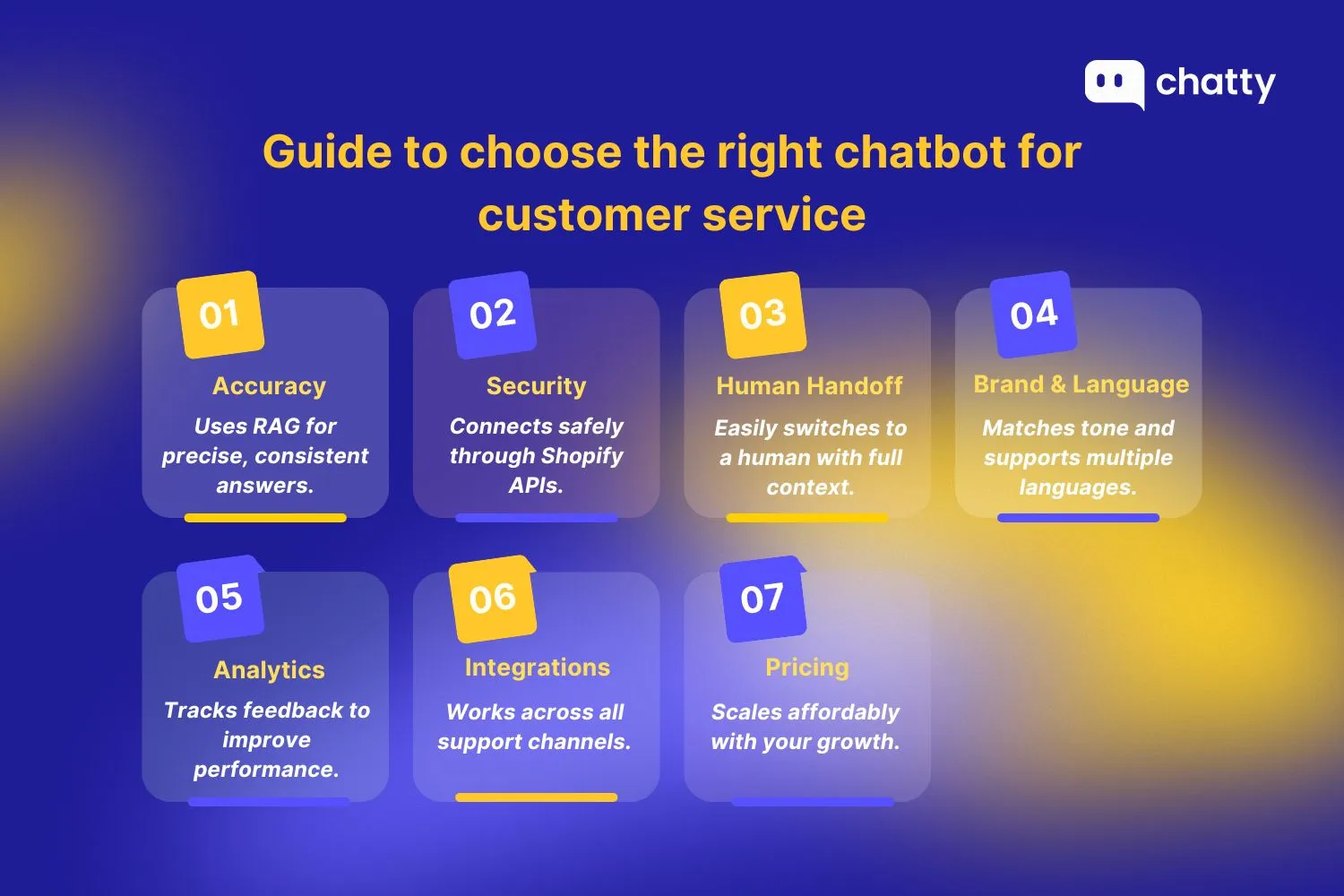
Pick the chatbot that fits how your team already works and keeps customer data safe. Check these seven things before you sign up.
- Accuracy and Grounding: A reliable chatbot must deliver correct answers every time. Choose one that uses Retrieval-Augmented Generation (RAG) so it pulls responses directly from your product catalog, FAQs, or store policies. This approach keeps answers accurate and consistent, even as your content changes.
- Safe Order Actions: If your chatbot helps with orders or accounts, it must connect safely through Shopify APIs. Check that it follows your store policies and uses permission-based access. This allows it to track orders, update details, or issue refunds securely without exposing sensitive data.
- Smooth Handoff to Humans: Even a smart chatbot needs a human backup. Look for a clear “talk to a human” option. The full chat should move with it, including order details and customer history, so your team picks up without asking the customer to repeat anything.
- Multilingual and Brand Voice Control: Your chatbot should match your brand’s tone and speak your customers’ language. Select one that supports multiple languages and lets you adjust personality, tone, and phrasing so every reply sounds natural and on-brand.
- Analytics and Training Loop: A great chatbot keeps improving through feedback. Choose one with analytics tools that label conversations, track satisfaction, and support retraining. A clear feedback loop helps the chatbot learn faster and maintain high accuracy.
- Integrations and Channels: Your chatbot should work across all your support touchpoints. Make sure it connects with Shopify, email forwarding, Messenger, WhatsApp, and shipment tools like 17TRACK. This keeps your customer experience consistent everywhere.
- Pricing Models and Limits: Finally, review how each platform charges. Some charge per message, others per conversation or support seat. Pick a pricing model that matches your current volume and leaves room to scale without unexpected limits.
Final thought
Start with where your customers ask and what they ask about. A large ticket queue points to Zendesk AI or Intercom Fin. Social DMs point to Manychat or Chatfuel, and a small team on a budget to Tidio, Crisp or Tawk.to.
For Shopify stores that want support chats to end in orders, Chatty is built for that job. Before you pick, copy the five questions your shoppers send most often and test them on your shortlist.

FAQ
Yes. A chatbot for customer support can answer common questions, track orders and pass an issue to your team when it needs a person.
That gives you 24/7 cover without adding staff, and customers stop waiting for routine answers.
For Shopify stores, Chatty, the AI sales agent for Shopify, is best for stores that sell through chat. Chatty answers from your own Shopify data: products, prices, stock, discounts and shipping. Chatty marks every order it assisted in Shopify, so you can check the return yourself.
You can create a chatbot in just a few steps:
- Pick a chatbot tool that connects to your store or help desk, and check how it charges (per message, per conversation, or per seat).
- Give it your own content: product catalog, FAQs, shipping and return policies, and past chats.
- Set the tone of voice and the languages it replies in, so answers sound like your brand.
- Add a handoff rule, so the chat moves to a person with the full conversation when the bot cannot answer.
- Test it with real customer questions before launch, then review its conversations every week and correct wrong answers.
It depends on your goal. ChatGPT is a general AI assistant for conversation and writing.
A chatbot for customer support is built to help your customers. It follows your business rules and answers from your own data. If you want automated customer service in your brand's voice, pick a support chatbot.