







 Blog
 Free tools
 Help center




A Shopify store with 25,000 sessions a month pays Rep AI $209 for its Sales plan whether 300 shoppers chat that month or 1,500. Rep AI bills on sessions, so the bill follows your traffic. Chatty, the AI sales agent, bills on AI conversations, so the bill follows your chats.
That makes starting prices a poor guide. Rep AI's $39 buys 3,000 sessions and Chatty's $19.99 buys 100 AI conversations, so the two numbers measure different things.
The number that decides it is your chat rate: AI conversations in a month divided by sessions in the same month. This guide calls the comparison the chat-rate test.
Below a certain chat rate, Chatty's meter costs less. Above it, Rep AI's flat session price wins.
Price is half the decision. The other half is what the AI should do after the order. Rep AI can cancel eligible orders on its own, while Chatty hands that work to your team.
This guide covers 5 head-to-head differences, break-even math at 3 traffic levels and a 14-day test plan. Prices and features were checked on 13 November 2026 against both App Store listings, both help centers and Rep AI's pricing page.
- Choose Chatty if
your chat rate sits below the break-even for your traffic. At 25,000 sessions, that's under about 1,247 AI conversations a month (5.0%), at an estimated 2.5 AI replies each.
- Choose Chatty if
you want to cap overage yourself and see AI-touched orders marked inside Shopify admin.
- Choose Chatty if
you're under 50,000 sessions and want the vendor's team to set up the AI for free.
- Choose Rep AI if
a large share of visitors chat, or your traffic is steady and you want one flat price.
- Choose Rep AI if
you want the AI to cancel eligible orders and route returns without a person, on the Concierge or Support plan.
- Choose Rep AI if
you also sell on WooCommerce or Salesforce Commerce Cloud.
Chatty vs Rep AI at a glance
Both apps recommend products, add items to the cart in chat and track orders. The 10 rows below are where they part ways.
| Capability | Chatty | Rep AI | Watch out for |
|---|---|---|---|
| What you pay for | AI conversations in your plan, then $0.075 per AI reply over it | Website sessions, whether or not the shopper chats | Compare at your chat rate, not the starting price |
| Entry paid plan | Basic, $19.99/month for 100 AI conversations | Sales $39 or Concierge $46/month for 3,000 sessions | Order actions need Concierge or Support |
| Overage control | Monthly spending limit from $1 to $1,000. The AI pauses at the cap | $12 per 1,000 extra sessions, capped at $1,000 per period | Without approved overage, Rep AI's widget switches off |
| Proactive chat | Campaigns you set by page, time, scroll and cart value | Starts chats from predicted drop-off behavior | Chatty's cart campaigns need Pro or Plus |
| After the order | Tracks orders. Cancels, returns and edits go to your team | Cancels eligible orders and checks return eligibility | Chatty needs a person for the final step |
| Email and social DMs | Connected to one inbox for your team | AI add-on at $0.75 per AI-resolved conversation | Rep AI bills DMs on top of sessions |
| Where you work | Inside Shopify admin | Separate web console | Rep AI means a second login for your team |
| Setup help | Chatty's team sets up the AI free on every plan | Assigned success manager above 50,000 sessions | Rep AI is self-led below 50,000 sessions |
| Revenue proof | Chatty Assisted and Chatty Direct fields on Shopify orders | Sales Analytics with same-session, AI-reviewed attribution | The two count different things |
| Platforms and trial | Shopify only. Free plan plus a 7-day paid trial | Shopify, WooCommerce, Salesforce Commerce Cloud. 14-day trial, no card | Neither trial runs long enough for a sale month |
Chatty vs Rep AI pricing: what each costs at your traffic
The table shows the two meters differ. This section prices both at real traffic, so you can see where your store lands.
How Rep AI bills: sessions, tiers and overage
Rep AI prices every website plan by monthly sessions. A billable session is a shopper's device visiting your store on a calendar day (UTC) while Rep AI's chat is shown. The shopper doesn't have to open the chat, and known bots and very short visits are excluded.
At the time of writing, the pricing calculator starts Sales at $39 and Concierge at $46 a month for 3,000 sessions. Concierge bundles the Sales and Support plans.
Go past your tier and Rep AI charges $12 per 1,000 extra sessions, with email alerts at 80%, 90% and 100% of the limit. If you never approved overage charges, the Rep widget is disabled until the next billing cycle. Overage stops at $1,000 per period, a cap shared with its email and social AI add-on.
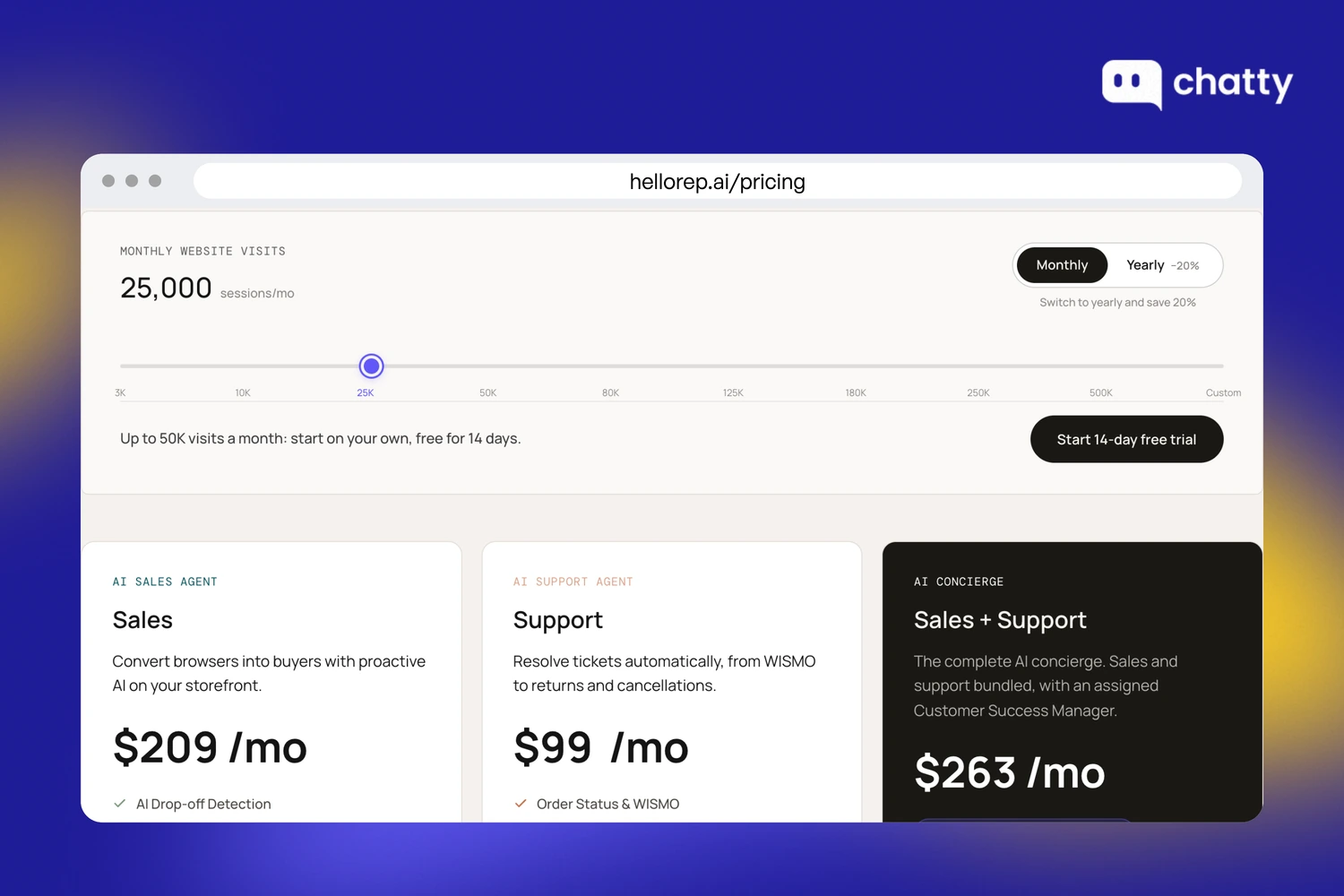 *Image via Rep AI, captured 13 November 2026.*
How Chatty bills: AI conversations, AI replies and a spending limit
Chatty prices its plans by AI conversations per month. The App Store listing shows four plans at the time of writing:
- Free: 50 AI conversations a month, unlimited human conversations.
- Basic: $19.99 a month for 100 AI conversations.
- Pro: $68.99 a month for 500 AI conversations, with proactive cart campaigns.
- Plus: $199 a month for 1,000 AI conversations.
One AI conversation is one shopper issue, however many messages it takes. Per Chatty's help center, a proactive message counts only when the shopper writes back, and the same shopper isn't counted twice within 24 hours.
Once your plan's AI conversations run out, paid plans charge $0.075 per AI reply, meaning each message the AI sends. You set a Monthly spending limit for that overage, from $1 to $1,000. When overage hits it, the AI pauses until the next billing cycle, Chatty emails you, and your team can still reply by hand.
The math below assumes 2.5 AI replies per conversation, the average across Chatty stores from 13 October to 11 November 2026. That covers about 152,000 AI conversations, with a median of 2. At 2.5, each conversation past the plan costs $0.1875.
2.5 is an estimate, not a promise. Your store's number depends on what your shoppers ask, so check 10 of your own transcripts and swap in your average.
At 2.5 replies, Basic is cheaper up to about 361 AI conversations a month, and Pro plus overage stays below Plus at any volume. So Plus is a features choice: unlimited members, 20,000 products, API and MCP access.
The chat-rate test, worked at 10,000, 25,000 and 50,000 sessions
For each Rep AI tier, break-even is the number of AI conversations at which Chatty Pro costs the same:
Break-even AI conversations = 500 + (Rep AI price − $68.99) ÷ ($0.075 × AI replies per conversation)
At 2.5 AI replies per conversation and monthly billing:
| Sessions a month | Rep AI Sales | Rep AI Concierge | Chatty costs less than Sales below | Chatty costs less than Concierge below |
|---|---|---|---|---|
| 10,000 | $104 | $130 | about 687 AI conversations (6.9% chat rate) | about 825 (8.3%) |
| 25,000 | $209 | $263 | about 1,247 (5.0%) | about 1,535 (6.1%) |
| 50,000 | $368 | $462 | about 2,095 (4.2%) | about 2,596 (5.2%) |
Treat the 50,000 row and the 25,000 Concierge figure with care. Above 1,500 AI conversations a month, Chatty's in-app cost calculator points you to a custom plan, so ask for a quote first.
The assumption moves the line a lot. At 5 AI replies per conversation, the 25,000-session break-even against Rep AI Sales falls to about 873 conversations, a 3.5% chat rate.
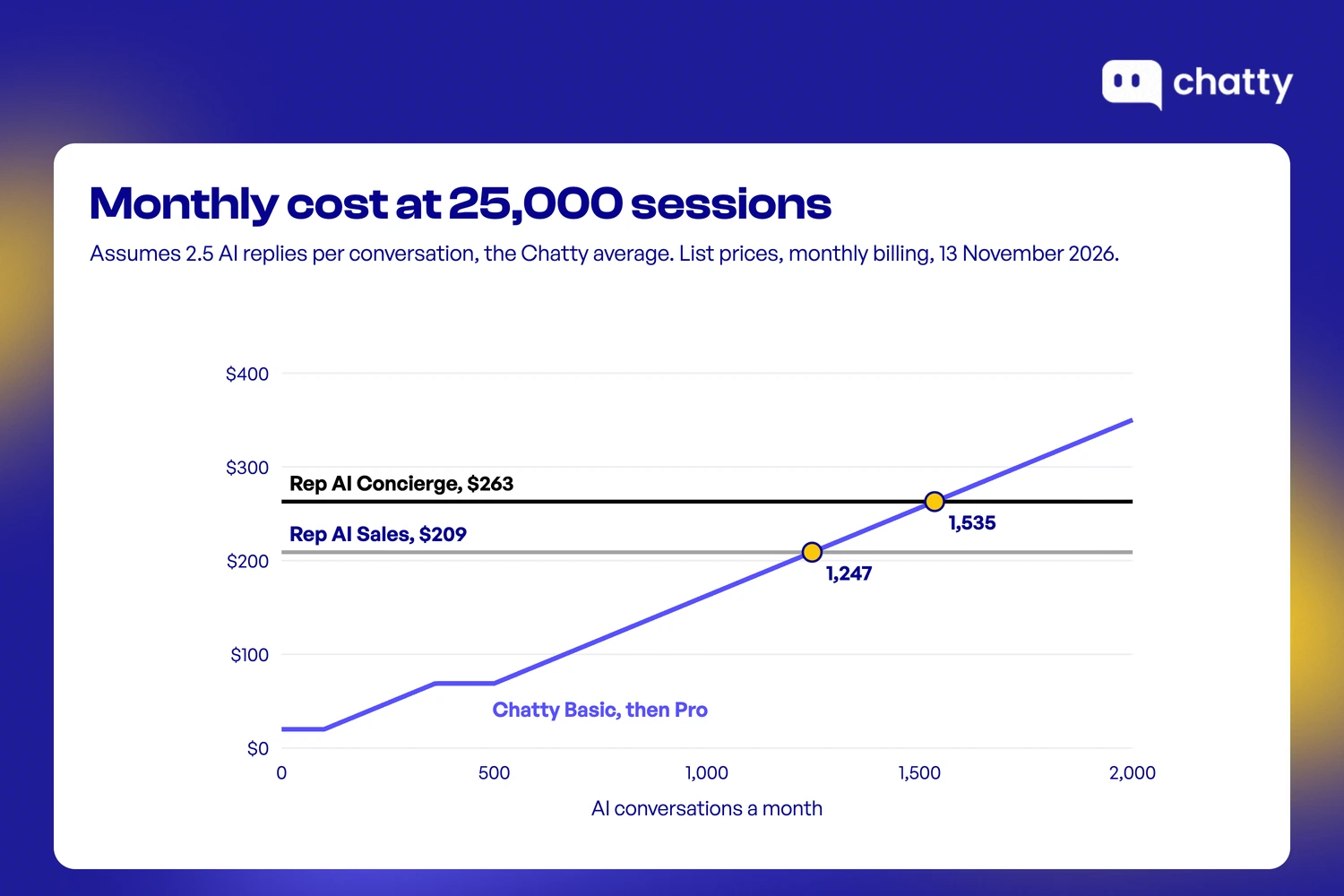 *At 25,000 sessions, Rep AI's lines stay flat while Chatty's cost climbs with each conversation.*
Copy this worksheet and fill it in with last month's numbers:
| Line | What to enter | Example (illustrative) |
|---|---|---|
| A. Sessions last month | From Shopify Analytics | 25,000 |
| B. AI conversations a month | From your current chat app, or the 14-day test below | 600 |
| C. Chat rate | B ÷ A | 2.4% |
| D. AI replies per conversation | Average of 10 transcripts, or 2.5 as a starting estimate | 2.5 |
| E. Chatty Pro cost | $68.99 + (B − 500) × D × $0.075, if B is above 500 | $87.74 |
| F. Rep AI cost | Tier price for A, plus $12 per 1,000 sessions over the tier | $209 Sales, $263 Concierge |
The example column is an illustrative skincare store, not a real merchant.
Now take November. Sessions jump to 40,000 and chats rise in step to 960, so Chatty Pro comes to $155.24. Rep AI Sales on the 25,000 tier adds 15 blocks of overage, or $180, for $389.
Moving to the 50,000 tier first would cost $368, and Rep AI's help center pitches annual plans as a way to absorb traffic swings.
Now flip it. At 1,500 AI conversations a month, a 6% chat rate, Chatty Pro would cost $256.49. Rep AI Sales would still be $209.
What to check in your own output: is your chat rate within about 1 point of the break-even? Then the meter won't decide this for you, and the next four sections will.
Proactive chat in Rep AI and Chatty: behavior signals or campaigns you set
Pricing tells you what a conversation costs. Proactive chat decides how many conversations you start, and the two apps start them very differently.
Rep AI predicts when a shopper is about to leave. Its AI Drop-off Detection watches dozens of behavioral signals, such as clicks, time on page, scroll depth and pauses between actions. When the prediction score reaches the threshold you set, the chat opens.
Rep AI's Sales Skills also target moments like a product page, a collection page or a cart view. This is Rep AI's strongest area.
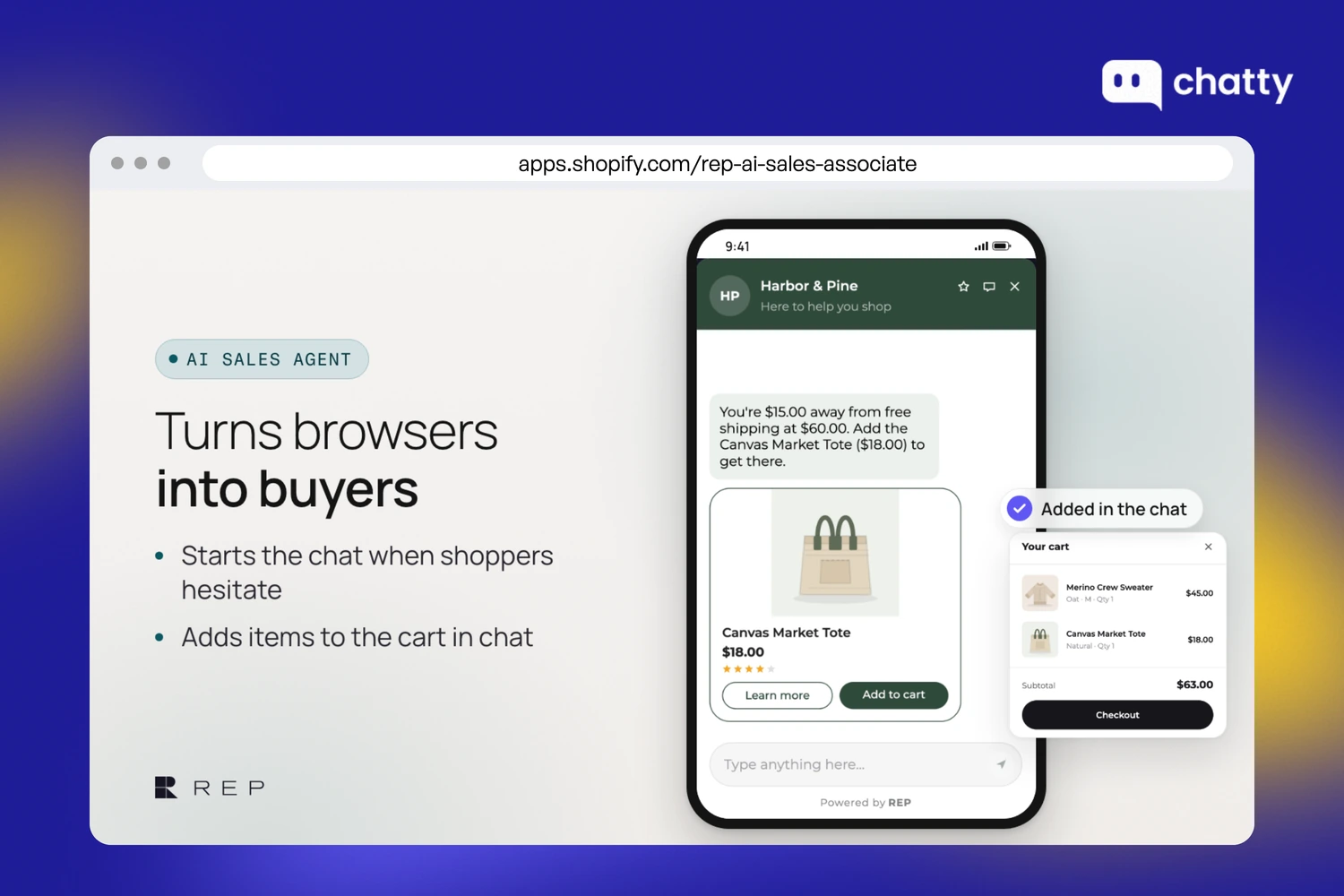 *Image via Rep AI's App Store listing. It's a marketing composite with a sample store, not a live widget.*
Chatty starts chats from campaigns you build. You pick a template, then set the page, the trigger (1 to 100 seconds on the page, or a scroll percentage) and the audience. Cart templates also take a minimum and maximum cart value.
Per Chatty's proactive chat guide, welcome, product page and newsletter templates work on every plan. Cart booster, View cart and Abandoned cart reminder need Pro or Plus.
Chatty doesn't predict drop-off. It fires where and when you tell it to.
Billing differs here too. A Rep AI proactive message costs nothing extra, because you already paid for the session. A Chatty proactive message only becomes an AI conversation when the shopper replies.
The decision: if you already know where shoppers stall, such as the size chart or the shipping cost at cart, campaign rules cover it. If you don't know, Rep AI's model looks for those moments for you, on every session you pay for.
Post-purchase support: Rep AI takes action, Chatty routes to your team
Proactive chat covers the sale. After the order is where Rep AI does the most work that Chatty doesn't.
Cancellations, returns and address changes
Rep AI's support skills act on the order. The Cancel Order skill verifies the shopper's email and order number, then cancels the order if your rules allow it. The default window is 2 hours after purchase.
The Returns/Exchanges skill checks the return window and sends eligible shoppers to your returns portal, with a direct Loop integration. Address changes have their own skill.
These skills come with the Support and Concierge plans, not Sales, so Concierge is the fair price to compare if you want them.
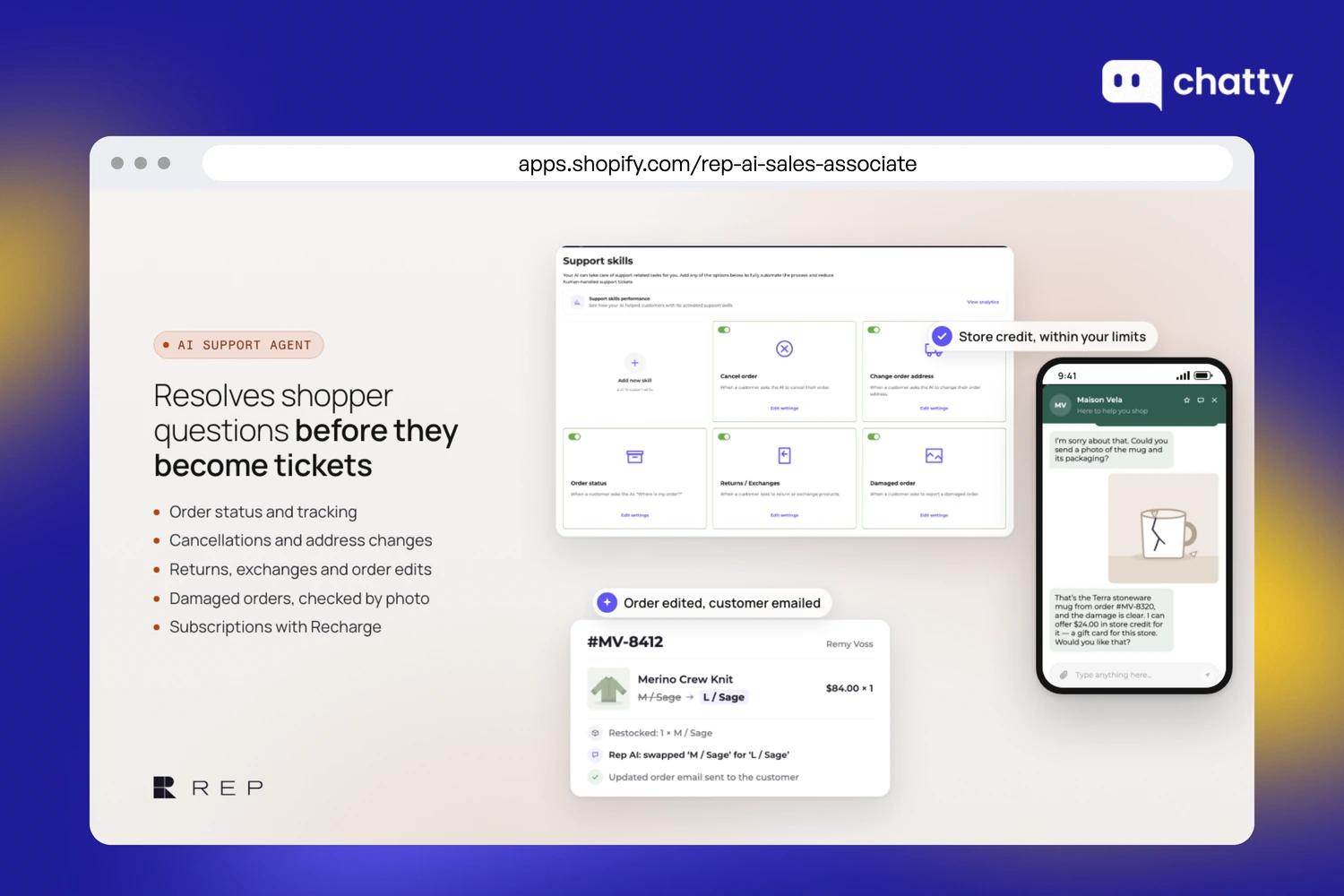 *Image via Rep AI's App Store listing.*
Chatty tracks orders on every paid plan, then routes the rest. Its after-sales support skill recognizes four request types: return and refund, cancel order, order issue and edit order. For each type, you choose one route:
- Transfer to email: a form collects the shopper's email, order number, the issue and an optional photo.
- Transfer to human: the chat moves to your team in the Chatty inbox.
- Send contact methods: the AI shows the contact options from your chatbox settings.
Chatty doesn't cancel, edit or refund orders itself. A person on your team does the final step, with the details already collected.
The decision: count last month's cancellation and address-change requests. If they take your team hours a week, Rep AI Concierge earns part of its price. If it's a handful, a clean form is enough.
Email, Instagram, Messenger and WhatsApp
Rep AI sells AI for email, Instagram, Messenger and WhatsApp as an add-on, at $0.75 per AI-resolved conversation or $0.50 on yearly billing. Past your bundle, each extra resolution costs $1.20, up to the shared $1,000 cap.
Chatty connects email, Instagram, Messenger and WhatsApp to one inbox for your team. If AI replies on social DMs are a core job for you, Rep AI builds and prices that as its own product.
Setting up Rep AI vs Chatty: who does the work at your traffic
Features only help once the AI knows your store. The two apps split setup work differently, and your session count decides which help you get.
Rep AI runs in its own console, outside Shopify admin, and trains on your site and catalog automatically. Its pricing page says stores up to 50,000 visits a month start on their own. Above that, plans come with an assigned customer success manager.
Rep AI's training loop is strong. Each reply shows its sources with a "Correct the AI" option, and Rep AI reads resolved helpdesk tickets overnight, turning them into drafts you approve.
Chatty syncs your products daily and learns from a knowledge base of Q&A, links, files and store pages. When your team replies in chat, Chatty suggests new knowledge for you to review.
The setup offer is the bigger difference. On any plan, Free included, you can click Set it up for me on the AI agent page. Then Chatty's team trains the AI, writes the instructions and hands it back ready to switch on.
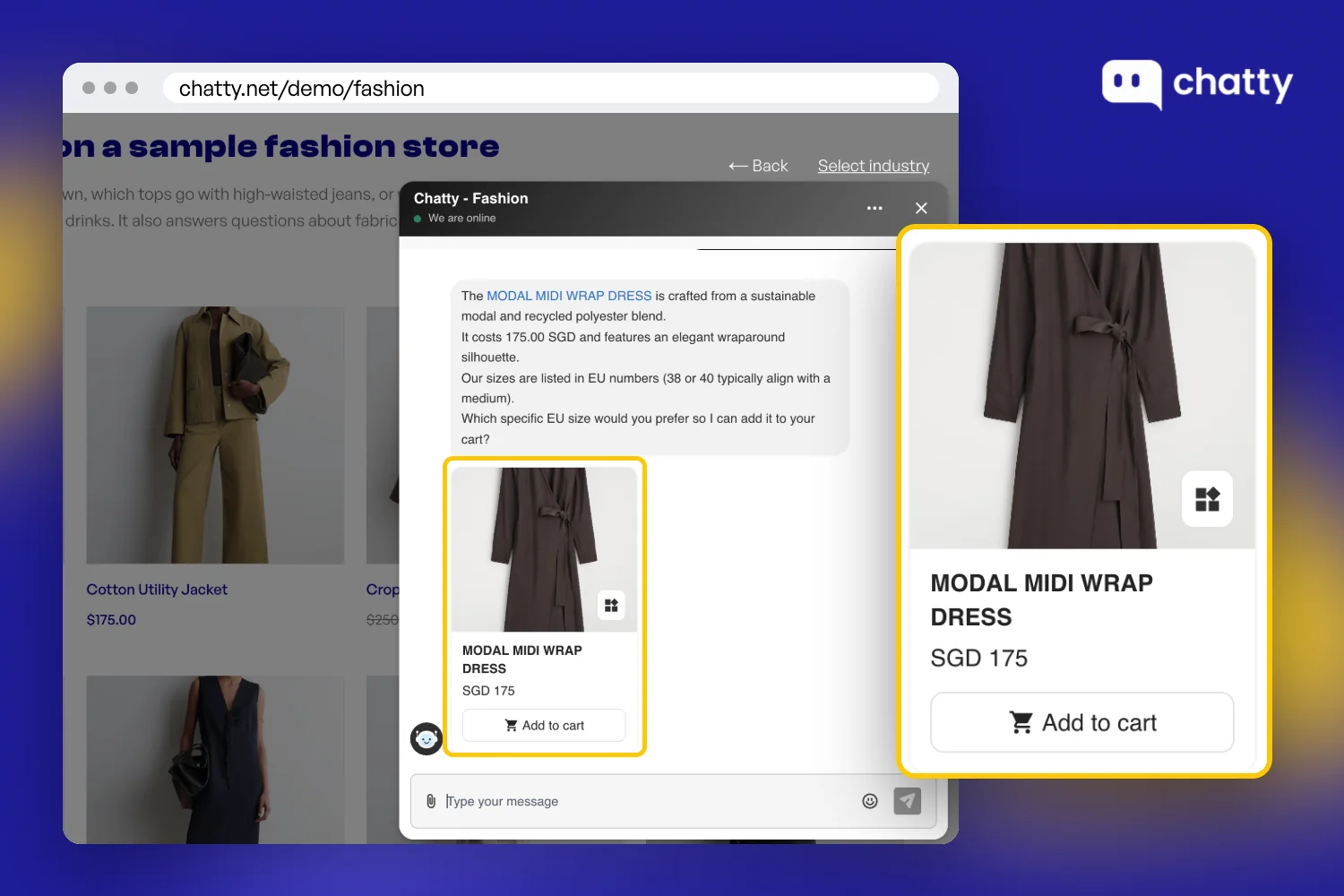 *Ask a product question on a Chatty demo store to see replies built from the synced catalog.*
Both apps show which source a reply came from and let you fix it on the spot. Neither one is a set-and-forget install.
The decision: if you want someone else to do the first setup and you're under 50,000 sessions, that's Chatty. If you're above it and want regular reviews with a named person, that's Rep AI.
Revenue tracking: how Rep AI and Chatty prove the sales they made
Once the AI is live, you'll want to know what it sold. The two apps answer that with different rules, so their totals aren't directly comparable.
Rep AI uses a strict attribution model. A sale counts only if the shopper bought in the same session as the chat. Rep AI then has its AI reread the conversation and drops the sale if the AI couldn't help or a person took over.
Sales Analytics then shows conversion rate with a lift against non-AI traffic, AI-generated sales as a share of store revenue, and AI-generated orders. For built-in reporting, Rep AI is ahead.
Chatty writes its attribution onto your Shopify orders as metafields:
- Chatty Assisted: the customer chatted with Chatty, or viewed your FAQs, within 7 days before the order.
- Chatty Direct: the order contains a product Chatty showed or mentioned in that chat.
You can pin both fields on the order page, filter orders by them and build customer segments, next to the rest of your sales data.
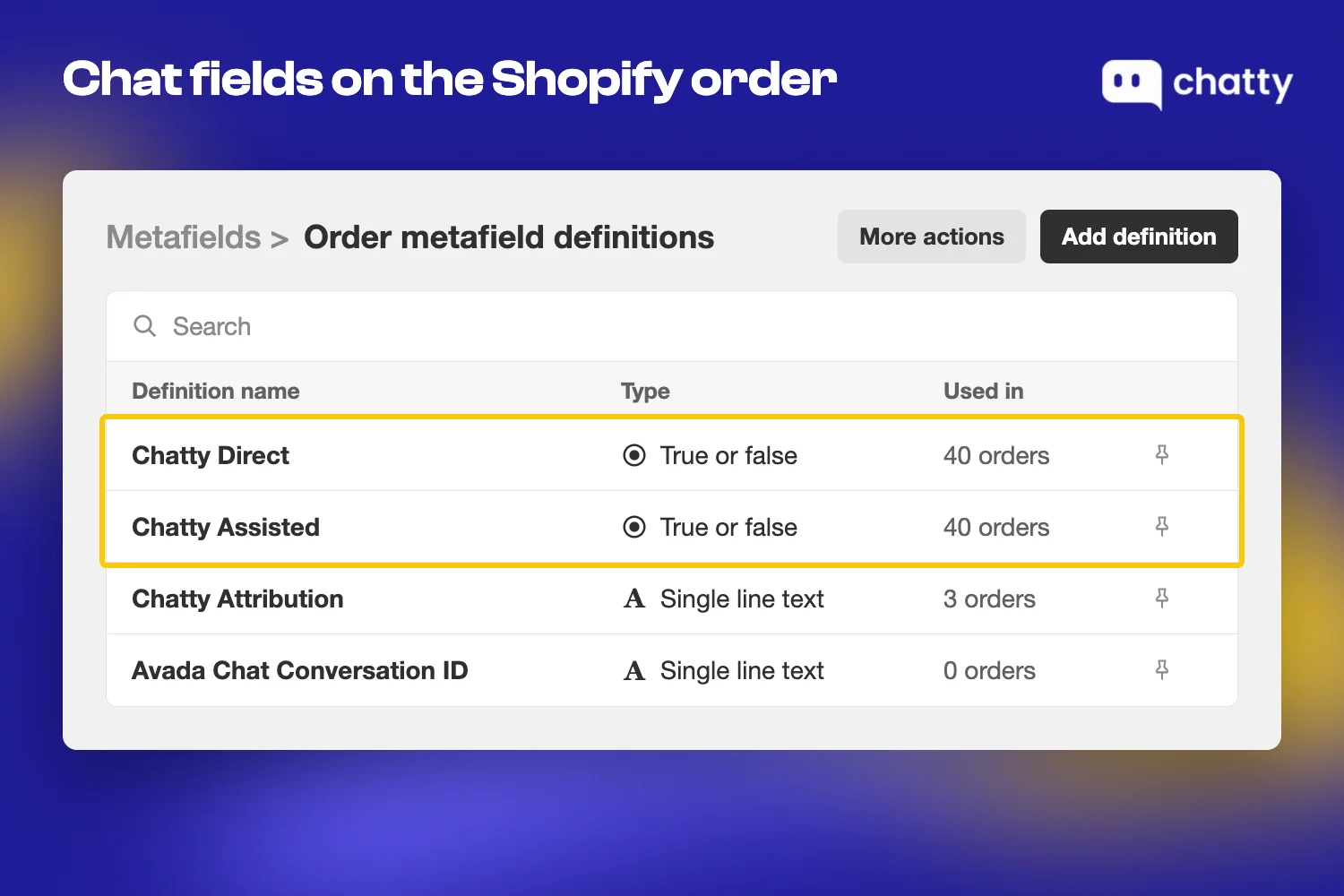 *Pin Chatty Assisted and Chatty Direct in Settings, then Metafields and metaobjects, then Orders.*
The catch: Chatty Assisted uses a 7-day window and counts FAQ views, so it will read higher than Rep AI's same-session figure. To compare the two fairly, set Chatty Direct against Rep AI's AI-generated orders. Neither figure proves the sale wouldn't have happened anyway, and our guide to orders that came from chat shows how to check that.
Chatty or Rep AI: which one fits your Shopify store
Each of the last five sections settled one axis. This section puts them back together into one verdict per app.
Chatty
Best for: Shopify stores with 5,000 to 50,000 sessions where most visitors browse without chatting. It suits teams that want the bill capped and setup done for them.
Skip it if: you need the AI to cancel or edit orders on its own, or you also sell outside Shopify. Skip it too if your chat rate already sits well above the break-even for your traffic.
Where it taps out: proactive chat fires on rules you write, not on predicted behavior. After-sales requests end with a person. Above 1,500 AI conversations a month you're into a custom plan, and if overage reaches your spending limit, the AI pauses until the next cycle.
Rep AI
Best for: stores with a high chat rate or steady traffic, where a flat price per session tier is easy to budget. It also fits a heavy cancellation and returns load.
Skip it if: your traffic is large but few shoppers chat, or it spikes in sale months. You pay for every session either way.
Where it taps out: order actions mean Concierge or Support pricing, not Sales. A traffic spike without approved overage switches the widget off until the next cycle. You work in a separate console with its own vocabulary of skills, product groups and policies.
If you're still between the two, match your situation to a row:
| If your store… | Pick | Why |
|---|---|---|
| Has a chat rate below the break-even in the pricing table | Chatty | You pay for the chats you get, not the sessions you don't |
| Has a chat rate well above the break-even | Rep AI | The flat session price absorbs the extra chats |
| Doubles traffic in sale months but not chats | Chatty | Rep AI's bill follows sessions, and overage or a tier jump follows |
| Spends hours a week on cancellations and address changes | Rep AI Concierge | Its support skills complete those steps without a person |
| Wants the vendor to set up the AI below 50,000 sessions | Chatty | Its setup service is free on every plan |
Test Chatty and Rep AI for 14 days before you commit
The tables run on your estimate of B, the AI conversations you'll get. Two weeks of real traffic replaces that estimate with a measured number.
Both trials fit. Rep AI gives 14 days with no credit card. Chatty has a Free plan plus a 7-day paid trial, with 300 bonus AI conversations on Pro.
Run one app at a time, because two chat bubbles on one store confuse shoppers and split your data.
| Days | What you do | What you record |
|---|---|---|
| Day 1 | Pull last month's sessions from Shopify Analytics. Note any promotion planned in the next two weeks | Line A of the worksheet |
| Days 1-7 | Install Chatty, start the Pro trial, add your top 20 questions, and turn on one product page and one cart campaign | AI conversations per day, AI replies in 10 sampled chats |
| Days 8-14 | Turn Chatty's chatbox off and drop it to Free if you won't keep Pro. Start Rep AI's trial and set up the same two moments | AI-handled conversations on Rep AI's Billing page |
| Day 14 | Compute each week's chat rate. Compare Chatty Direct orders with Rep AI's AI-generated orders | Your break-even check and your decision |
Measure two numbers and nothing else: your chat rate and the orders the AI touched. Rep AI's daily usage chart isn't available during the trial, so use the cycle summary on its Billing page.
Traffic swings week to week, so treat a small difference between the two weeks as a tie. A tie sends you back to the post-purchase and setup sections.
Chatty vs Rep AI: pick the meter that matches how your shoppers behave
Rep AI charges for every session and gives you its strongest proactive and post-purchase tools in return. Chatty charges for the conversations that happen and caps what overage can cost.
The chat-rate test decides which meter is cheaper. Your post-purchase workload decides whether Rep AI's Concierge is worth the difference.
This week, fill in lines A to F of the worksheet with last month's sessions. If you don't know B, run the 14-day test and let real chats fill it in.
If most of your traffic browses without chatting, Chatty is the cheaper meter to try first. Preview Chatty on your store, then start on the Free plan and check your chat rate before you pick a paid one.
Frequently asked questions
Rep AI does: its About page lists Shopify, Salesforce Commerce Cloud and WooCommerce, while Chatty is built for Shopify only. Running several Shopify stores? Chatty's Plus plan at $199 a month includes multi-store management, and Rep AI prices each store by its own sessions.
No, but you can start without a fixed fee. The Pay-as-you-Grow plan is free to install and charges $12 per 1,000 sessions with sales skills only, so 5,000 sessions cost $60 a month. At 10,000 sessions it's $120, against $104 for the Sales tier.
Mainly the order actions and predicted drop-off triggers. Cancellations and address changes go to a form or your team, and you rebuild your proactive moments as campaigns with page and cart rules.
Our list of Rep AI alternatives covers what to check before you move.
Yes, on both. Rep AI's listing shows yearly savings of 19% to 26% depending on the plan, though usage charges like extra sessions aren't discounted. Chatty's yearly plans save 14% to 15%, so Pro works out to about $58.99 a month, billed as $707.88 a year.
Check your chat rate first, because a yearly plan locks in the meter.
Chatty. Its App Store listing carries the Built for Shopify badge, and Rep AI's listing doesn't at the time of writing. Shopify awards it for meeting its Built for Shopify standards on performance, design and integration, not for AI quality.