










Personalization works best when you know a shopper. BFCM hands you the one weekend when you don't. Traffic on Black Friday and Cyber Monday spikes hard in a two-day window, and most of the people arriving in that window have never seen your store before.
That's the paradox worth naming before you plan anything else this season: the moment your store most needs to feel personal is the same moment you have the least history to personalize with.
The usual playbook doesn't help here. Segments, loyalty tiers, and past-purchase recommendations all assume a shopper who has visited before, and a huge share of BFCM traffic hasn't.
The fix here is to change what you personalize around. Instead of who this shopper is, read what they're doing right now, in the session that's already happening. This article walks through why the old model breaks during BFCM, what session signals work in its place, and where the honest limits of that approach sit.
Why BFCM Breaks Profile-Based Personalization
Most personalization tools are built on an assumption that quietly falls apart during BFCM: that a shopper's history is worth learning from. That holds up fine in October. A returning customer has browsed before, maybe bought before, and left behind data a recommendation engine can use.
Profile-based personalization needs exactly that kind of trail: multiple sessions, or at least one long enough to build a read on what someone wants. So what happens when a store gets a weekend's worth of shoppers who have none of that?
BFCM doesn't give a system that runway. Chatty's internal data across 2,000+ active Shopify stores shows conversation volume jumping 44% on Black Friday itself, from a baseline of roughly 78,000 conversations a day to 112,641.
Cyber Monday hits a nearly identical peak of 106,140, then drops back toward baseline within two days. That shape matters more than the raw numbers. There's no gradual ramp across November here, just two days of concentrated pressure bracketed by ordinary traffic on either side.
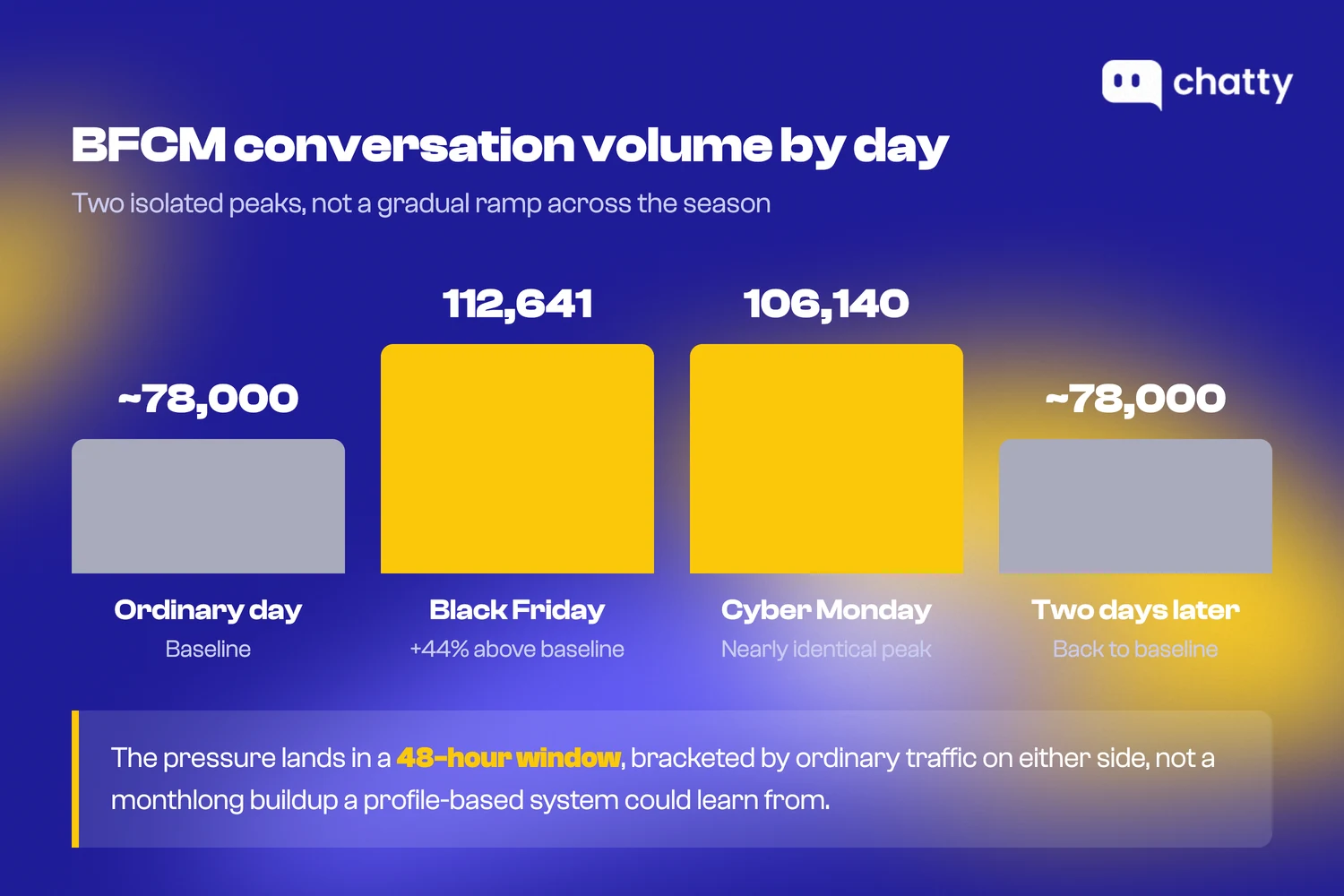
A traffic pattern shaped like that carries an obvious implication, even without a precise count: a large share of the people generating that spike are showing up cold. Regular shoppers are already spread across the rest of the year, so the surge that lands in a 48-hour window looks like people responding to a sale they heard about elsewhere, or checking out a store for the first time. That leaves the usual tooling with nothing to work from:
- Recommendation engines trained on past purchases have nothing to recommend.
- Segments built from loyalty tier have no one to place.
None of this means personalization should be shelved for the weekend, only that the input has to change. If a store can't wait for history to accumulate, it has to work with what's available immediately: what a shopper does in the session already underway.
That shift, from betting on who someone is to reading what they're doing right now, is the mechanism the rest of this article is built around. It also connects to a broader shift in how BFCM customer journeys need to work under this kind of traffic. The comparison between a traditional and an AI-assisted BFCM journey lays out that fuller picture end to end.
The traffic doesn't ramp, it spikes. Black Friday and Cyber Monday each pull conversation volume roughly 44% above baseline, then fall back within two days, so preparation has to concentrate on those two days rather than spread across the month.
Profile-based tools need time this weekend doesn't give. A store can't measure the exact share of first-time visitors in that spike, but recommendation engines and segments built on purchase history have nothing to work with when a shopper's entire relationship with a store is the current tab.
How to Personalize the BFCM Shopping Experience Using Session Signals
If a shopper's history isn't available, the next best input is whatever they're revealing right now. Call it session-signal personalization: instead of relying on data collected across past visits, the store reads signals generated inside the current session and responds before the shopper leaves. It doesn't require a login, a returning cookie, or a purchase history, only attention to what's already happening on the page and in the conversation.
This doesn't replace profile-based personalization, it's a different tool for a different situation. A returning customer with a real purchase history is still better served by a system that remembers what they bought last time. A first-time visitor mid-spike doesn't have that option, and session signals are what's left to work with instead.
| Profile-based personalization | Session-signal personalization | |
|---|---|---|
| Data it needs | Purchase history, account, or multiple past sessions | Whatever the shopper does in this session: page viewed, question asked, market accessed from |
| Time to become useful | Builds up over days, sessions, or purchases | Useful from the first message or page view |
| Best fit | Returning shoppers with an existing relationship to the store | First-time or anonymous shoppers, high-traffic windows like BFCM |
| Fails when | Shopper has no account or history | Doesn't try to predict long-term preference from a single short visit |
This is a narrower kind of personalization than the behavioral, declared, and transactional data model most personalization guides describe, and it's meant to be. The guide to personalized customer experience covers how those data types work together over a longer relationship; this article is about the case where none of that accumulated data exists yet.
Three signals are available inside a single BFCM session, each mapping to a different moment in the shopper's path:
- What they're looking at right now, which drives product discovery.
- What they just asked, which is often a sizing or fit question.
- Where they're browsing from, which decides the price and link they should see.
What They're Viewing Right Now: Personalizing Product Discovery
The first signal doesn't require a shopper to say anything. It's the product page they're already on. When someone lands on a specific product during a BFCM sale and opens the chat, the most useful thing an AI assistant can do isn't to ask a discovery question like "what are you shopping for today." It's to look at the page the shopper is already on and respond to it directly.
A generic recommendation widget can't do that without a login or a return visit to learn from. Chatty's proactive chat solves it differently, with two mechanisms that both run off the current session:
- Similar-product recommendations from the page itself. Suggestions are pulled from the same collection as the product the shopper is viewing. This is a Pro-plan capability, and it works without a prior visit, because the recommendation comes from the session that's happening, not a purchase history that doesn't exist for a first-time visitor. A shopper looking at a pair of boots during a Black Friday sale can get a same-collection recommendation in the first reply, without creating an account.
- Auto-generated follow-up questions. Chatty produces three to four clickable follow-up buttons after each product-related response, built from the gap between what the shopper has already asked and what they haven't yet.
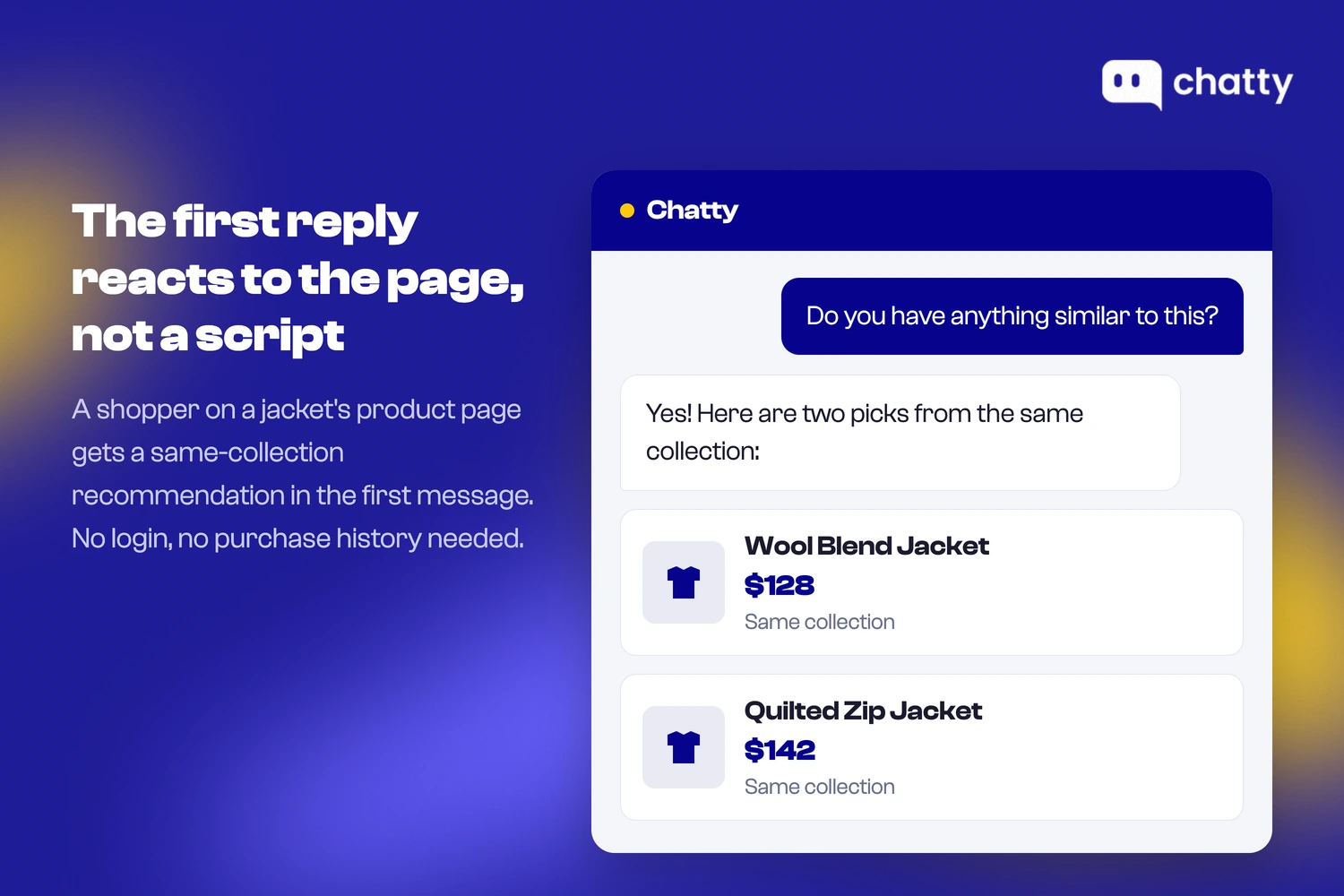
Those buttons matter more during BFCM than they would in a quiet week. A first-time shopper doesn't have the patience to type out exactly what they want, and a follow-up-question flow keeps them moving forward with one click instead.
Neither mechanism depends on knowing who the shopper is, only what page they're on and what they've asked so far, the kind of signal still available when purchase history is not. It's the same underlying idea behind reducing cart abandonment during Black Friday: a shopper who gets a relevant answer in the first exchange is less likely to open five tabs and abandon all of them, and that first message matters more than usual because a first-time visitor clicked an ad rather than a habit, with competing tabs open right next to this one.
The general breakdown of how AI product recommendation works covers this mechanism outside BFCM too, and the Chatty pricing page has the plan details for the similar-products feature.
The first reply should react to the page, not ask a question. A shopper already looking at a product doesn't need to be asked what they want; the page itself is the signal.
Follow-up buttons replace typing with clicking. A first-time visitor with no patience for a long conversation still gets to explore, one tap at a time, without describing their own preferences.
The Question They Just Asked: Personalizing Sizing and Fit
The second session signal is the question a shopper types, and nowhere does getting that answer right matter more than sizing. A wrong-size guess made during a BFCM sale doesn't just cost a sale, it creates a return weeks later, while the merchant is still working through the rest of the holiday order backlog.
This matters more for some merchants than others, and the data points at exactly which ones. Fashion & accessories and health & beauty together account for 50.9% of all BFCM conversations across Chatty's merchant base, according to Chatty's internal BFCM Shopper Behavior data. Both categories are also notoriously prone to returns, because fit and shade are hard to judge from a product photo. If a merchant sells in either category, sizing questions aren't a minor detail buried in the FAQ. They're a majority-share slice of the entire BFCM conversation volume.
Chatty's size guide recommendation uses AI to answer a shopper's sizing question directly inside the conversation, without an account or a past order to reference. Either phrasing works:
- "I'm 5'6" and 130 lbs, what size should I get?" The answer is built from the size guide the merchant set up for that product.
- "How does this fit compared to my usual size?" Same input, same source, no generic size chart link the shopper has to find and interpret themselves.
That's a session signal in the purest sense: the question itself is the only input needed.
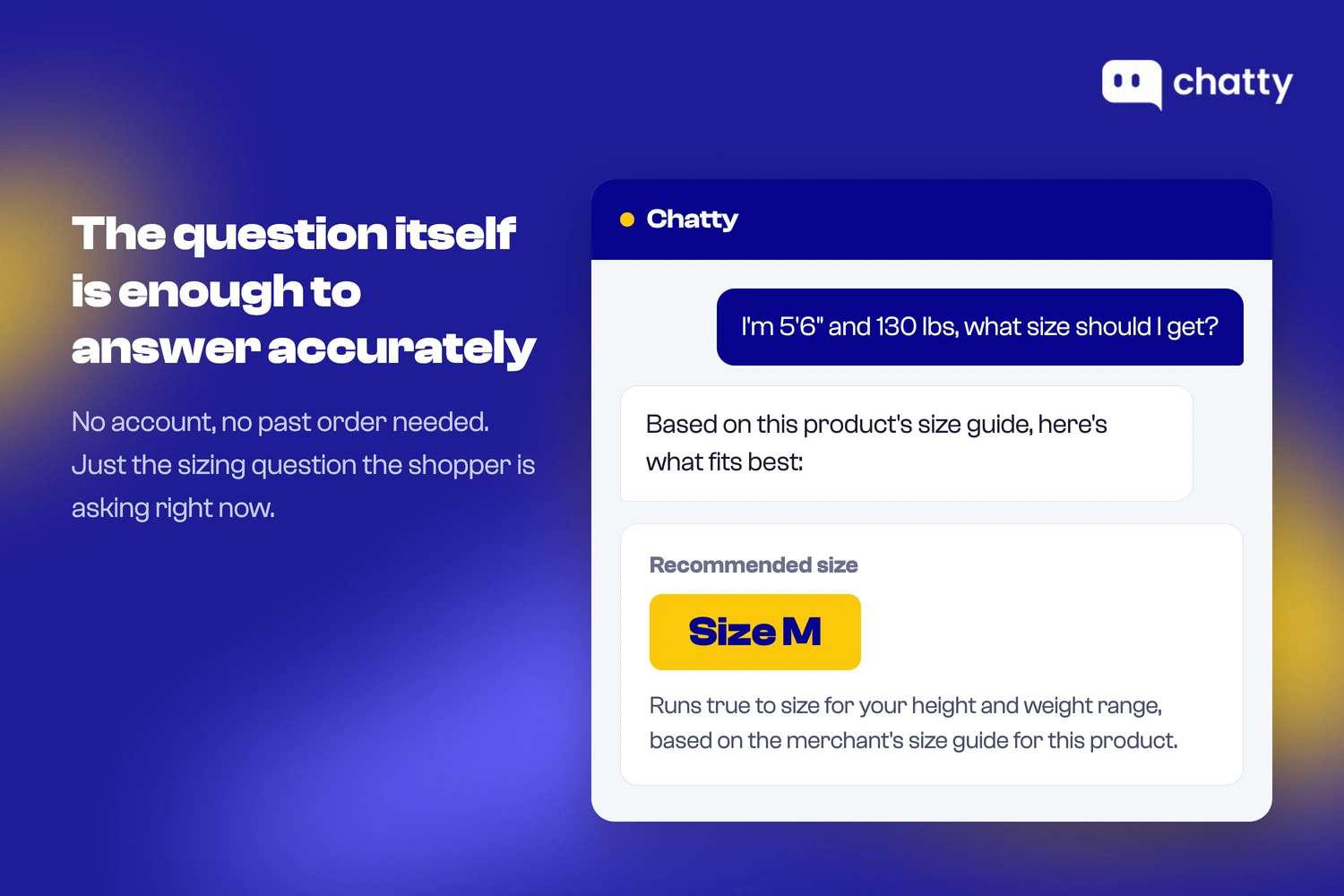
It's easy to treat sizing as only a conversion lever, but the bigger payoff for a merchant in fashion or beauty shows up after BFCM ends, in the return queue. A customer who gets confident, specific sizing guidance before checkout is less likely to mail something back three weeks later, and getting it right at the point of purchase is a cheaper fix than handling the return afterward; the guide to managing and reducing BFCM returns goes deeper into that downstream side. None of this requires knowing whether the shopper has bought from the store before, only answering the question they asked.
Sizing questions are a session signal, not a history problem. The shopper's own question, asked in the moment, is enough input for an accurate answer, even with no past order to check against.
Fashion and beauty carry the highest stakes here. Those two categories make up more than half of BFCM conversations in Chatty's data, and they're also the categories most exposed to size-related returns.
Where They're Shopping From: Personalizing Price and Language
The third signal is the quietest one, and it's less about adding something new than about not getting something wrong. When a store sells across multiple markets, each with its own domain or locale, the risk during a high-traffic weekend is that a shopper sees a price or a product link that doesn't match where they're actually shopping from.
That mismatch is what Chatty's product recommendations are built to avoid, in two ways:
- Domain and locale stay in sync. When the AI suggests a product inside a conversation, it points to the version listed on the domain the shopper is currently visiting, not a default that might belong to a different market. For a merchant running separate storefronts by region, this closes a gap that's easy to miss until a shopper is confused mid-checkout.
- Multi-price products default to the lowest variant. A shopper isn't steered toward the most expensive option by chance.
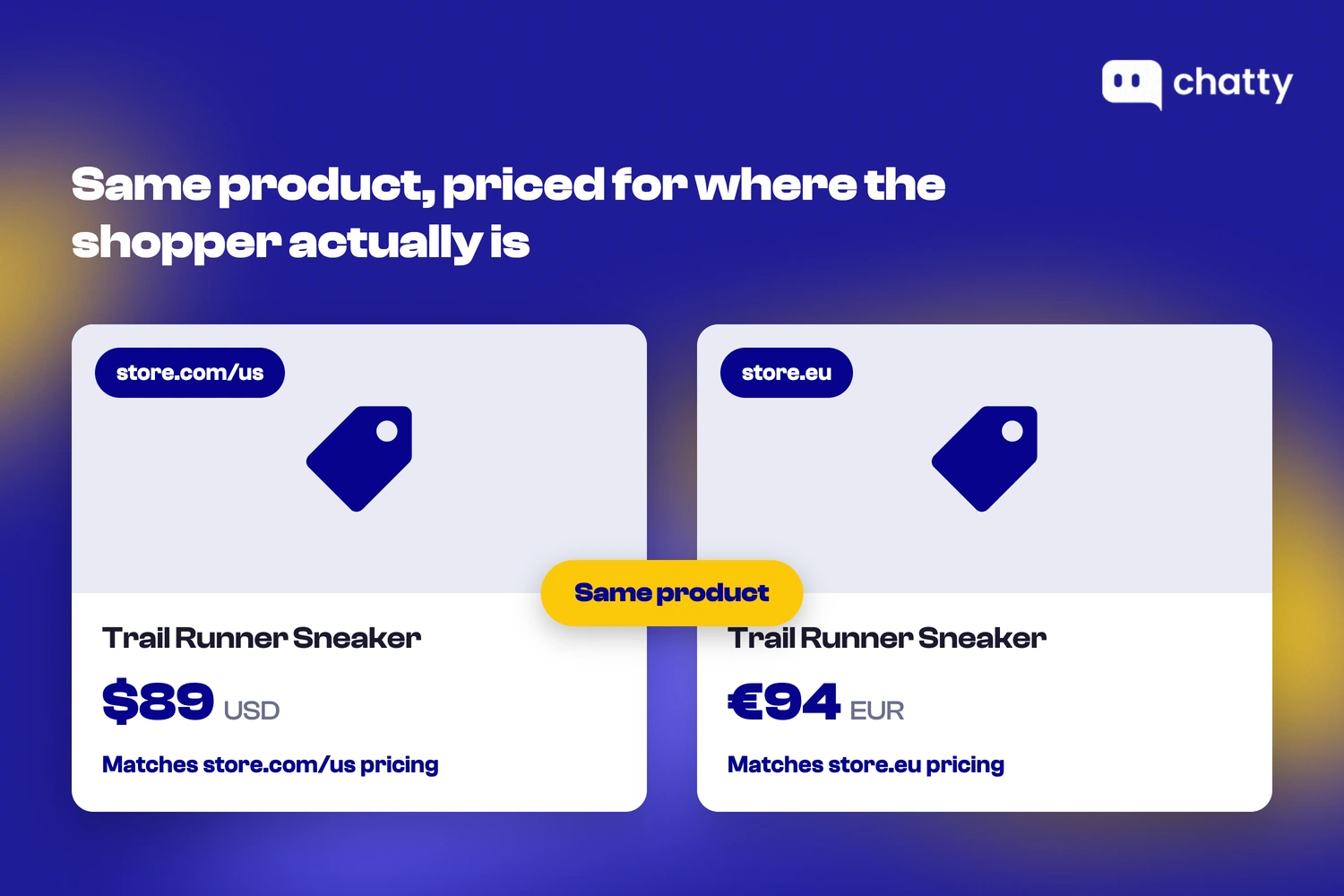
This is personalization in a narrower, quieter sense than the first two signals: it doesn't predict what a shopper wants, it just makes sure they don't see something technically wrong for where they are. Getting it wrong is worse than not personalizing at all.
A shopper who sees a price that doesn't match their market reads that as a store that doesn't have its pricing straight, and on the two days a year when traffic is highest and trust is most fragile, that's an expensive impression to leave. The shopper never sees this working; it just shows up as a store that feels coherent. The broader case for automating that kind of consistency during BFCM is covered in the piece on getting customer support ready for BFCM.
Getting the domain right prevents a trust problem, not just a UX one. A shopper who sees the wrong market's price or link reads it as the store's inventory being disorganized, which costs more trust than a generic recommendation would.
What Not to Personalize When You Don't Know the Shopper Yet
Everything so far describes what session-signal personalization can do. It's worth being just as clear about what it can't, because the honest limits here matter more during BFCM than the rest of the year, when the temptation to oversell "AI-powered personalization" is highest.
Three boundaries are worth stating plainly:
- It isn't an upgrade on profile-based personalization. Session signals are for the specific case where a store has no other option: a shopper with no history, in one short session, during a window where waiting for more data isn't realistic. When a shopper does have a real purchase history, that history is still the better input.
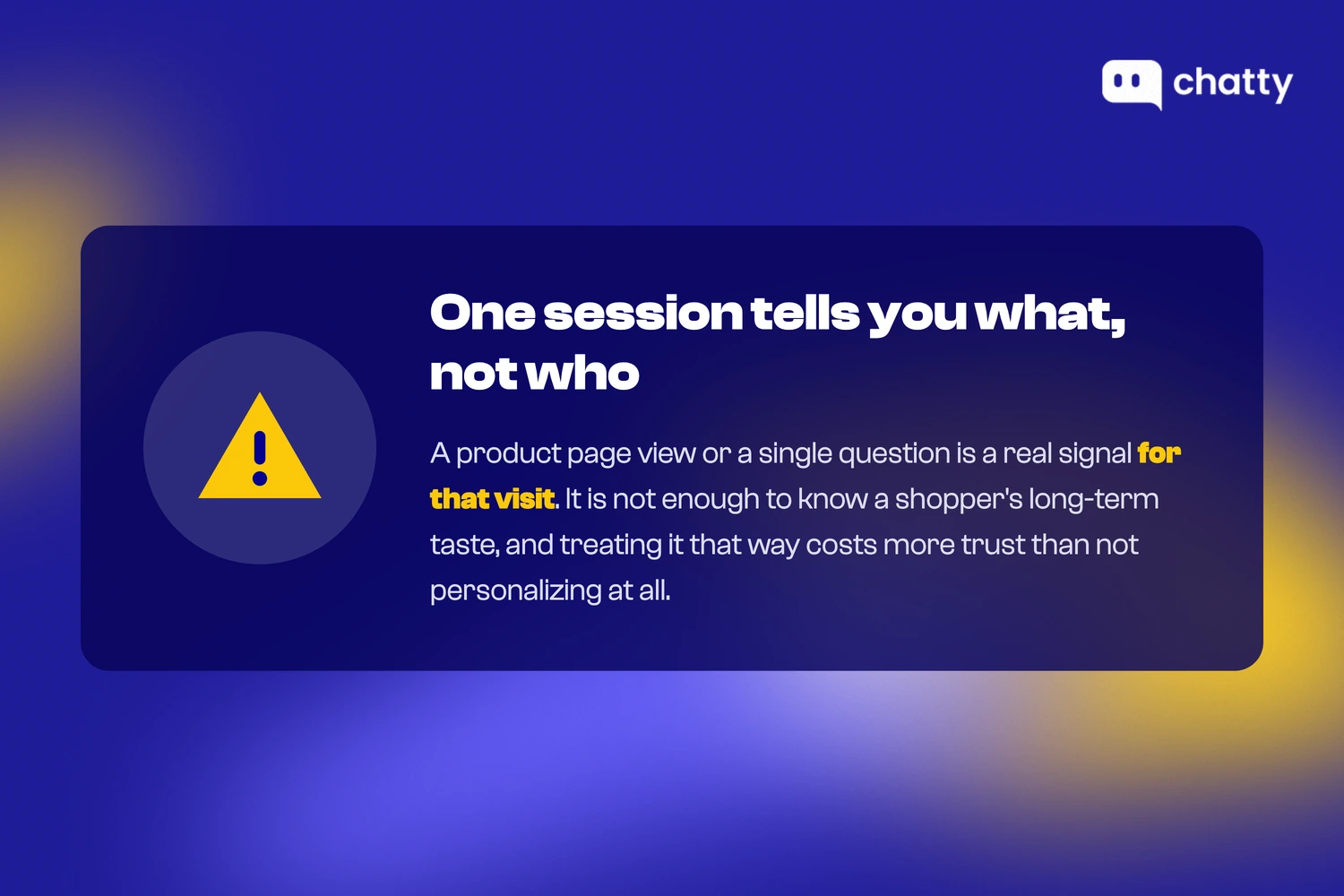
- One visit isn't a personality. Knowing someone is looking at running shoes right now is a useful signal for that moment. It isn't evidence they're "a running shoes person" to re-target with running gear for six months, and a shopper who feels a store is assuming too much from one visit tends to trust it less, not more.
- Chatty doesn't claim more than this. It does not predict long-term preferences from third-party data, and it does not track a shopper across sessions to build a profile if that shopper has never interacted with the store before. It reads the signals present in the session that's actually happening.
The piece on what personalized customer service actually means covers that broader boundary in more detail. That's not a limitation to apologize for; it's the difference between a system useful in the moment it operates and one that overpromises what a single short visit can tell you about a person. On the two highest-traffic days of the year, that honest boundary is worth more than a flashier claim.
Session signals describe a moment, not a person. What someone looks at in one visit is a real signal for that visit; it isn't evidence of a lasting preference worth acting on later.
Don't retire profile-based personalization for shoppers who've earned it. A returning customer with real history should still get personalization built on that history; session signals are for the shoppers who don't have one yet.
Put Session-Signal Personalization Into Your BFCM Checklist
The shift this article has argued for is narrow but specific: when a shopper arrives with no history, which is most of who arrives during the Black Friday and Cyber Monday spike, personalization has to come from what's happening in that session instead of what's known about that person.
Three signals carry that weight:
- The product page they're already viewing. Drive a same-collection recommendation in the first reply, before the shopper has to describe what they want.
- The question they just typed. A sizing question especially is enough input for an accurate answer, with no account history behind it.
- The domain or market they're browsing from. Let it quietly determine the price and the product link they see, so nothing looks like it belongs to the wrong store.
None of this needs a login or weeks of accumulated behavior, only attention to the session already in progress and a response before the shopper closes the tab.
If you're mapping this against everything else that needs to be in place before Black Friday, the BFCM readiness playbook is built to score a store across the full checklist, not just personalization. And if this is one piece of a bigger CX picture you're still assembling for this BFCM, the complete guide to improving CX for BFCM 2026 is the pillar page that ties the rest of it together.
Frequently asked questions
Yes. Session-signal personalization works from what a shopper does in the current visit (the product they're viewing, the question they ask, the market they're browsing from) rather than from a purchase or account history. It doesn't need a returning shopper to function; it's built for the first-time visitor specifically.
Profile-based personalization uses data collected across past visits or purchases, which takes time to build up. Session-signal personalization uses whatever's happening in the current session alone, useful from the first message, but it doesn't carry information forward the way a real profile does.
No. Session signals like the page a shopper is viewing, the question they type, or the domain they're accessing don't require a login. That's what makes them usable for anonymous, first-time visitors, who make up a large share of BFCM traffic.
It answers the specific question the shopper asks in the moment, using the size guide set up for that product, rather than relying on a history of what they've ordered before. The input is the current question, not a past record.
No. A session signal like a product page view or a typed question is available immediately, so a response can be generated in the first exchange. Pre-built segments take longer to become useful, since they depend on data that accumulates over multiple visits, which a first-time BFCM shopper hasn't had time to generate.