










Returns don't arrive evenly across the year, and they don't arrive all at once either. The questions start during the sale week itself. The parcels pile in roughly 2-3 weeks after BFCM, once delivery plus a decision has run its course, right as the team that would normally handle them is running on the least capacity it has all year. Processing volume then peaks in January.
Nearly a fifth of everything sold online gets sent back (19.3%, according to NRF and Happy Returns' 2025 Retail Returns Landscape report), and for holiday purchases specifically, retailers expect that figure to hit 17% this season. That's not a rounding error. On real revenue, it's the difference between a profitable BFCM and one that looks good on the sales dashboard and bad on the margin line three weeks later.
This is not a "how to write a better return policy" article. Policy matters, but it is one lever among several, and treating it as the whole answer leaves the volume and cost problem untouched. This article covers the part most "reduce returns" content skips: the timing itself is what makes post-BFCM returns so expensive, not just the policy.
- Returns follow a predictable calendar
The questions start during the sale week itself, the parcels land 2-3 weeks after it, and processing peaks in January, all while team capacity sits at its lowest point of the year.
- The scale is real
NRF and Happy Returns put online returns at 19.3% of sales and holiday returns at 17%, according to their 2025 Retail Returns Landscape report (checked 2026-09-10).
- Three forces land in the same window
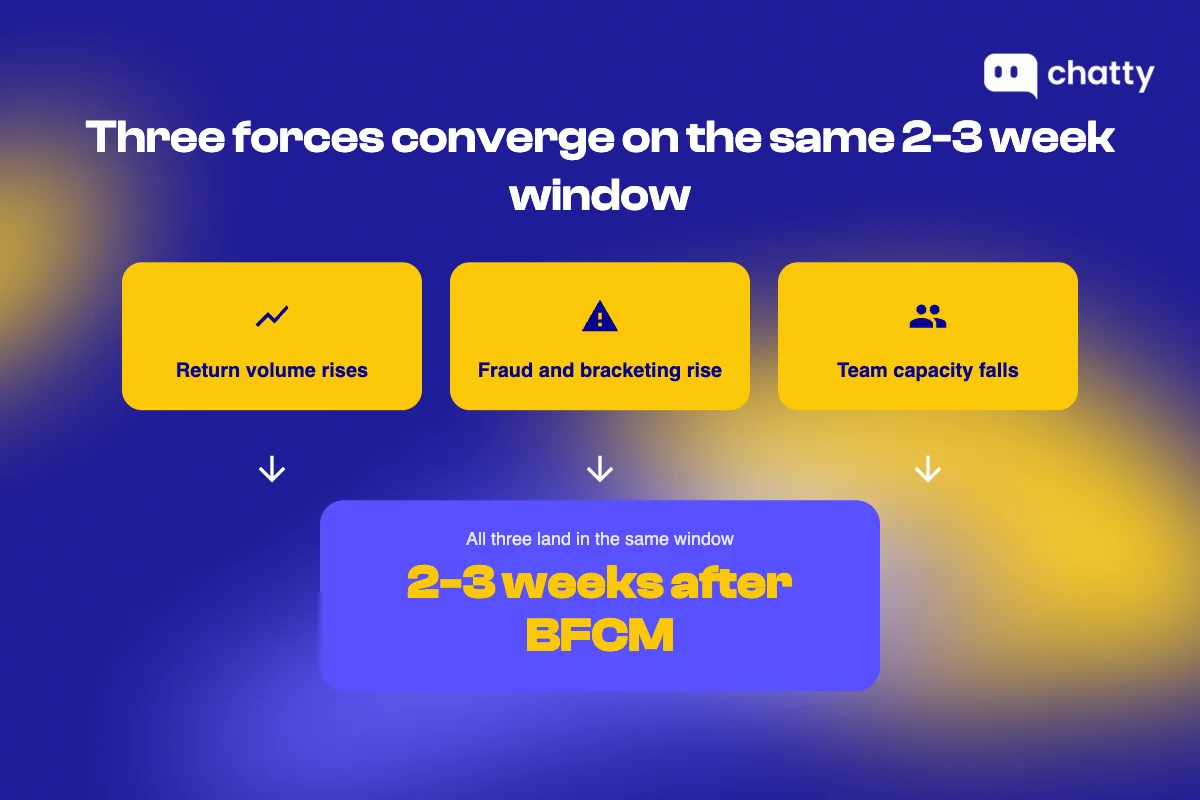
Rising return volume, rising fraud and bracketing pressure, and falling team capacity all converge in the same 2-3 weeks, which is why fixing only one of them barely moves the cost.
- Cutting return volume works best before the item ships back, not after it lands in the warehouse
Sizing accuracy, bracketing-aware routing, and pre-purchase fit questions all reduce the number of returns that happen at all.
- The team capacity gap is a staffing-timeline problem
Seasonal staff usually leave right after Cyber Monday, before the return spike even arrives.
Why BFCM returns hit differently, and why reducing them starts with timing
Returns exist year-round. What makes BFCM returns different is arithmetic: an order placed on Black Friday takes days to arrive, then the shopper takes days to decide, so the parcels come back in a band roughly 2-3 weeks after the sale. Three separate pressures land inside that band, right after the team that would normally absorb them has already been stretched thin.
- Volume. NRF and Happy Returns put real numbers on it in their 2025 Retail Returns Landscape report (checked 2026-09-10): an estimated 19.3% of online sales get returned across the year, and for the holiday season specifically, retailers expect 17% of sales to come back. Whichever number applies to your store, it is large enough that a merchant who only starts thinking about returns capacity once boxes start arriving is already behind.
- Fraud and bracketing. The same NRF report found that 9% of all returns are fraudulent. Bracketing, ordering multiple sizes or colors with the intent to return some of them, adds volume on top of that: 51% of Gen Z shoppers admit to bracketing, compared to 24% of Baby Boomers. The report describes the practice as surging as younger shoppers gain more buying power. This is not new behavior. It is existing behavior concentrated into the same few weeks as everything else.
- Capacity. This is the pressure most "reduce returns" advice leaves out entirely. Chatty's internal BFCM data shows positive ratings dropping from 77.2% the week before BFCM to 66.3% during BFCM week itself, measured market-wide across more than 2,000 stores. What caused that drop is not established, so read it as a pattern that shows up in the same week volume peaks, not as a verdict on any one store or tool. Post-purchase conversations (returns, refunds, exchanges, and related questions) made up 11.8% of classified conversations during the 8-day BFCM peak (November 24 to December 1, 2025), the third-largest share behind order and account questions (26.1%) and product recommendations (19.3%). That workload lands exactly when the team answering it is already stretched.
None of these three forces is dangerous by itself. A normal volume spike is manageable with normal staffing. A predictable fraud rate is manageable with a normal review process. A capacity dip recovers on its own once BFCM week ends.
What makes the post-BFCM period expensive is that all three land in the same 2-3 weeks, exactly when a store has the least slack to absorb any one of them, let alone all three at once. That is why reducing BFCM returns has to start with the calendar mismatch, not the policy. Fix the timing first, and the fixes below actually have somewhere to land.
This is the article that a broader BFCM customer experience guide would point to for this exact window, the part most high-level playbooks skip past.
How to manage and reduce BFCM returns: 5 fixes that target each pressure point
The three forces above (volume, fraud, capacity) don't get fixed by one tactic. Each needs its own fix, aimed at the point where it's cheapest to catch.
1. Set your return deadline and policy before BFCM starts, not after
The holiday return deadline, often extended into mid or late January to cover early holiday shoppers, needs to be locked and published before BFCM starts. Deciding it reactively, after returns are already arriving, is the most common version of this mistake, and it's an expensive one.
A vague deadline creates more work in both directions:
- Shoppers who are not sure how much time they have return items early "just in case," inflating volume that would not have existed with a clear date.
- Shoppers who misread a rolling "30 days from purchase" window, which turns ambiguous the moment purchase dates span several weeks of a sale, return late and dispute the outcome.
Both failure modes are avoidable with the same fix: pick a specific date and say it clearly, everywhere a shopper might look.
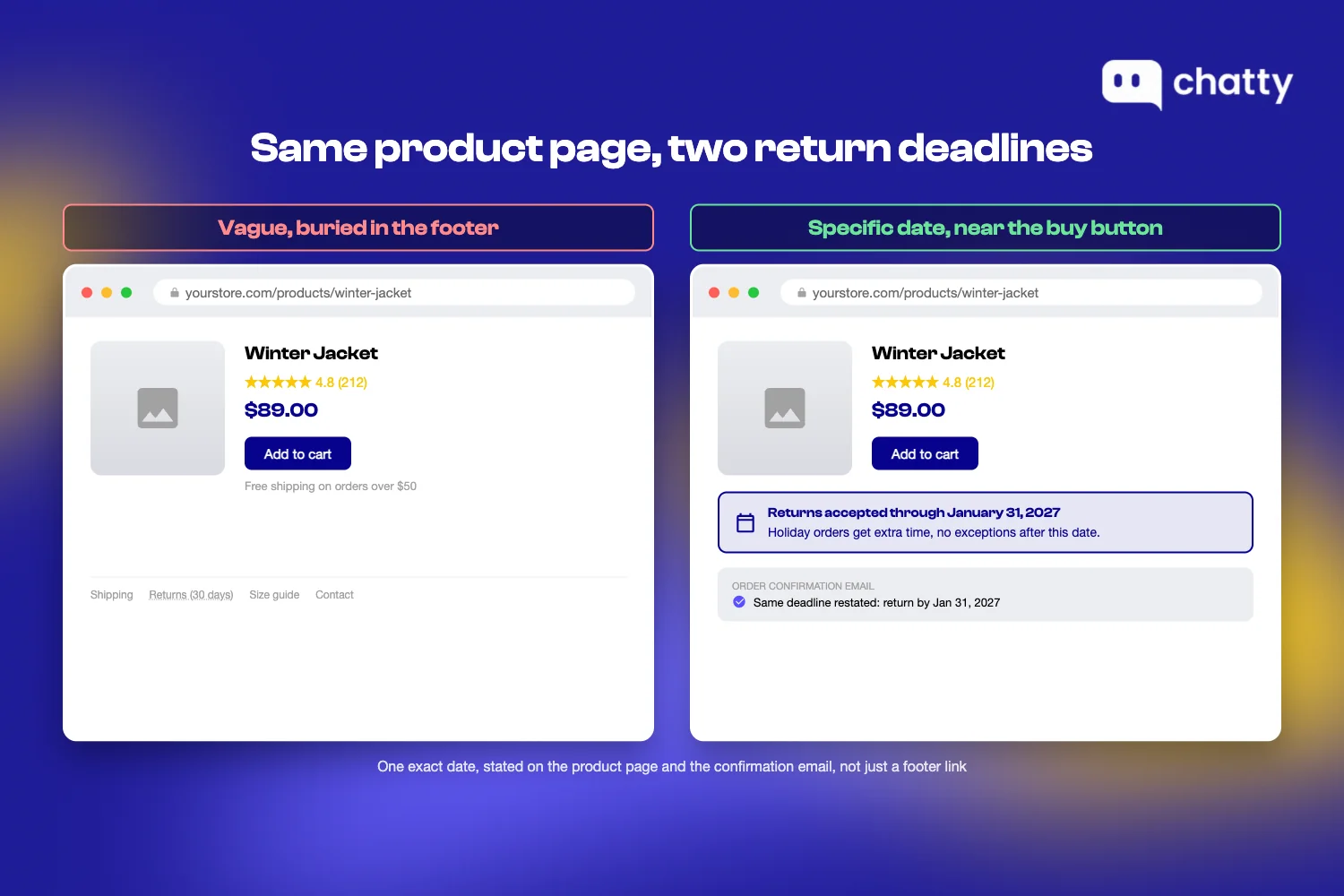
- Publish the deadline as an actual date ("returns accepted through January 31, 2027"), not a rolling day count that turns ambiguous once purchase dates span weeks of BFCM promotions.
- Put that date on the product page and in the order confirmation email, not only in a footer policy page a shopper has to go looking for.
- Keep exactly one version of the answer synced across your AI assistant, your policy page, and your human agents, so two different answers aren't circulating during the highest-volume weeks of the year.
- If you haven't rewritten the policy copy itself yet, keep that language under 100 words and easy to scan; this fix is about the date getting locked and distributed before BFCM opens, not rewritten after returns are already piling up.
2. Cut return volume before the item ships back, not after
Processing returns faster once they've already landed in the warehouse helps with cost, but it doesn't touch volume. Real volume reduction happens earlier, in the decisions a shopper makes before they ever click "buy."
Fix sizing and expectation mismatch, the most common cause of returns industry-wide, and also the most fixable. A shopper who orders the wrong size, or gets a product that looks different in person than it did on the product page, is returning a mismatch between expectation and reality, not a defective item.
- Build size charts around actual measurements, not just S/M/L labels, and show them prominently on the product page rather than one click away.
- Add multi-angle photos and, where the product allows it, video or 360-degree views, so what a shopper sees matches what arrives.
- Write specific, honest descriptions (fabric weight, fit type, true-to-size notes) instead of generic marketing copy that leaves room for a shopper to guess wrong.
Route bracketing differently, don't fight it. Bracketing, ordering multiple sizes or colors with the intent to return the ones that do not fit, is not a behavior you can prevent; the NRF report found 51% of Gen Z shoppers already bracket their purchases. What a merchant can control is the cost once it happens:
- Offer a free size or color exchange, which costs less to process and keeps the sale.
- Apply a small restocking fee on clearly bracketed full refunds to protect margin without penalizing every customer.
Catch impulse purchases before they ship, not after. Promo-driven purchases return at a noticeably higher rate after BFCM, since a shopper moving fast through a flash sale has less time to check whether an item actually fits their need. Let AI or support answer the "will this work for me" question in the moment a shopper is deciding. A shopper who gets a clear, specific answer to a sizing or fit question mid-purchase is far less likely to order the wrong thing in the first place, and that's cheaper than any return workflow downstream.
3. Tell return fraud from a real return without slowing down real customers
Fraud pressure rises in the same window as everything else, and it is the angle most "reduce returns" advice treats as an afterthought. NRF and Happy Returns' 2025 Retail Returns Landscape report found that 9% of all returns are fraudulent, a share too large for a team to safely ignore.
The harder problem is timing, not the fraud rate itself. A team running on stretched capacity right after BFCM has less time to look closely at each case. Less time pushes toward one of two bad extremes: reject everything and lose real customers along with the fraudulent ones, or accept everything and absorb the margin hit. Neither extreme is really a policy; both are what happens by default when there is no time to tell the two apart.
The fix is a fast, standardized way to sort cases before a person has to look at each one individually:
- Standardize 2-3 clear signals for fast triage: unusual return frequency from the same customer, visible signs of use on a "like new" claim, or a mismatch between purchase date and return date that doesn't fit the stated reason.
- Let clear-cut cases, within the deadline and matching the stated condition, auto-process or fast-track without a manual review, freeing human attention for the cases that actually need judgment.
- Don't add friction for every customer just because a small share is committing fraud. NRF puts fraud at 9% of returns, so a slower, more suspicious process for everyone punishes the other nine in ten to catch the one that isn't.

4. Give the returns team back the capacity BFCM just took away
Many merchants staff up for BFCM week itself and cut seasonal support right after Cyber Monday, exactly when the actual return spike is still 2-3 weeks away. By the time returns start arriving in volume, the extra hands hired to handle exactly this kind of load have often already left.
Closing that gap does not require permanently larger headcount. It requires matching the staffing timeline to when the work actually shows up:
- Keep a portion of seasonal staff on for 2-3 extra weeks past Cyber Monday instead of releasing everyone the moment the sales numbers are in. The return spike, not the sales spike, is what that extra time is for.
- Pre-define answers to the most repeated return questions (refund status, return deadline, return conditions) so the repeatable share of the workload doesn't need a person at all, freeing the team for the cases that genuinely need judgment.
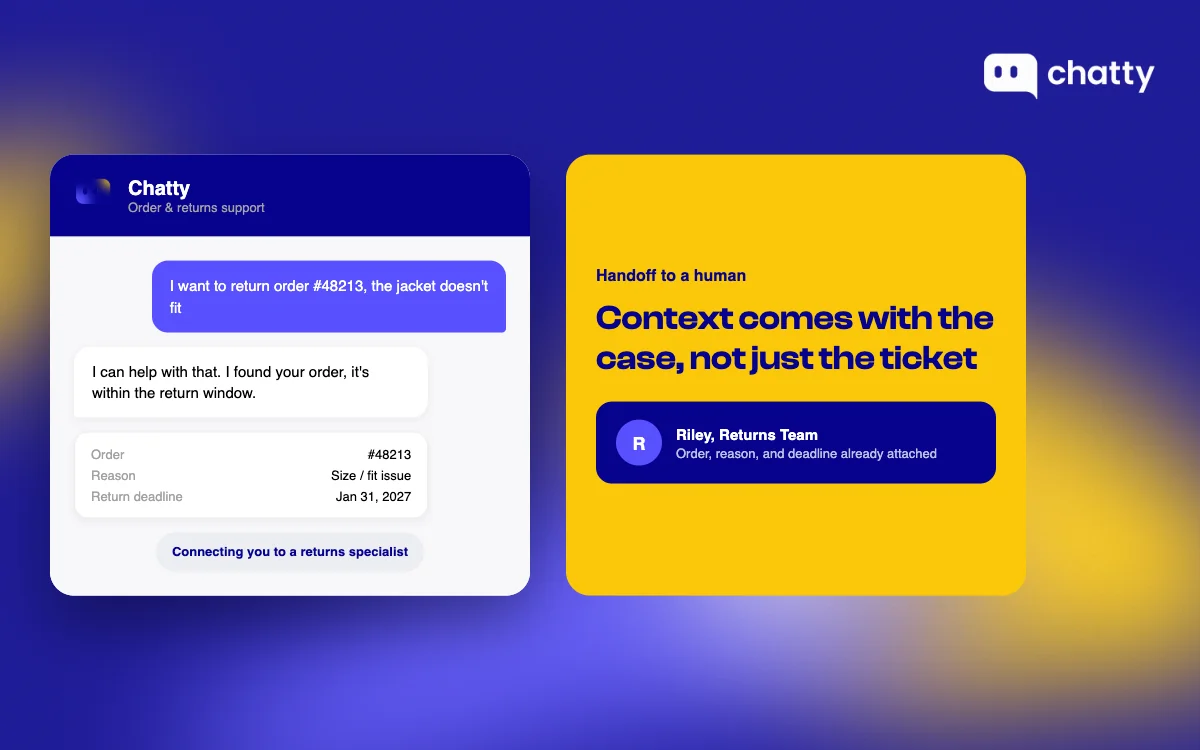
- Make sure a return case that escalates from AI to a human keeps its context, so a shopper isn't repeating their order number and issue from scratch with a new person.
Chatty ships a default scenario built for exactly this after-sales window:
- It automatically detects post-purchase intent (return, refund, exchange, or cancel requests) and hands the conversation to a human or email with that context already attached, so a shopper doesn't have to start over.
- It trains directly from a store's own return-policy page, so its answers stay matched to whatever deadline and conditions are actually published there, rather than drifting out of sync once a policy is updated mid-season.
Neither feature replaces a returns team; both exist to keep the repeatable share of the workload off a team that's already running on less capacity than the rest of the year.
Once an agent has the conversation, they can convert it into a Chatty Helpdesk ticket with a priority and an internal note. The agent can then reply with Send and snooze, so the ticket stays snoozed while the parcel is on its way back. A return that takes a week to settle no longer sits in the live chat queue.
You can see how the handoff works on the Chatty app listing on the Shopify App Store.
5. Make the return experience itself part of what brings a BFCM buyer back
For a first-time BFCM buyer, the return experience is often the only second interaction they ever have with a brand, and it can shape whether they buy again more than the original purchase did. A shopper who gets a clear, fast, low-friction return walks away with a better impression of the store than the one who bought nothing extra, even though the return itself was a loss on that order.
The trap: treating the post-BFCM window as purely a cost problem, letting the return process turn into something that feels like a penalty (too many steps, long waits for a refund, no visibility into where a return stands). That saves a little on each case while quietly costing repeat purchases, a worse trade than it looks like on a single order.
The fix is knowing which cases can be cut for cost and which can't:
- Cut cost on the clear-cut cases: batch-process straightforward, in-policy returns, and fast-track anything that already passed triage as low-risk.
- Don't cut experience on the cases that matter for retention: a genuine, first-time BFCM buyer's return should still feel fast, clear, and handled, even if it costs slightly more to process well than to rush.
What to prioritize if you're short on time
Post-BFCM returns are a timing and capacity problem before they are a policy or goodwill problem. Return volume, fraud pressure, and team capacity all converge in the same 2-3 week window, and fixing only one of them while ignoring the calendar mismatch behind all three barely moves the actual cost.
If only one or two things get done before BFCM starts, make them these:
- Lock and publish the return deadline and policy before the sale begins, not after returns are already arriving.
- Keep processing capacity, people and AI together, through the full 2-3 week window instead of cutting seasonal staff the moment Cyber Monday ends.
If you haven't already worked through the full five-stage BFCM customer experience picture this article sits inside, the five stages a BFCM shopper moves through is the place to start; this article is the depth behind its returns-management pointer.
Frequently asked questions
NRF and Happy Returns' 2025 Retail Returns Landscape report puts online returns at 19.3% of sales overall, and holiday-season returns specifically at 17% (checked 2026-09-10). Either figure means a meaningful share of BFCM revenue needs to be planned for as a return, not counted as final the moment the order ships.
In three waves. Return questions start during the sale itself: after-sales conversations were 11.8% of classified conversations across the eight peak days, while most parcels were still in transit. The parcels arrive 2-3 weeks later, once delivery plus a decision has run its course. Processing volume then peaks in January. That spread is exactly why staffing for BFCM week alone, then cutting support right after, leaves a store understaffed for the window that matters most for returns.
Standardize a small number of clear triage signals, such as unusual return frequency from the same customer, visible signs of use, or a mismatch between purchase and return dates, and let clear-cut, in-policy cases auto-process. That keeps the process fast for the large majority of returns that are not fraudulent while still flagging the minority that need a closer look.
Most merchants do, since holiday shoppers buy gifts well before the people receiving them can try them on or use them. What matters more than the exact length is publishing a specific, locked date everywhere a shopper might look (product page, confirmation email, policy page) before BFCM starts, rather than leaving it ambiguous and deciding case by case afterward.
Yes, for 2-3 extra weeks, since that's when the actual return spike lands, not the week of BFCM itself. Pair that with pre-defined answers to the most repeated return questions so AI can absorb the repeatable share, which means the extra staffing time goes toward the cases that genuinely need a person's judgment.