










A customer used to walk your store's funnel alone. They searched, compared, decided, and only talked to you when something went wrong. That journey still exists in 2026, but it's no longer the only one. A growing number of shoppers now hand part of that walk to an AI agent, and the agent acts on signals before the customer even asks.
For a small or mid-size Shopify store, none of this means you need to build agent-to-agent infrastructure before Black Friday. It means two things need attention: whether an outside AI agent can find and recommend you during discovery, and whether your own support can shift from purely reactive to at least partly proactive when volume spikes. Purchase and checkout, for now, are still solidly in the customer's hands.
- More actors, not just more steps
The customer journey went from a straight funnel with one actor (the customer) to a loop with up to three (the customer, the customer's AI agent, your own AI/support system).
- Reactive versus proactive is the real dividing line
Traditional CX responds after the customer acts, agentic CX can act on a signal before the customer has to ask.
- Discovery and comparison already carry real commercial weight
AI already influences these stages in ways that move real sales, but clean, accurate product data matters more than any copy rewrite.
- Checkout is still yours
It hasn't moved to AI yet, and this BFCM isn't the moment to bet on that changing.
- The handoff is the real risk, not the AI
The single most common breakdown point in AI-assisted support is passing context from AI to a human.
Traditional CX journey vs. agentic CX journey: what's the difference?
The traditional CX journey is a funnel one person walks mostly alone: awareness, consideration, search, browse, product page, add to cart, checkout, delivery, support, loyalty. One actor, the customer, does the searching, comparing, and deciding. Your job at each step is to persuade, and to respond promptly when they reach out.
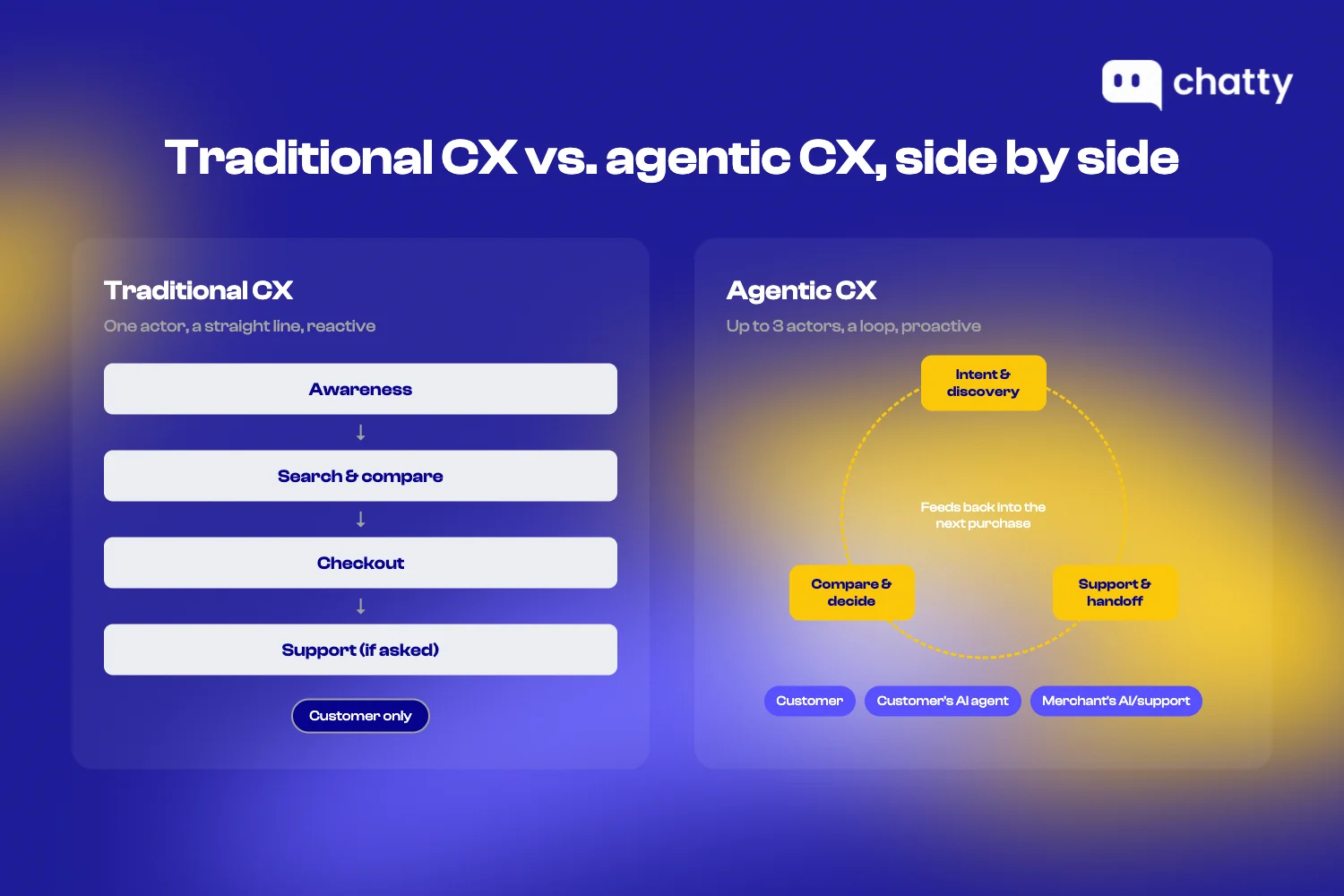
The agentic CX journey starts the same way, with a need, but the customer can now delegate part of the research and comparison to an AI agent. It reads less like a straight line and more like a loop: intent, then optional delegation to an AI agent, then the agent discovering and evaluating options. The customer usually still decides, the transaction still closes on the merchant's own site, and delivery and support feed back into the next purchase.
Strip away the jargon and the difference comes down to two things:
- More possible actors. Traditionally one, now up to three: the customer, the customer's AI agent, and your own AI or support system.
- Reactive versus proactive. Traditional CX responds after the customer acts or asks. Agentic CX can act on a signal before the customer has to ask.
How real is this today? Deloitte frames it as a progression, not a switch:
- Assisted discovery. Basic recommendations, still mostly search-driven.
- Assisted shopping. AI helps with navigation and questions, most stores are here today.
- Agentic shopping. AI discovers, compares, and recommends without the customer visiting your site directly.
- Autonomous shopping. An agent acts on the customer's behalf within set limits, still early and rare.
- Agent-to-agent commerce. Two AI systems transact with minimal human input, not yet happening at any real scale.
Most stores right now sit in stage two, assisted shopping. Full autonomous shopping, where an agent buys without a human approving, is not the stage to plan your BFCM around.
How AI has changed product discovery and comparison
A customer used to type a keyword, open five tabs, and compare manually. You won that comparison with SEO, ads, or persuasive product copy. In 2026, a growing share of that same customer describes an intent to an AI assistant, something like "noise-canceling headphones under $300 for a flight this Friday", and the assistant narrows the field, sometimes comparing across stores in the same conversation.
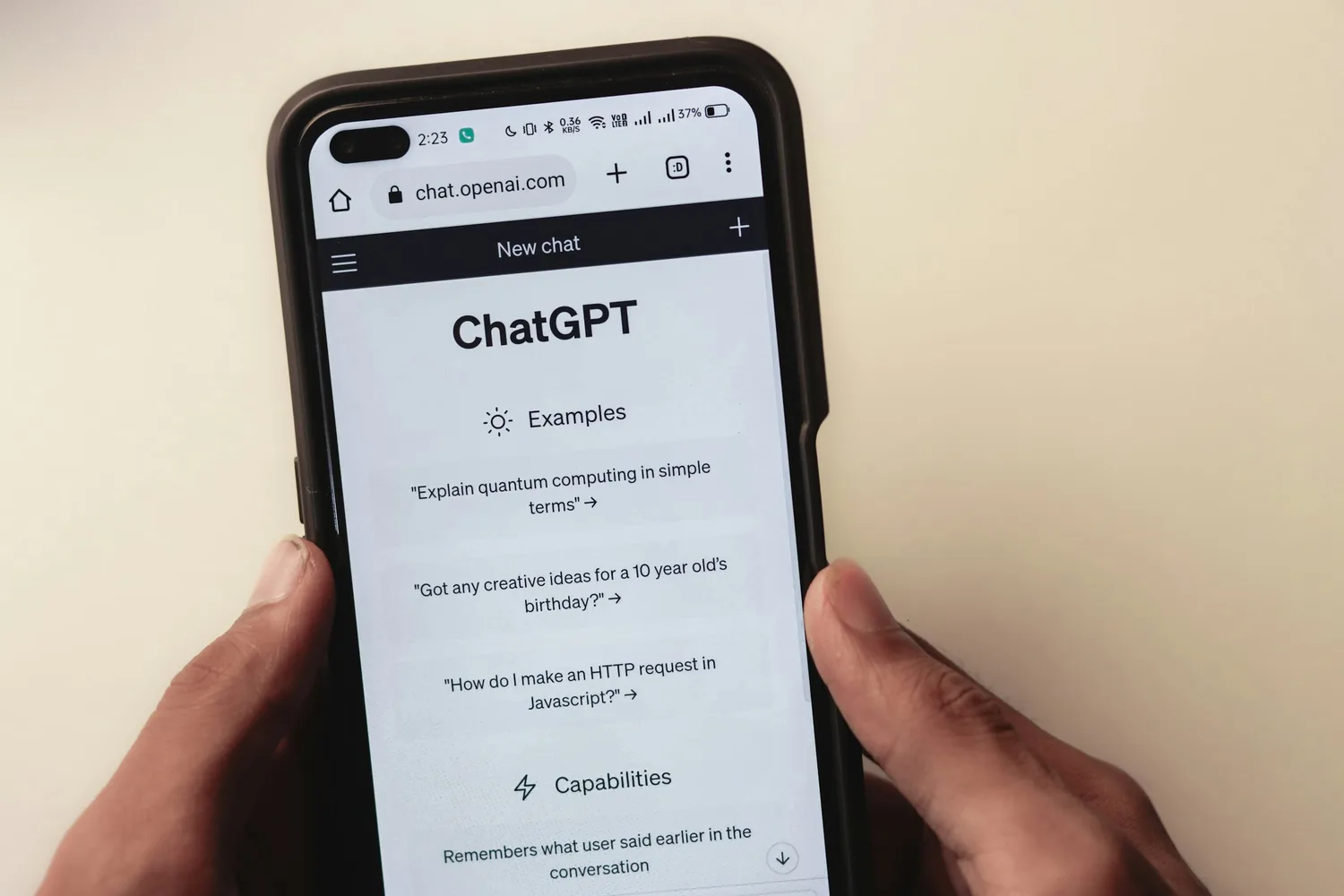
This isn't hypothetical for small merchants. In a Shopify Community thread titled "ChatGPT is becoming a sales channel", one merchant, posting as pawtrait, reported sales increasing 3x in a single month after their store started getting recommended directly in ChatGPT answers. That's real commercial weight, not a hypothetical, and it lines up with what Shopify's own agentic storefront rollout is already showing at scale.
The same thread also carries the necessary reality check. Merchant bchen27 called full autonomous negotiation, an agent haggling and closing a deal on its own, "years away from mattering" for stores under $10M a year, and pointed out that what actually matters right now is having clean product data. That lines up with McKinsey's point that AI agents query structured data, not the way a human browses a webpage: your catalog and policies need to be machine-readable just to enter consideration at all.
So the practical question for a small store isn't "how do we get more clicks." It's "can an AI agent understand what we sell well enough to recommend us." That depends on structured, accurate product data: titles, descriptions, price, availability, schema markup. It does not depend on rewriting your marketing copy one more time. This is also the exact problem Shopify's Universal Commerce Protocol is trying to standardize across merchants, so it's worth checking whether your store already meets that bar.
Why trust now works in two layers, and what that means for checkout
Customers used to evaluate directly whether they trusted your website: your reviews, your policies, your design. In 2026, there are two trust layers instead of one:
- Customer to agent. The customer trusts their AI agent's judgment about which options are worth considering.
- Agent to merchant. That agent has to reliably parse your own data: reviews, stock accuracy, delivery reliability, and how clearly your return policy is written.
People trust AI more to help them compare options than to actually complete a purchase for them. That gap is exactly why checkout hasn't moved to AI yet. Trust hasn't caught up to capability. Some tools now let a customer set rules ("buy the best option under $200") and let an agent execute inside those rules, but adoption is still early and far from the norm.
For a small store right now, the practical reality is simple: AI researches and recommends, the customer still approves, and the transaction still closes on your own checkout. That's not a limitation to work around this BFCM, it's the current shape of the market.
What changes is the cost of sloppy data. These used to just cost you a hesitant human visitor, now they can also make an AI agent skip your store entirely during the comparison stage, before a human ever sees your product page:
- Inconsistent stock counts
- Vague return policy language
- Stale reviews
So this isn't a stage to plan around changing, it's a stage to make sure the boring fundamentals are solid.
Why support is shifting from reactive to proactive, and why that matters most at BFCM
The old pattern: a customer notices a problem first, "where's my order", and a support agent looks it up and responds, reactively, only after being asked. The 2026 direction is proactive: AI-supported service can flag a delayed shipment before the customer has to ask at all. That's the same shift covered in more depth in this breakdown of proactive customer service strategies. Genesys frames this as AI moving from isolated, conversational tools toward a connected model that can act inside the interaction, a shift that changes what "good support" even means.
The scale of the expectation shift is worth sitting with. According to Genesys's 2026 State of Customer Experience report, based on 5,811 consumers and 1,560 CX leaders:
- 92% of consumers benchmark every experience against the best one they've ever had anywhere, not just against your competitors.
- 76% genuinely don't care whether AI or a human resolves their issue, they just want it resolved.
- 84% give an AI agent about three tries before giving up on it.
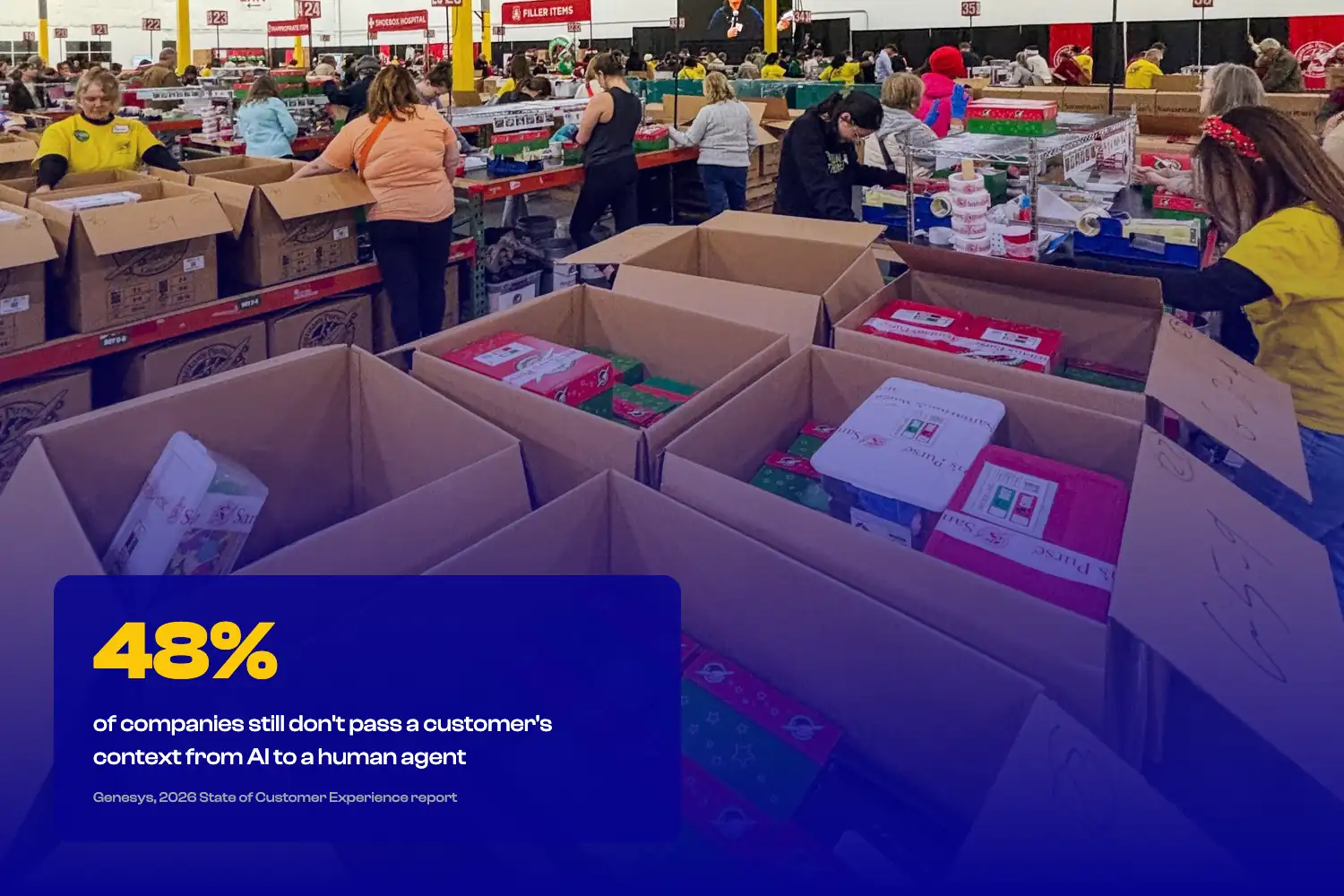
- 95% expect their information to carry across channels so they don't have to repeat themselves, but 48% of companies still don't pass that context from AI to a human agent.
That last gap, not AI quality itself, is the single most common breakdown point.
BFCM is where this gap gets expensive. Support volume climbs sharply during that window. On-site chat runs 44% above baseline on Black Friday and 36% on Cyber Monday (Chatty conversation data, Nov 24 to Dec 1, 2025). A broken AI-to-human handoff is the most likely place an otherwise-good AI investment fails a customer, right when they're least patient and most likely to be shopping somewhere else next.
How to prepare for the agentic CX journey before BFCM 2026
Everything above points to the same conclusion: two stages need real attention before BFCM, and two don't need to change at all. For a broader look at the volume side of that equation, this piece on handling BFCM support spikes is worth reading alongside this checklist. Here's how that breaks down by stage.
- Discovery and comparison. Open your 10 best-selling products in your Shopify admin. For each one, check: does the title include the actual product type and use case (not just a brand name), is there a full description of at least a few sentences, is the price and stock status accurate right now, and does the product have schema markup (most themes add this automatically, but confirm with Google's Rich Results Test). Fix whichever of these is missing before touching anything else, since a thin listing is invisible to an AI agent the same way it's invisible to Google.
- Trust and decision. Pull up your return policy page and time how long it takes to find the actual return window and who pays for shipping. If it takes more than 15 seconds or requires a click-through, rewrite it in plain terms at the top of the page. Then spot-check your 10 best sellers for stock accuracy against what's actually in your warehouse, and skim your most recent reviews for anything that contradicts your product description.
- Purchase. Don't spend BFCM prep budget trying to plug into autonomous AI checkout. That's not proven at this scale yet. Instead, run a real test purchase on your own site on both desktop and mobile, and count the steps from product page to confirmation. Treat anything past 3 steps, or any break on mobile, as a friction point to fix before BFCM traffic hits, since this is still the stage where every sale actually closes.
- Support. Export your last 60 to 90 days of support tickets or chat logs and tally the 10 most repeated questions. For each one, write the answer down somewhere your team, a new seasonal hire, or an AI tool can find it in seconds, shipping cutoffs, extended return windows, sale-specific FAQs. Then walk through what happens today when a conversation moves from your AI tool to a human: does the human see what the customer already asked, or does the customer have to repeat it. If it's the second one, that's the fix to make before BFCM volume hits.
The bottom line for Shopify merchants this BFCM
The customer journey went from a funnel one person walked alone and reactively served, to a loop with up to three possible actors that can act proactively. For a store your size, that shift only really touches two stages this BFCM:
- Discovery and comparison. Being findable and trustworthy to an AI agent.
- Support. Being ready to lean proactive, and to hand off cleanly to a human when higher-expectation, AI-assisted customers show up in volume.
This is the first article in a series looking at what the agentic shift means for Shopify merchants heading into BFCM 2026. The rest of the series gets more specific:
- How cart abandonment behaviour changes when part of the journey is AI-assisted.
- Whether a CS team is actually staffed and ready for BFCM's compressed handoff volume.
- What personalization looks like when you don't know the shopper yet.
- The stage-by-stage CX guide turns this framework into a checklist, and the 8-week prep timeline puts it on a calendar.
For the wider context behind why this shift is happening now, see this rundown of the CX trends actually worth acting on in 2026.
The discovery-and-compare stage happens before a shopper reaches you, and it is won with clear product data and policy pages an outside agent can read. Chatty picks up after that: it answers the compare-and-fit questions on your own store, so a shopper deciding between two of your products does not have to leave to get an answer, and it transfers to a human on triggers you set.
Frequently asked questions
The traditional journey is a funnel one customer walks alone, reactively served at each step. The agentic journey is a loop where the customer can delegate part of the research and comparison to an AI agent, and where support can act on a signal before being asked, though the customer still typically decides and pays.
Not typically yet. Consumers trust AI more to help them compare options than to complete a purchase on their own, so checkout remains customer-approved in the vast majority of cases, even when an AI agent handled the research and comparison stage.
Focus on two stages: clean, structured, accurate product data so AI agents can find and recommend you, and support that can shift from purely reactive to at least partly proactive with a solid handoff to a human when needed.
Not necessarily. Genesys's 2026 research found 76% of consumers don't care whether AI or a human resolves their issue, they just want it resolved quickly, though they'll give an AI agent about three tries before giving up on it.
Being invisible during AI-assisted discovery because of thin or inconsistent product data, and a broken handoff between AI and human support during BFCM's highest support volume, the point where 48% of companies fail to pass context along and lose an otherwise-resolvable customer.