












In January 2026, Shopify and Google stood on the NRF stage and described a new open standard as a "universal language" for commerce. Six months later, the Universal Commerce Protocol (UCP) is live, endorsed by more than 20 of the largest names in retail and payments, and quietly wired into millions of stores that never had to lift a finger.
If you sell on Shopify, your products are already speaking it.
Most coverage of UCP treats it as a future-tense story: a thing to prepare for. It isn't. The protocol is already routing AI agents to merchant catalogs at scale. The useful question is no longer "what is coming," it's "what does this protocol actually govern, what does it leave to me, and where do I spend my time." This article answers all three.
- UCP is an open protocol, not a Shopify feature you install.
Co-developed by Shopify and Google, it gives any AI agent a single, standard way to find products, build carts, complete checkout, and track orders across millions of merchants.
- Shopify merchants are included by default.
If your store is eligible, your catalog is already reachable through UCP via Agentic Storefronts. No app, no integration, no monthly fee.
- UCP and ACP are different things, and you don't have to choose.
UCP (Shopify plus Google) is the broad standard. ACP (OpenAI plus Stripe) primarily powers ChatGPT. Shopify handles both for you.
- UCP governs the machine layer, not the human one.
It standardizes how agents transact. It says nothing about what happens when a shopper that an agent sent lands on your store with a question. That gap is yours.
- The work that matters is product data plus on-store experience.
Clean, structured data gets you discovered through UCP. An on-site AI Sales Agent closes the high-intent shopper the protocol delivers to your door.
What is Shopify UCP?
The Universal Commerce Protocol (UCP) is an open standard that defines how AI agents discover, transact with, and track orders from any merchant, in one shared language. Instead of every AI platform building a custom integration with every store, UCP gives them a single protocol that works everywhere it's adopted.
Think of it the way HTTP works for the web. Your browser doesn't need a bespoke connection to each website, because every site and every browser agreed on one protocol. UCP does the same thing for commerce between AI agents and merchants. An agent that speaks UCP can talk to any merchant that speaks UCP, without either side knowing about the other in advance.
Shopify co-developed UCP with Google and announced it at NRF in January 2026. The protocol was built with input from Walmart, Target, Etsy, and Wayfair, and is endorsed by more than 20 partners across retail and payments, including Visa, Mastercard, Stripe, Adyen, American Express, Best Buy, The Home Depot, and Zalando. That breadth is the point. A protocol is only useful if enough of the ecosystem agrees to speak it, and UCP arrived with that agreement already in place.
For a Shopify merchant, the practical meaning is simple. Your product catalog becomes machine-readable infrastructure that any UCP-speaking agent can query, recommend from, and sell on your behalf, whether that agent lives inside ChatGPT, Google's Gemini app, Microsoft Copilot, or a tool that doesn't exist yet.
Why Shopify built a protocol instead of a feature
Before UCP, connecting commerce to AI agents was an N-by-N problem. Every AI platform that wanted to sell products had to build a separate integration with every merchant or commerce platform. Every merchant who wanted to appear in AI conversations had to integrate with every platform individually. The math gets ugly fast: ten platforms and ten thousand merchants is a hundred thousand brittle, custom connections, each one a thing that can break.
That model doesn't scale, and it quietly favors the largest players. A solo developer building a shopping agent could never negotiate catalog access with millions of stores one by one. A small merchant could never build integrations with every emerging AI platform.
A protocol collapses the N-by-N problem into N-plus-N. Each agent implements UCP once. Each merchant supports UCP once, or in Shopify's case, gets it automatically. Now any agent can reach any merchant. As Shopify framed the developer pitch: commerce that can show up anywhere, inside anything, built by anyone.
This is why the framing matters. UCP is not a button in your admin. It is the shared rail that makes the whole agentic commerce ecosystem interoperable, and Shopify's bet is that owning the rail is more durable than owning any single feature on top of it.
How UCP works, simplified
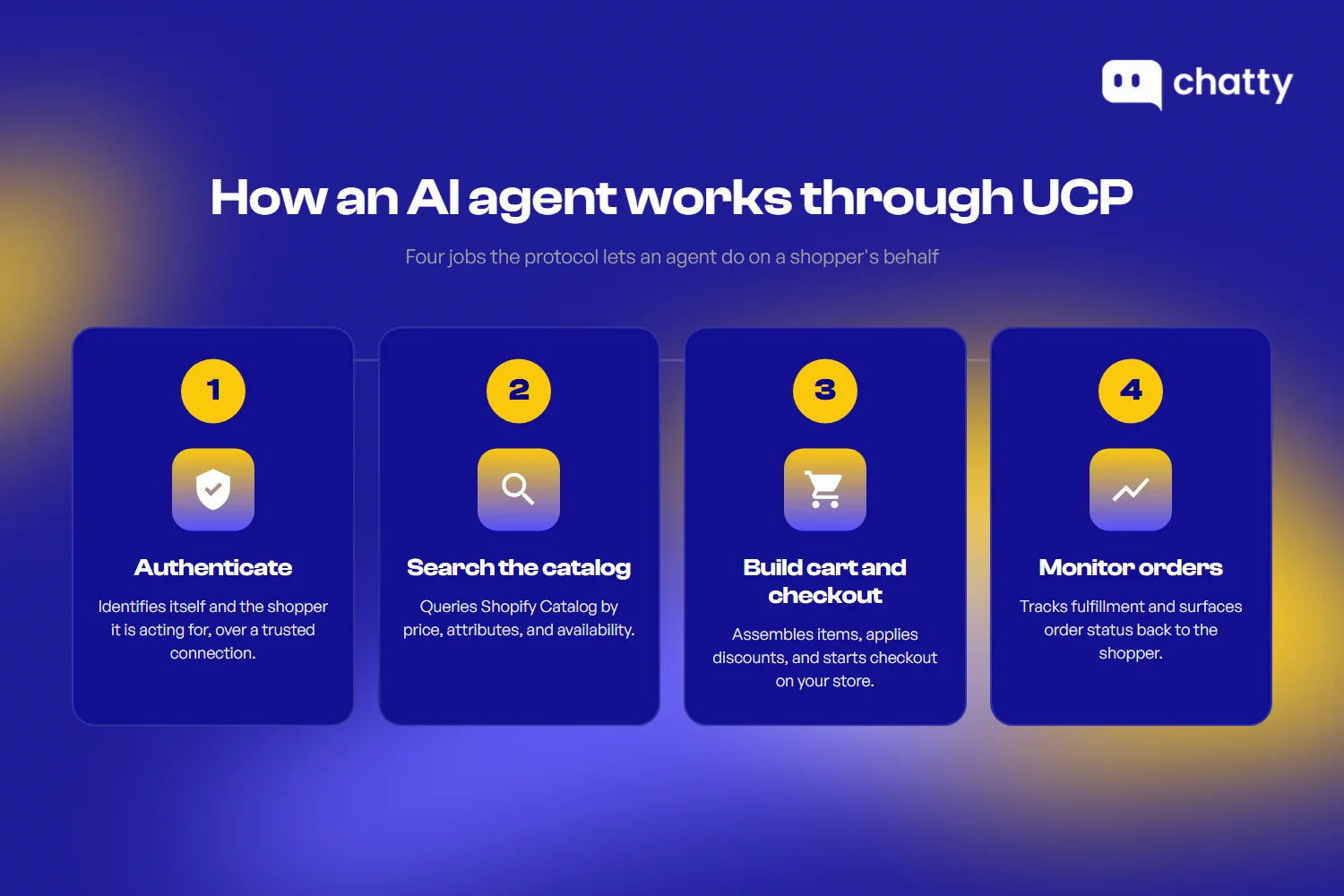
UCP defines what an AI agent is allowed to do and how it does it. Under the hood, it covers four jobs an agent performs on a shopper's behalf.
- Authenticate. The agent identifies itself and the shopper it's acting for, establishing a trusted, permissioned connection to the merchant.
- Search the catalog. The agent queries Shopify Catalog, billions of products across millions of merchants, filtering by attributes, price, availability, and relevance to the shopper's request.
- Build a cart and checkout. The agent assembles items into a cart and initiates checkout, including discount codes, loyalty credentials, subscriptions, and pre-orders.
- Monitor orders. After purchase, the agent can track fulfillment and surface order status back to the shopper.
One capability worth calling out is the Universal Cart. It lets an agent collect items from multiple merchants, on or off Shopify, into a single unified cart. From the shopper's side, that means one conversation can assemble a basket spanning several stores and check out once.
UCP is also transport-flexible. It supports REST APIs, the Model Context Protocol (MCP), Agent Payments Protocol (AP2), and Agent2Agent (A2A), so different AI platforms can connect in whatever way fits their architecture. As a merchant, you don't choose among these. They exist so that the agent side has options, while your catalog stays a single source of truth.
The order, payment confirmation, and fulfillment data all flow back through the same standard, which means the operational side of an AI-driven sale looks the same in your Shopify Admin regardless of which agent or platform the shopper used.
UCP vs ACP: the two protocols, and why you don't have to choose
Search "shopify ucp" and you'll quickly hit a second acronym: ACP. Confusing the two is the most common mistake merchants make right now, so it's worth being precise.
-
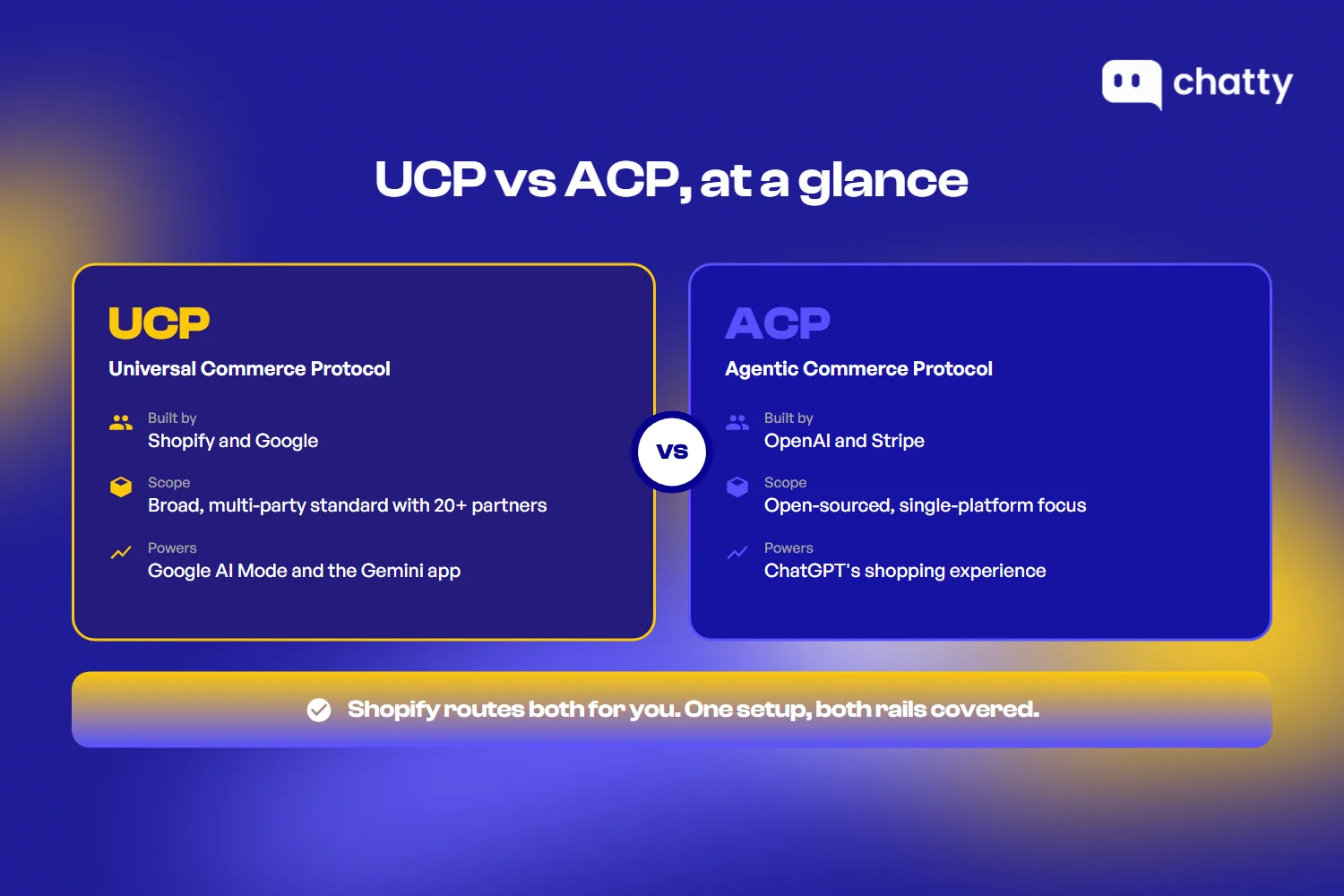
UCP, the Universal Commerce Protocol. Co-developed by Shopify and Google. The broad, multi-party standard, backed by 20-plus partners across retail and payments. Powers native shopping in Google AI Mode and the Gemini app, and is designed to be the industry-wide rail.
-
ACP, the Agentic Commerce Protocol. Co-developed by OpenAI and Stripe, open-sourced on GitHub. Primarily powers ChatGPT's shopping experience.
The two are not in a simple winner-take-all fight. ACP launched first with Instant Checkout in September 2025, an attempt to let shoppers buy directly inside ChatGPT. By March 2026, OpenAI wound that down. Only around 30 merchants had gone live, and Walmart reported conversion rates roughly 3x lower for purchases completed inside ChatGPT versus those that clicked through to the store. The lesson reshaped both protocols toward the same model: agents are excellent at discovery, and checkout belongs on the merchant's own store.
Here's the part that matters for you. Shopify handles both protocols through Agentic Storefronts. One setup on your side, both rails covered. You do not need to read either spec, pick a side, or maintain separate integrations. Your job is to keep your catalog clean and your store ready, and let Shopify route the protocols underneath.
What UCP means for your store
The headline is reassuring: for Shopify merchants, UCP participation is largely automatic.
- What happens without you doing anything. Since March 24, 2026, Shopify has activated Agentic Storefronts by default across roughly 5.6 million stores. If your store is eligible, your products are already discoverable through UCP-speaking agents. Any change you make in admin, new pricing, inventory, an updated description, propagates to every connected AI channel automatically. You set your product data once, and the protocol distributes it.
- What it costs. Nothing beyond standard payment processing. There is no UCP subscription and no extra transaction fee for discovery through Agentic Storefronts. Shopify's separate Agentic Plan exists for brands that want to sell on AI channels without running a full storefront, but existing merchants on any standard plan already have UCP connectivity built in.
- What the numbers look like so far. Shopify's Q1 2026 figures show AI-driven traffic up 8x year over year, AI-attributed orders up 13x, and average order value on agent-driven orders up 30%. The honest caveat: AI traffic is still under 0.2% of total ecommerce sessions today. The absolute volume is small. The growth curve and the order quality are what merchants are positioning for.
- What still needs your attention. Automatic inclusion gets your catalog into the room. It does not guarantee you get recommended, and it does nothing for what happens after a shopper arrives. Both of those are on you, which is the next two sections.
What UCP does not do, on purpose
This is the part almost no UCP explainer mentions, and it's the part that decides whether the channel makes you money.
A protocol standardizes the machine-to-machine layer. UCP defines how an agent authenticates, reads your catalog, builds a cart, completes a transaction, and tracks an order. Every one of those is an interaction between software and software. By design, UCP says nothing about the interaction that decides most sales: the one between your store and a human being.
Picture the handoff. An agent does its job perfectly. A shopper asks Gemini for "a creatine that's safe to stack with pre-workout, under $40," the agent queries Catalog through UCP, compares specs and reviews, and recommends your product. The shopper clicks through to your store. The protocol's work is done. It delivered a pre-qualified, high-intent buyer to your front door.
Then the shopper has questions the agent could not answer from structured data:
- "Will this arrive before Saturday?"
- "Is the unflavored one actually unflavored?"
- "Does it work with the shaker I already have?"
On most stores, nobody answers. There's a static FAQ page and a contact form promising a reply in 24 hours. The shopper leaves.
The data on this gap is stark. Around 42% of shoppers abandon a purchase because of insufficient product information on the store itself. And because agents like ChatGPT and Gemini don't keep business hours, the traffic they send doesn't either: 35 to 50% of ecommerce orders arrive outside the times a human is available to respond.
None of that is a flaw in UCP. The protocol was never meant to persuade, reassure, or close. It moves the shopper to your door. What greets them there is a store problem, and it happens to be the one part of this entire stack you fully control. We made the full case for the seller side in our deep dive on Shopify agentic commerce; the short version is that discovery is solved and closing is wide open.
How to get ready for UCP
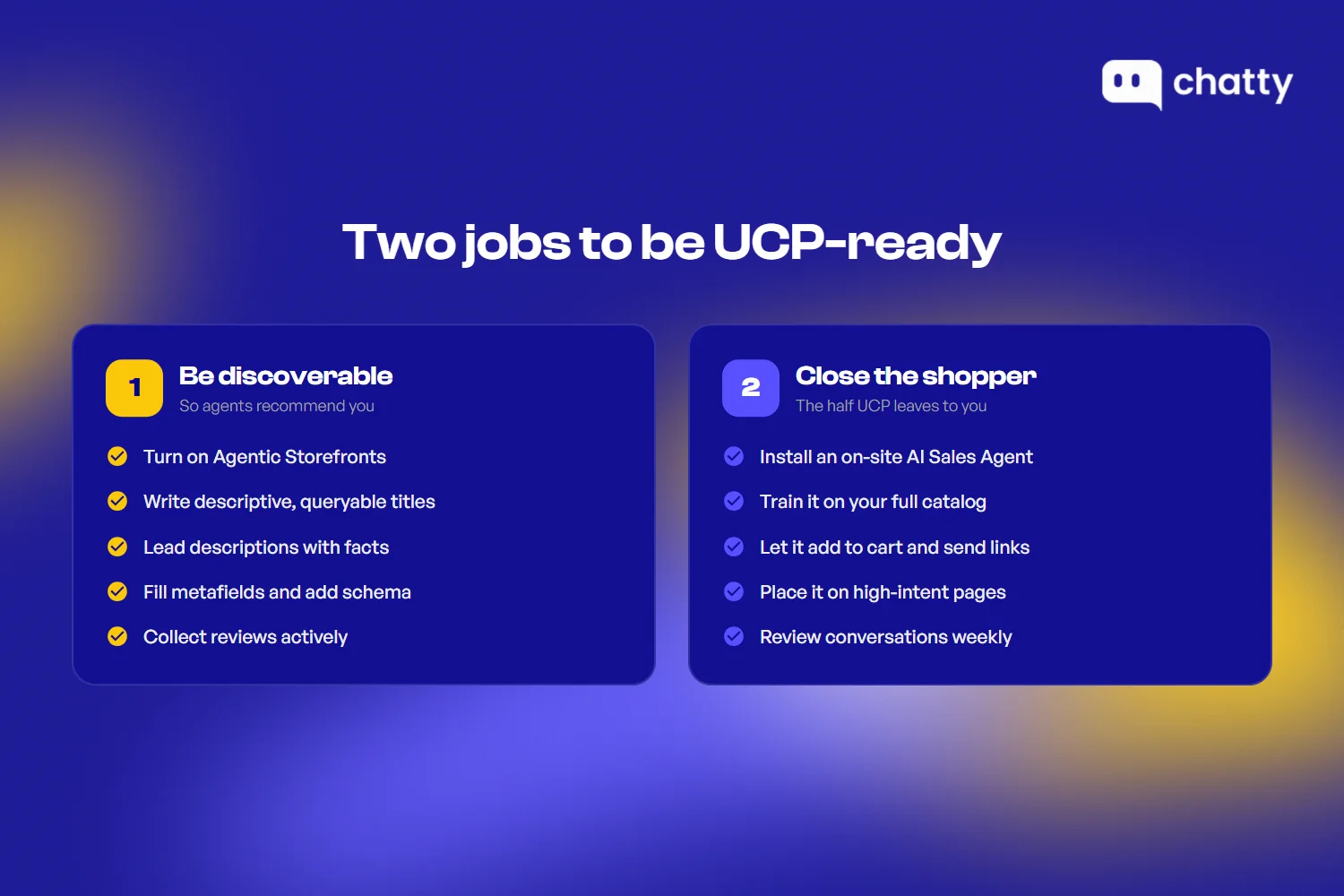
Readiness splits into two jobs. The first makes you discoverable through the protocol. The second makes the traffic it sends actually convert.
Job one: be the product an agent recommends
UCP can only surface what it can understand, and agents recommend a short list, often two or three products per query. Vague data gets skipped silently.
- Confirm Agentic Storefronts is on. Settings, then Sales channels, then Agentic Storefronts. Complete all four store policies (shipping, returns, privacy, terms), enable guest checkout, and confirm you sell to US customers.
- Write titles for matching, not branding. "Unflavored Creatine Monohydrate, 500g, Third-Party Tested" is queryable. "The Performance Edit" is invisible.
- Lead descriptions with facts under consistent labels: Materials, Dimensions, What's Included, Best For, Compatibility. Replace superlatives with specs.
- Fill metafields and add structured data. Capacity, material, certifications, compatibility, plus JSON-LD Product, Review, and FAQ schema on product pages.
- Use the free Knowledge Base app to control how agents describe your brand, and to see what shoppers are asking that your data doesn't yet answer.
- Collect reviews actively. Volume and rating are quality signals agents lean on when choosing what to recommend.
Job two: close the shopper UCP sends you
This is the half the protocol leaves to you, and the half with the higher return.
- Install an on-site AI Sales Agent that answers product questions in real time, 24/7, in the shopper's language.
- Train it on your full catalog: specs, variants, sizing, compatibility, shipping cutoffs, and the policies in your Knowledge Base.
- Let it act, not just answer. Recommend alternatives, add to cart, and send checkout links inside the conversation.
- Put it where intent is highest: product detail pages and the cart.
- Review conversations weekly and close the gaps where it couldn't answer.
The cost asymmetry is the reason to do both now. Cleaning product data is work you should do regardless. An on-site AI Sales Agent runs around $69 per month. For under $100 a month you cover both jobs, against a channel growing at triple-digit rates with high-intent, ready-to-buy traffic.
The protocol gets them to the door. The rest is yours.
UCP is genuinely a big deal. It turns commerce into something an agent can navigate the way a browser navigates the web, and Shopify gave its merchants a seat by default. Understanding it is worth your time.
But understanding it also means seeing its edges. UCP is a discovery and transaction rail. It will deliver pre-qualified shoppers to your store at 2am, in volumes that compound month over month. It will not answer their questions, ease their doubts, or recommend the bundle. That moment, the one that actually converts the visit into revenue, lives on your store, and it's the one thing in this stack that no protocol will ever standardize for you.
Chatty is an AI Sales Agent built for Shopify. When UCP sends a shopper to your store, Chatty answers product questions, recommends the right item, updates the cart, and sends a checkout link, 24/7, in 95-plus languages. If you've done the work to be discoverable, make sure you're ready to close.
FAQ
UCP, the Universal Commerce Protocol, is an open standard co-developed by Shopify and Google that lets AI agents discover products, build carts, complete checkout, and track orders across any merchant that supports it. For Shopify merchants, it's enabled by default through Agentic Storefronts.
No. UCP (Shopify plus Google) is the broad, multi-party standard backed by 20-plus partners. ACP (OpenAI plus Stripe) primarily powers ChatGPT. Shopify supports both protocols for you, so you don't have to choose between them or integrate either one manually.
Not to participate. Since March 2026, eligible Shopify stores are included by default. To benefit, optimize your product data so agents recommend you, and add an on-site experience that converts the traffic UCP sends.
No. There is no UCP fee or subscription beyond standard payment processing. Shopify's separate Agentic Plan is aimed at brands selling on AI channels without a full storefront; existing merchants already have UCP connectivity included.
UCP powers native shopping in Google AI Mode and the Gemini app, and is designed to extend across the ecosystem as more platforms adopt it. Through Shopify, your catalog also reaches ChatGPT, Microsoft Copilot, and Perplexity.
It increases your reach, not automatically your revenue. UCP gets pre-qualified shoppers to your store. Converting them depends on your product data quality and your on-store experience, including whether someone, or an AI Sales Agent, is there to answer questions when the shopper arrives.