











Black Friday doesn't give shoppers a new reason to abandon their cart. It gives them the same four reasons they always had, compressed into a few days where every one of those reasons costs more. Shopper chat volume on Black Friday climbs 44% over baseline days, according to Chatty's internal BFCM Shopper Behavior data, and that surge in concurrent shoppers is exactly what turns a shrug-worthy friction point into a lost order.
If you already ran the mobile purchase test, the guest checkout check, and the throttled-connection load test from Chatty's BFCM 2026 CX guide, you know whether your checkout has a problem. This article is the next step: the specific causes behind that drop-off, and which ones to fix first with limited time left.
- BFCM amplifies existing causes, it doesn't create new ones
Traffic, inventory/price volatility, and competing discount codes turn ordinary friction into lost orders at scale.
- Hidden costs still top the list
40% of shoppers abandon over unexpected shipping, tax, or fees, according to Baymard, and BFCM shoppers have more open tabs to switch to when they hit one.
- Inventory and price staleness is the most BFCM-specific cause
Concurrent order volume can outrun inventory sync, so a shopper adds something that's gone or repriced by checkout.
- Mobile checkout fails more, not differently, under BFCM-level load
The mobile-vs-desktop abandonment gap sits at roughly 10 points, and that gap widens under concurrent traffic.
- Discount code failures at the last screen are a solvable, BFCM-specific loss
Validate codes earlier in the flow so a bad code surfaces before checkout, not at it.
Why cart abandonment gets worse at BFCM, not just more frequent
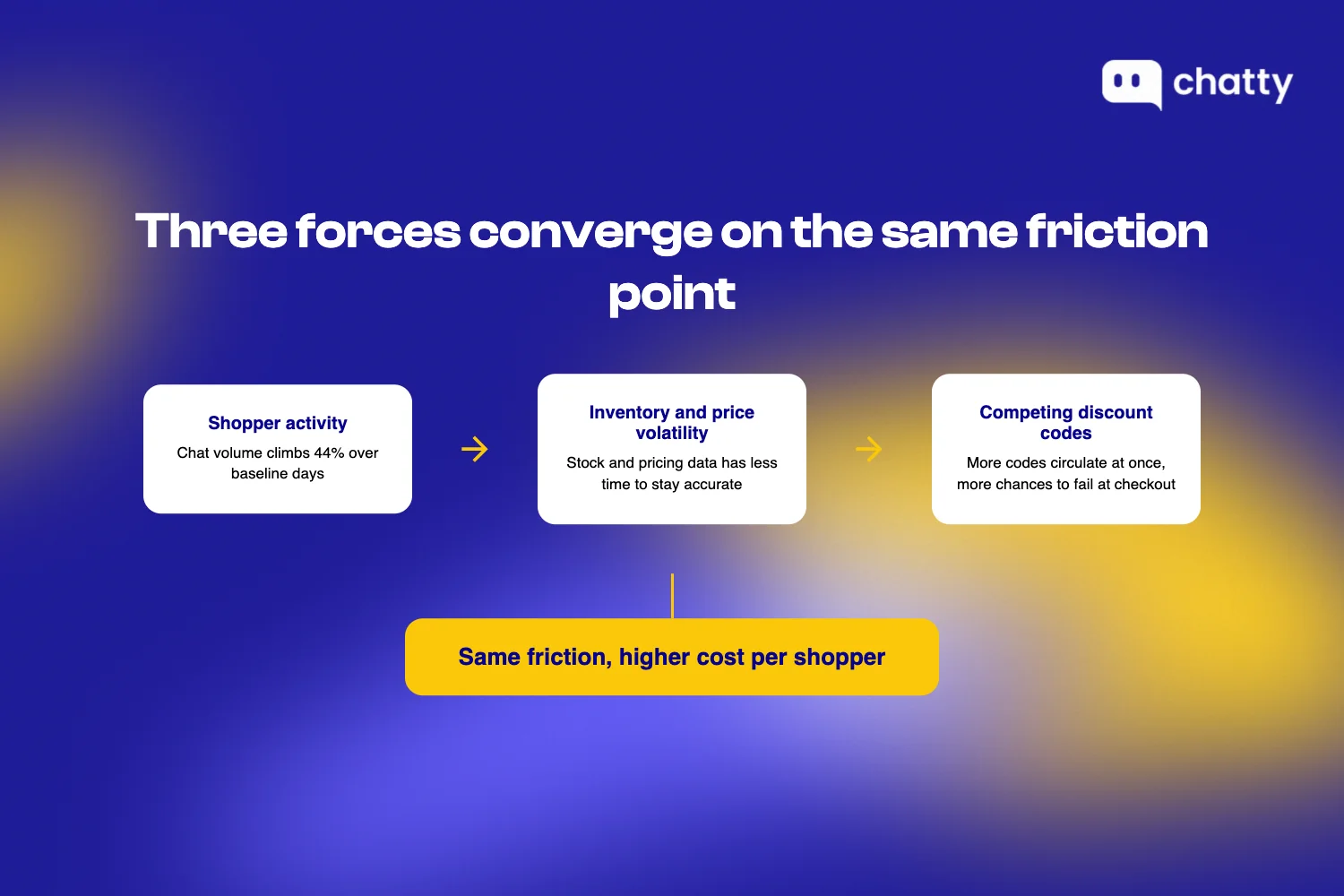
Cart abandonment gets worse at BFCM because three forces compound at the same time: the number of shoppers actively browsing and asking questions multiplies, inventory and pricing data has less time to stay accurate, and more discount codes compete for the same checkout. None of these forces are new. What's new is how little slack they leave a merchant who hasn't already fixed the friction underneath them.
Shopper activity is the clearest of the three to quantify. Chatty's internal BFCM Shopper Behavior data, drawn from AI conversation volume across its merchant base, shows the scale of the jump:
| Period | Relative shopper chat volume |
|---|---|
| Baseline day | 100% (reference) |
| Black Friday | +44% |
A 44% jump in concurrent shoppers doesn't just mean more people see your checkout. It means more orders competing for the same inventory in real time, more shoppers holding several browser tabs open to compare prices, and more codes circulating that your checkout has to validate correctly under load it doesn't see the rest of the year. Each of the four causes below plays out worse under exactly this compression, not because the cause itself changed.
The four cart abandonment causes during BFCM, and how to fix them
Four causes account for most of the orders you lose at BFCM scale, and each one already exists in your store today. For each, here's how bad it normally is, what BFCM does to it, and what to fix.
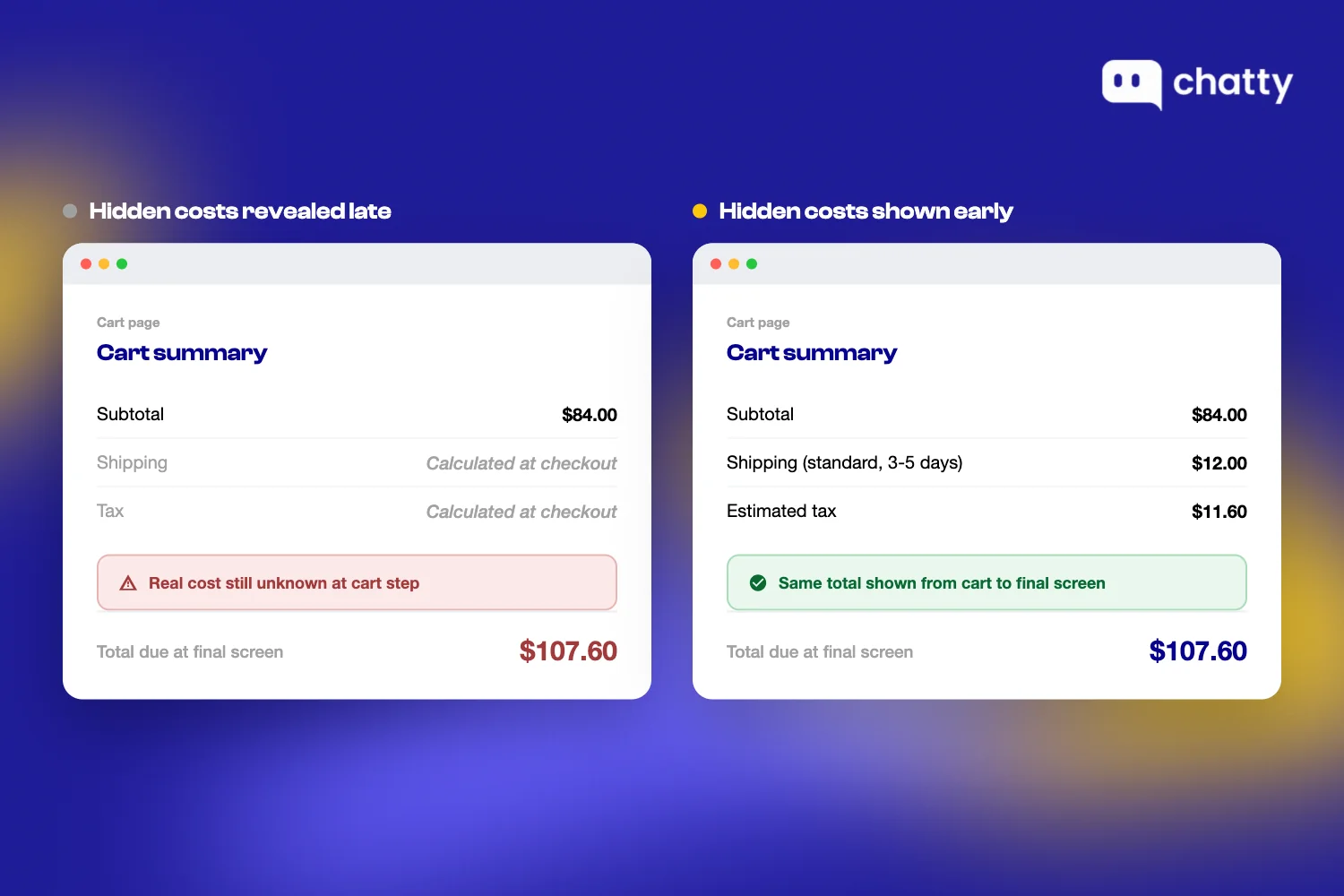
Hidden costs revealed too late
Extra costs (shipping, tax, and fees appearing late in checkout) are the single largest documented reason shoppers abandon carts, cited by 40% of shoppers according to Baymard Institute (read September 2026). At BFCM, that same shopper usually has two or three other tabs open comparing the same product, so a fee that shows up at the last screen sends them straight to a competitor instead of back to yours.
Fixing this matters more than diagnosing it. Show the full cost, not just the item price, well before the final checkout step:
- Display estimated shipping cost on the product page or cart page, using the customer's location or a shipping calculator widget, not just at the last screen.
- Show tax as early as the cart summary if your platform supports it, so the number a shopper commits to matches what they pay.
- Audit any per-item or per-order fee (rush processing, gift wrap, restocking) and disclose it before checkout, not inside it.
Stock and price data that's wrong by the time they check out
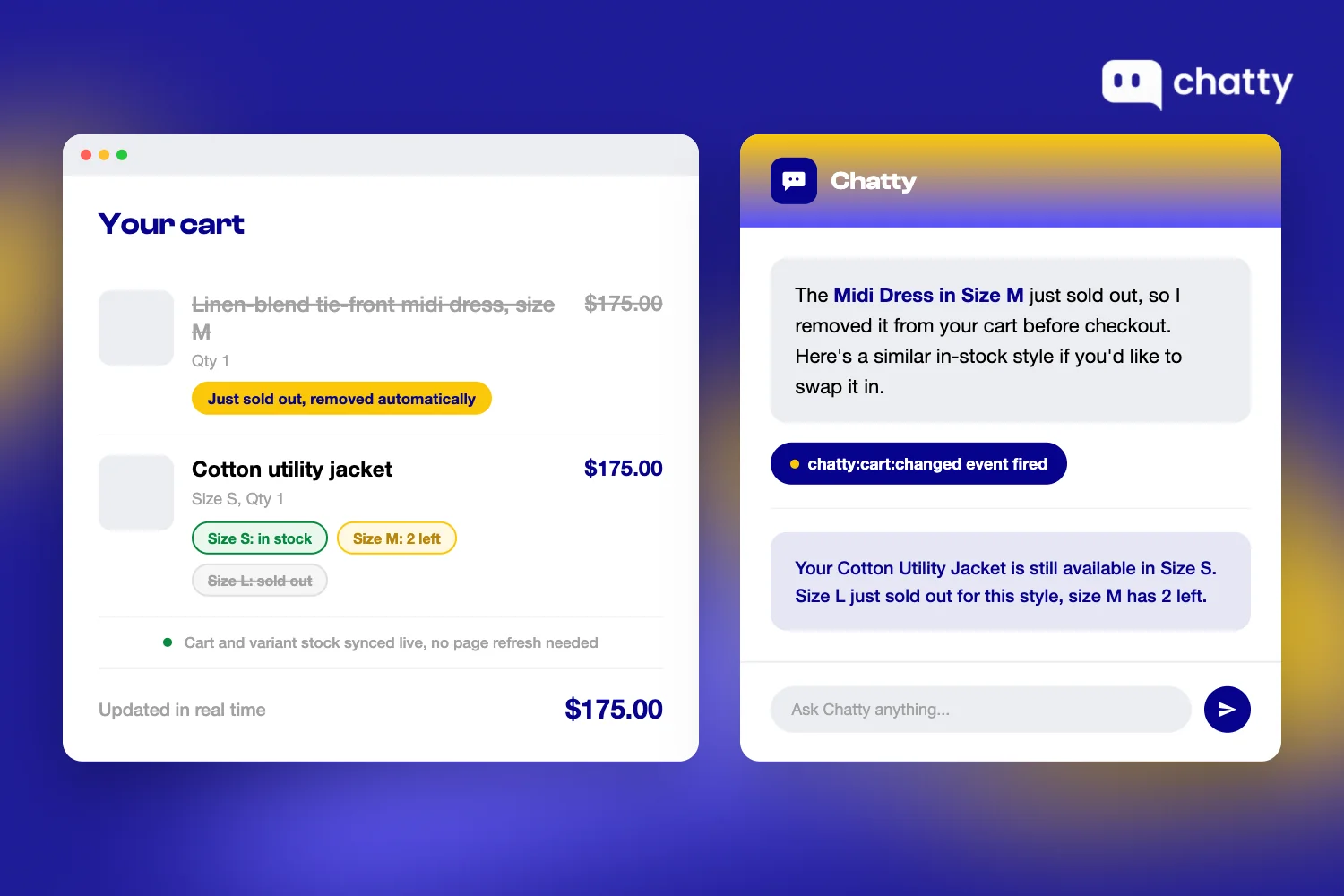
This is the cause that's most specific to BFCM and the one no evergreen checklist covers: when order volume spikes, real inventory can change faster than your store's displayed stock and price data updates. A shopper adds an item that sells out or reprices in the minutes between adding to cart and reaching checkout, and the mismatch itself is what drives the abandonment, not a UX flaw.
The fix is to keep cart state and inventory status accurate in real time, rather than reviewing your inventory process after the fact:
- Sync the cart the moment an item's status changes, so a shopper never sees a cart that looks "frozen" while stock underneath it is moving. Chatty pushes an instant update signal to your storefront the moment it changes something in the cart, so even a custom cart drawer that doesn't auto-refresh on its own still shows the right items right away.
- Keep inventory status accurate down to the variant level (in stock, out of stock, backorder), not just at the product level, since a size or color running out is what actually breaks a checkout attempt during BFCM concurrency.
- Confirm whichever tool handles proactive chat or product recommendations only surfaces products with current, accurate stock status, so shoppers aren't sent toward something that's already gone.
Mobile checkout friction at a scale desktop testing won't show you
If you've already run the mobile purchase test from the BFCM CX guide or the throttled-4G load test from Chatty's BFCM readiness playbook, you've confirmed your checkout works on a phone under normal conditions. Mobile abandonment still runs roughly 10 percentage points higher than desktop (79.84% versus 69.48%), according to Dynamic Yield's cart abandonment benchmark, a rolling tracker across the past twelve months of data. The exact gap moves slightly over time, though mobile has stayed the weaker channel throughout. That gap widens further once BFCM concurrency slows mobile networks, shrinks patience for retyping a fat-fingered field, and exposes autofill bugs that a quiet Tuesday never triggers.
The fix isn't a full mobile redesign with days left. It's finding and fixing the one step that drops the most mobile traffic:
- Pull your mobile checkout funnel in analytics and identify the single step with the steepest drop-off, not the whole flow.
- If it's a form field, widen the tap target and switch to the correct mobile keyboard type (numeric for card number, email for email).
- If it's autofill, test Safari and Chrome on an actual phone, not just a browser's mobile emulator, since autofill bugs frequently only surface on the real device.
- Fix that one step first, then move to the next-highest drop-off if time allows.

Discount codes and price-matching that don't resolve at checkout
Multiple discount codes circulate at once during BFCM, through email, banner takeovers, social posts, and third-party coupon-aggregator sites, at a volume no other week of the year sees. A shopper who hits "apply" and gets an error at the final screen doesn't retry. They leave to verify the code somewhere else, or assume your store is the one that's wrong.
The fix is to move code validation earlier in the flow instead of just showing an error at the end:
- Validate a code the moment it's entered in the cart, before the shopper reaches the final payment screen.
- Show a specific reason for failure ("expired," "minimum order not met," "one use per customer") instead of a generic "invalid code" message.
- Cap and test every active BFCM code against your actual product catalog before launch, so an expired or misconfigured code never reaches a live shopper in the first place.
What to fix first if you only have a few days left
With limited time before BFCM traffic hits, fix in this order:
- Show hidden costs earlier. This is a copy and page-layout change, not a system change, so it's the fastest fix available and addresses the single largest documented abandonment cause.
- Validate discount codes at the cart step. Also fast, usually a setting or a small flow change, and it removes a last-screen failure that otherwise reads as a broken store.
- Fix the single worst mobile checkout step. Requires a quick funnel pull and one targeted fix, doable in a day if you already know where the drop-off is.
- Review real-time cart sync and variant-level inventory accuracy. This takes longer since it touches your app or theme setup, so start it now if you haven't already, rather than treating it as a same-week fix.
If you need the full week-by-week prep calendar beyond cart abandonment specifically, Chatty's BFCM readiness playbook covers the broader timeline.
How Chatty fits into this without replacing your checkout
Chatty is a chat widget that runs on your own store, not an external AI shopping agent like ChatGPT or Gemini doing product research on a shopper's behalf before they ever land on your site. That distinction matters here because the inventory and cart-sync fix above is exactly where a tool like Chatty operates. It works on your storefront, reading and acting on your own product and cart data, not comparing your store to competitors from the outside.
Three capabilities from Chatty are directly relevant to the causes above:
- Real-time cart sync, so a shopper doesn't see a cart that looks stuck while Chatty adds, updates, or removes an item on their behalf.
- Accurate per-variant inventory status, so Chatty never recommends a specific size or color that's actually out of stock.
- Proactive chat that only surfaces in-stock products, so an AI-initiated conversation doesn't point a shopper toward something they can't buy.
None of this means Chatty reduces cart abandonment by a fixed percentage. No case study measures that claim directly. The honest version is narrower: these three capabilities close the specific inventory-and-cart-accuracy gap covered above. That is the same gap Chatty's two-layer trust framework describes, where a shopper's AI agent has to trust your store's data even though your checkout is still run by your own team.
The amplifier, not a new checklist
BFCM cart abandonment isn't a separate problem from year-round cart abandonment. It's the same four causes, hit harder by traffic, faster-moving inventory, and more competing codes than any other week gives them. Fix hidden costs and code validation first since they're fast, fix the worst mobile checkout step next, and start your inventory-and-cart-sync review now if it isn't already solid.
For the full five-stage BFCM customer experience picture beyond just the purchase step, the pillar guide referenced above is the place to work from next.
Frequently asked questions
Cart abandonment doesn't spike because shoppers behave differently at BFCM. It spikes because shopper chat volume climbs 44% over baseline (Chatty internal data), which compresses the same year-round causes, hidden costs, stale inventory data, mobile friction, and broken discount codes, into a shorter window where each one costs a real order instead of a shrug.
The causes are identical. The difference is severity and timing: at BFCM, a shopper has more competing tabs open, inventory and pricing data has less time to stay accurate under concurrent order volume, and more discount codes are circulating at once, so the exact same friction converts into a lost sale far more often.
Fix hidden costs first. Showing shipping, tax, and fees earlier is usually a page-layout or copy change you can ship same-day, while a mobile checkout fix requires pulling funnel data to find the worst-performing step before you touch anything.
No tool eliminates cart abandonment outright, and no verified case study measures a specific percentage reduction from AI chat alone. What a well-integrated tool like Chatty can do is close a specific gap: keeping cart state synced and inventory status accurate at the variant level so shoppers don't hit a false or stale product state at checkout.
When order volume spikes, real stock levels can change faster than a store's displayed inventory updates. A shopper adds an item that's sold out or repriced by the time they check out, and that mismatch itself, not a UX flaw, is what drives the abandonment. Syncing cart state and inventory status in real time at the variant level closes this gap.