





 Blog
 Free tools
 Help center




A chatbot is the chat window a customer types into. ChatGPT is OpenAI's AI assistant, built on GPT models that can also write the replies inside a chatbot. A rule-based chatbot follows a fixed script, while a GPT-powered chatbot writes each reply from context.
Think of it like a car and its engine. The chatbot is the car you drive, and the GPT model is the engine that powers it.
Chatty is the AI sales agent for Shopify stores. AI chatbot and live chat are two standout features of Chatty. The AI chatbot answers from your own Shopify data, and with live chat your team takes over from the AI and closes the sale.
92% of product answers were right on price, stock and details when we compared 300 real Chatty answers with each store's website in October 2026.
- The GPT model behind ChatGPT is the engine, and a chatbot is the car it powers. The GPT model generates natural-sounding responses from prompts, but on its own it has no store interface, buttons or workflow. It becomes practical for a store once it runs inside an application such as a customer-facing chatbot.
- Rule-based chatbots handle scripted tasks reliably but fail the moment a conversation goes off-script. A rule-based bot can guide a pizza order through a structured flow but cannot answer a spontaneous follow-up like "Which option has the fewest calories?", which is where language model intelligence becomes necessary.
- Combining a chatbot interface with ChatGPT intelligence produces something neither can achieve alone. The chatbot provides structure, workflow and conversation organization, while the GPT model provides the reasoning and natural language. Together they give replies that feel conversational and fit the context.
- The GPT models behind ChatGPT can power writing tools, voice assistants and chatbots from one underlying model. GPT models can run inside any application that processes and generates text, such as product description generators and email drafting assistants. That makes them far more flexible than a purpose-built chatbot.
- AI-enhanced chatbots use NLP to understand intent rather than just matching keywords in a fixed script. NLP-powered bots interpret what the customer means, while keyword-matching bots only respond when the exact word appears. That is the difference between a useful answer and a frustrating near-miss.
Defining Chatbot and ChatGPT
At first glance, chatbots and ChatGPT look similar: you type something, and a machine replies. What happens behind the scenes is very different.
To see their roles clearly, separate the interface (the chatbot) from the engine (the GPT model behind ChatGPT).
What is a chatbot?
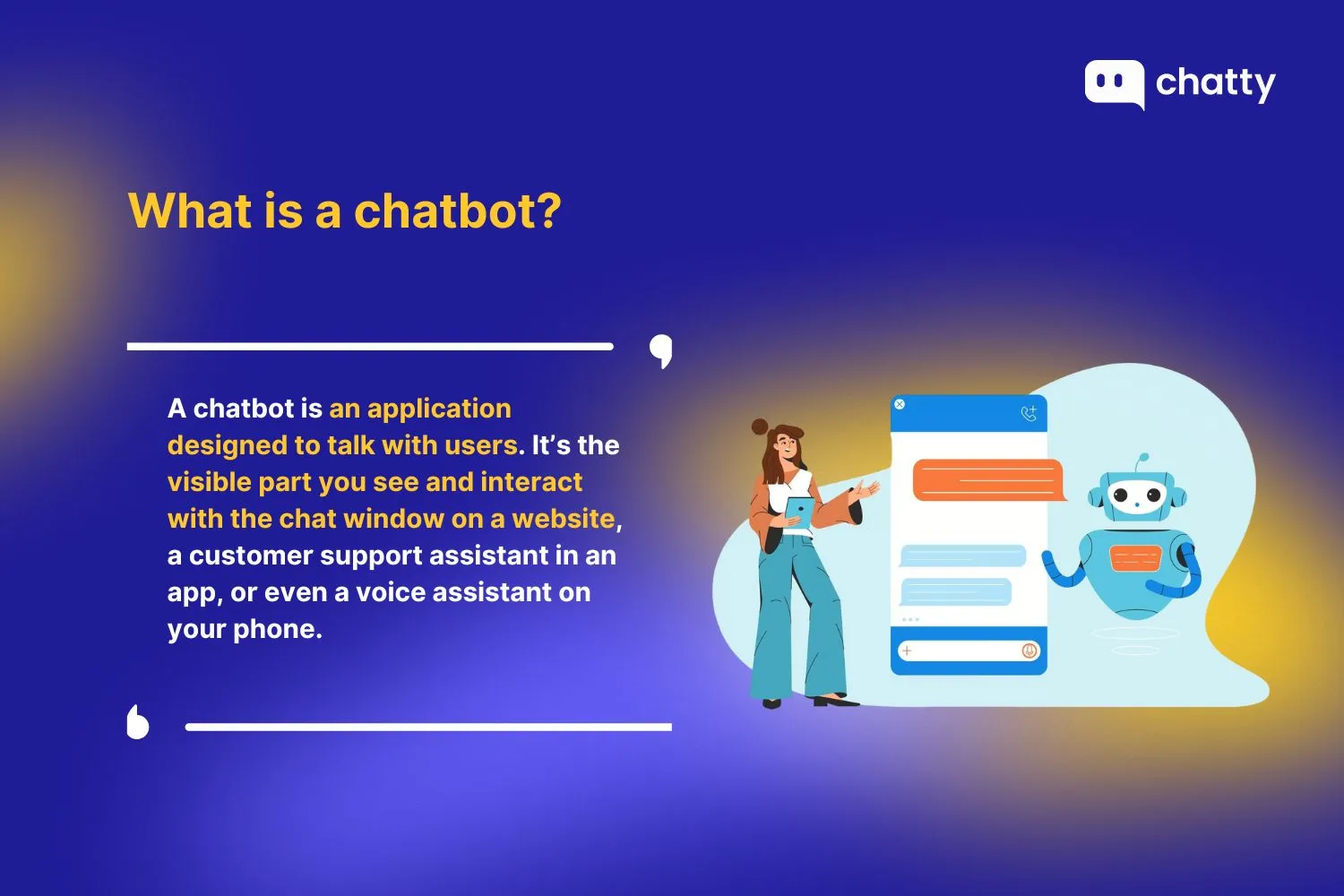
A chatbot is an application built to talk with users. It's the part you see and use. That could be the chat window on a website, a support assistant in an app, or a voice assistant on your phone.
Chatbots come in two main forms:
- Rule-based bots: These follow pre-written flows and decision trees. They give specific answers to specific questions, like a menu system. For example, "Press 1 for billing, press 2 for support."
- AI-enhanced bots: These use natural language processing (NLP) to understand intent and respond more flexibly. They still have limits, but feel less robotic.
However it's built, a chatbot is the front end. It's the structured interface that organizes a conversation, and without it users have no clear way to interact with the system.
Think of a store clerk who greets you, guides you through the aisles and helps you at checkout. A chatbot does the same job on screen: it gives the conversation order and clarity.
What is ChatGPT?
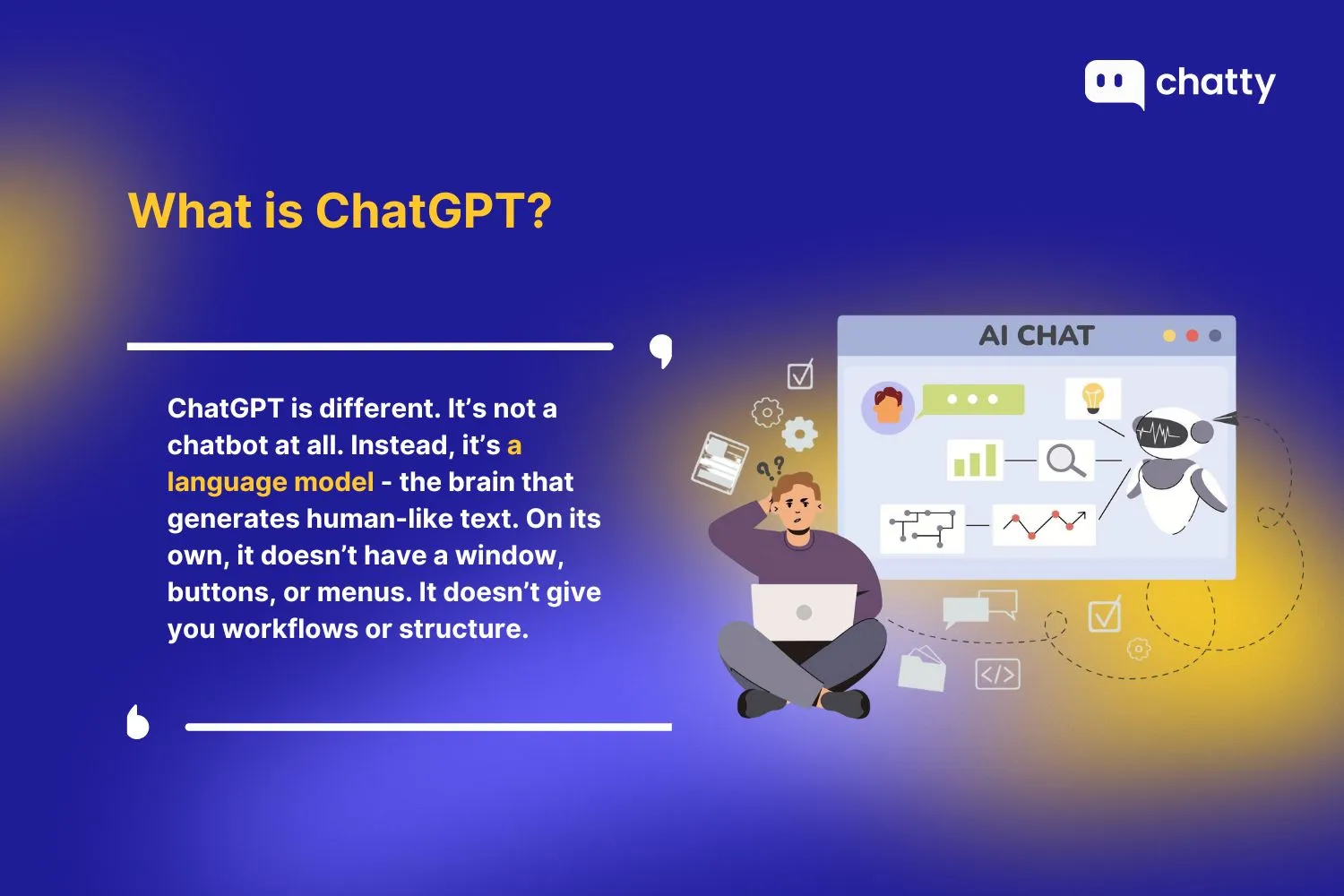
ChatGPT is OpenAI's AI assistant. For this comparison, the part that matters is the language model underneath it, the brain that generates human-like text.
On its own, that model has no window, buttons or menus for your store. It doesn't give you workflows or structure either.
What the model does best is process prompts and return natural-sounding answers. It predicts the next word in a sentence so well that its replies feel conversational, adaptive and even creative.
The catch is that your customers can't use the model directly on your store. To make it practical, developers wrap it inside an application. That could be a chatbot on a website, a voice assistant on your phone or a tool in your workspace.
Once it's wrapped, the GPT model powers the chatbot and gives it far more range than rules or scripts. If the chatbot is the store clerk at the counter, the model is the knowledge and experience inside the clerk's head.
Clarify what it really means
Here's the simplest way to explain it:
- Chatbot = the car: the full vehicle with seats, wheels and steering that takes you from point A to point B.
- ChatGPT = the engine: the power source that makes the car move.
A chatbot without a strong engine can only do basic, scripted tasks. It answers FAQs but struggles once questions go beyond its script.
An engine without a car doesn't take you anywhere, because nobody can use it directly. Put the two together and the chatbot organizes the conversation while the GPT model answers naturally and adapts to context.
If you think ChatGPT is just another chatbot, look at what else runs on the same model. The GPT model behind it can power many kinds of applications, from writing tools to virtual assistants.
If you think chatbots are outdated, you're overlooking their value. A chatbot gives users buttons, flows and a clear path to follow. In customer service, where clarity counts, that structure matters.
So you don't need to choose one or the other. Pair them: the chatbot gives your customers a reliable interface, and the GPT model makes the conversation natural.
How do the two kinds of bot compare side by side? Traditional bots and GPT-powered bots have different strengths, and knowing them helps you pick the right fit for your business.

Traditional chatbots vs. chatbots powered by GPT: Side-by-side comparison
Both kinds of chatbot aim to make talking to a machine feel natural. The way they work, and the experience they create, are very different.
Here's a quick snapshot:
| Aspect | Traditional Chatbot | GPT-Powered Chatbot |
| How It Works | Runs on pre-set rules, scripts, or decision trees. | Uses AI (GPT) to generate answers based on context. |
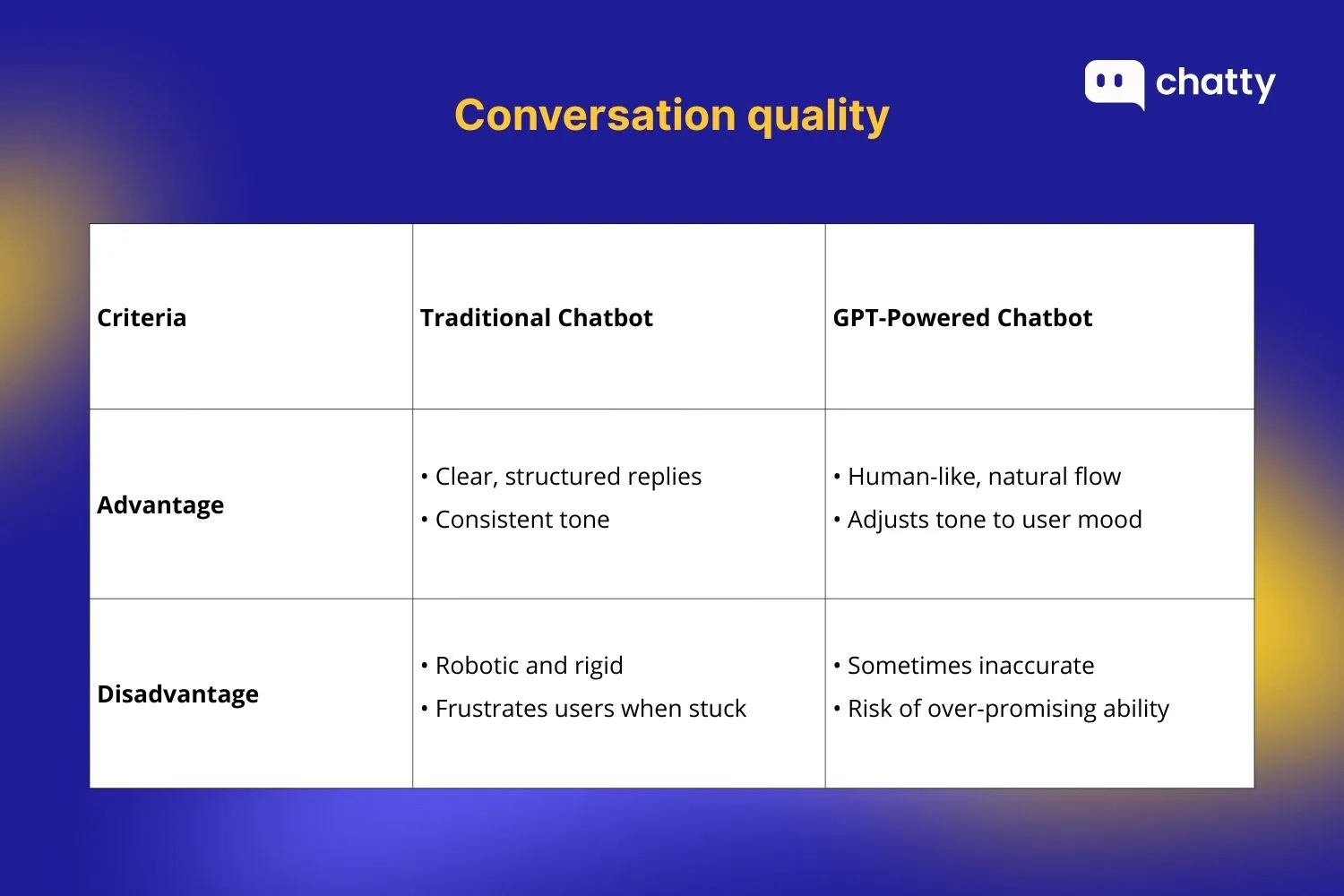
| Conversation Quality | Functional but limited; struggles outside the defined scope. | Natural, adaptive, feels closer to human dialogue. |
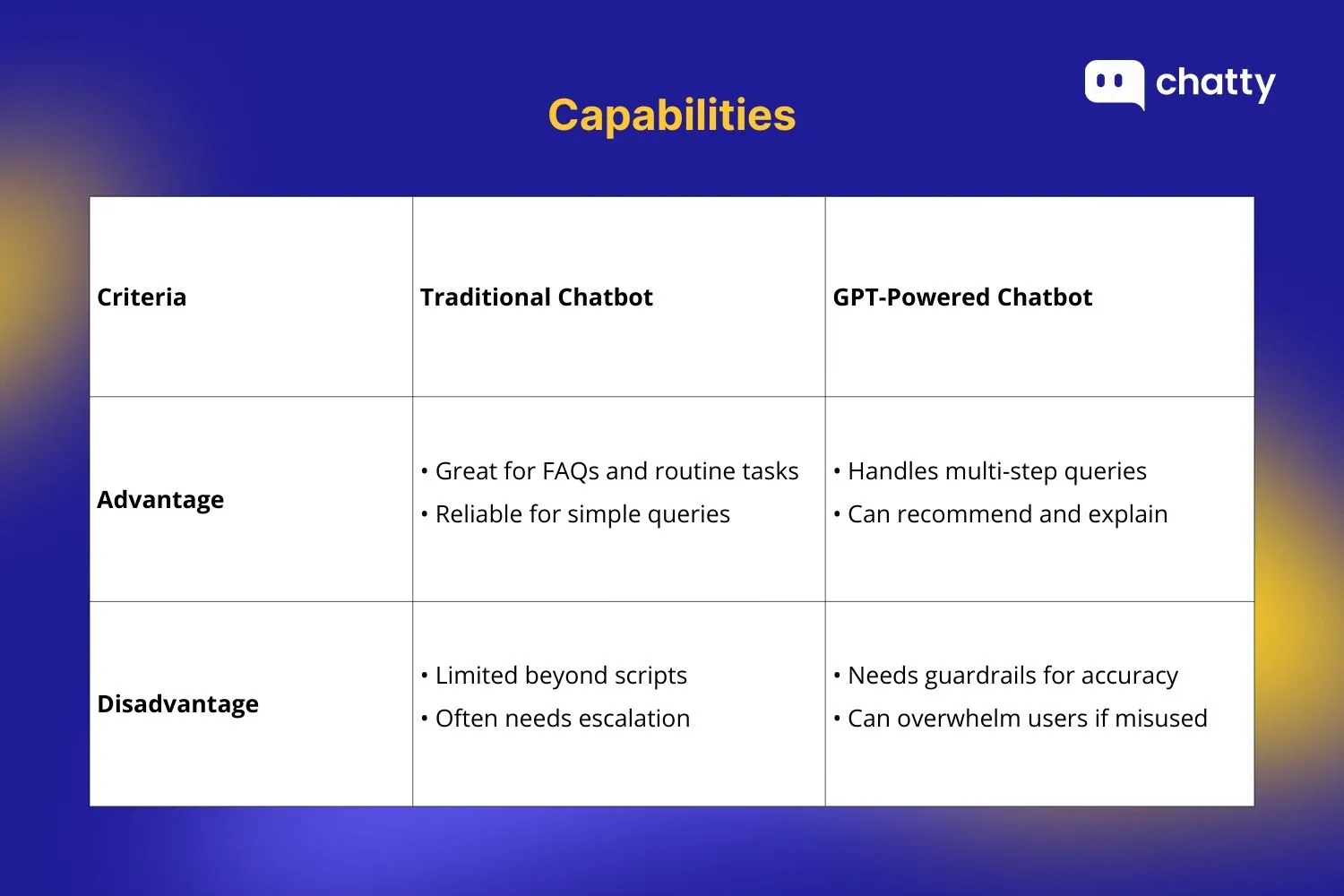
| Capabilities | Good for FAQs, order status, and routine tasks. | Can explain, recommend, and handle multi-step or complex queries. |
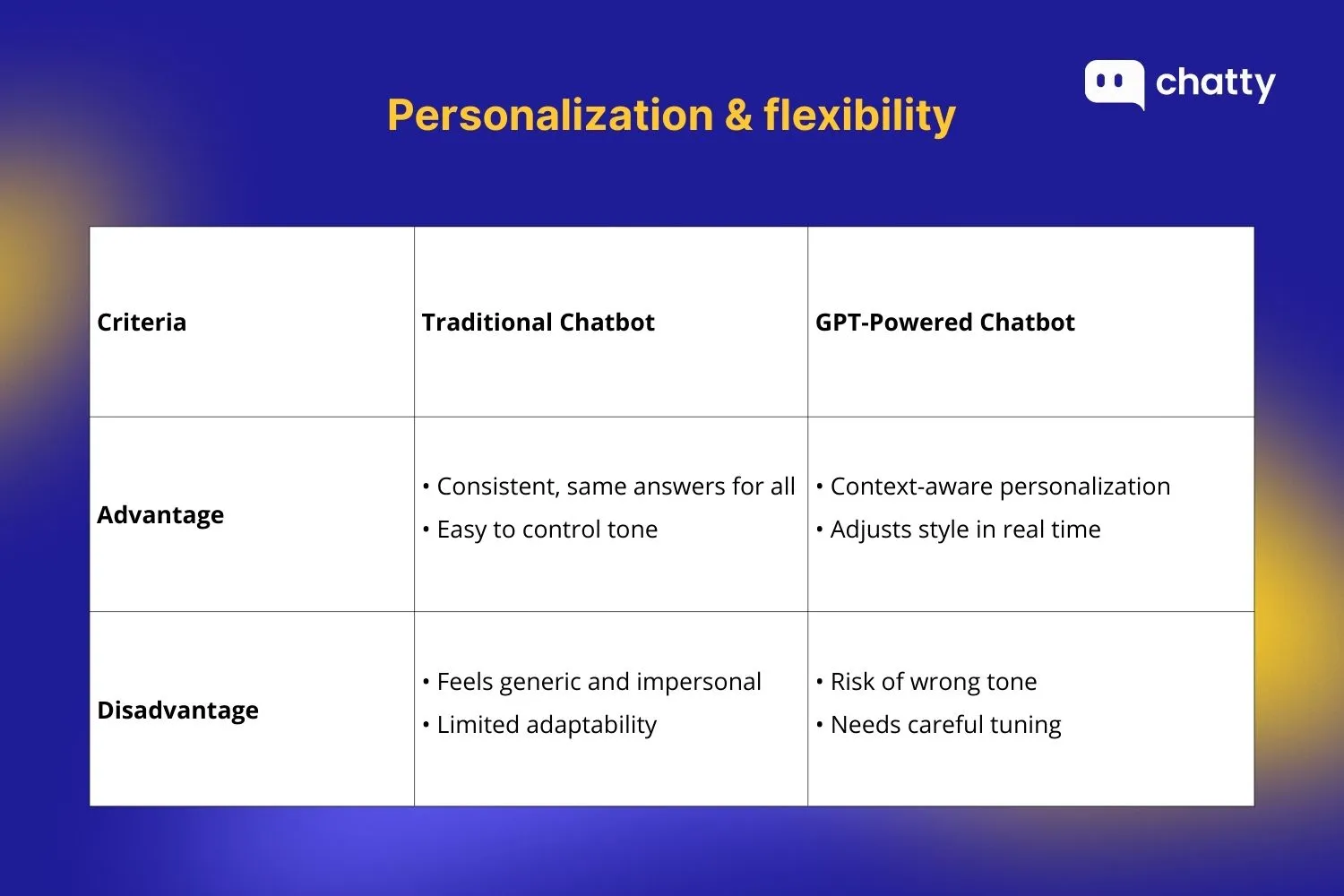
| Personalization & Flexibility | Offers generic, one-size-fits-all responses. | Adapts tone and content to user input and context. |
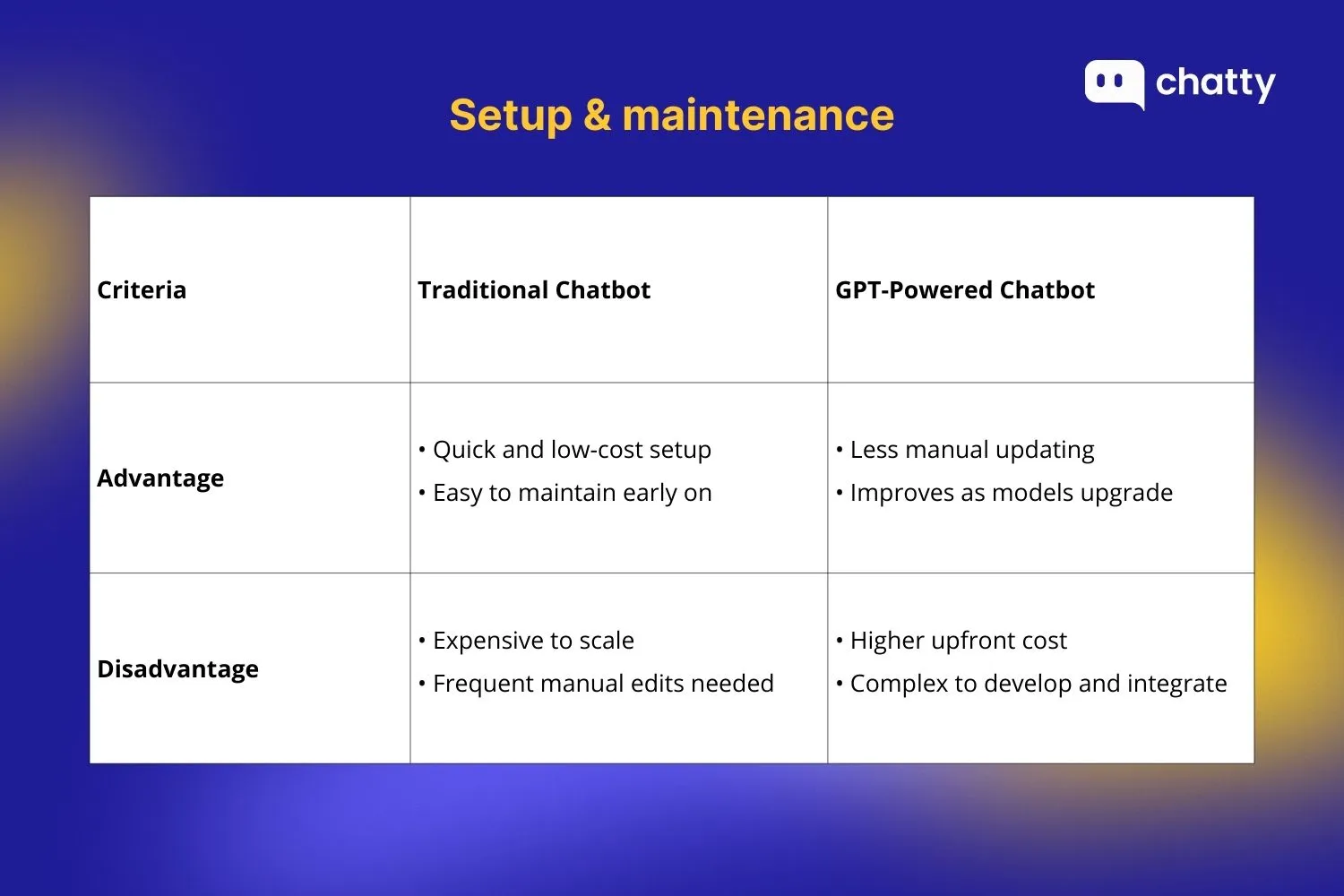
| Setup & Maintenance | Quick to deploy, low-cost, but requires frequent script updates. | Higher cost, requires monitoring, but less manual scripting. |
How it works
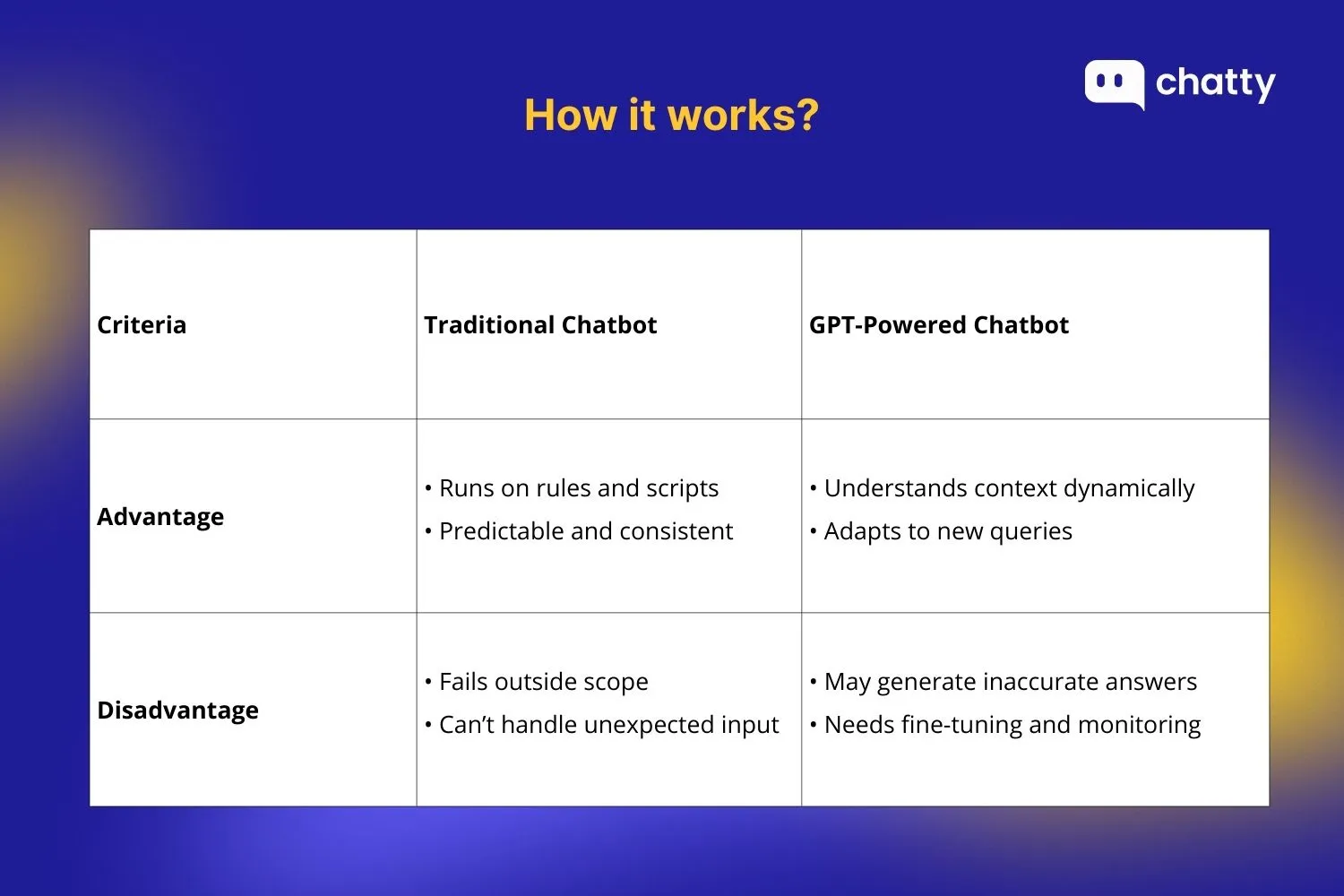
Traditional chatbots run on preset rules and decision trees, so they can only respond to what they've been programmed to handle. That makes them predictable but very limited.
When a customer asks something outside the script, the bot often fails. A survey found that 59% of consumers feel chatbots misunderstand the nuances of human requests, which shows how rigid systems frustrate users.
GPT-powered chatbots work through natural language processing and generative AI. Instead of following scripts, they read the context of the question and write a response. That makes them better at unexpected inputs and complex wording.
Because they generate their answers, they sometimes produce wrong or overconfident replies. That's why monitoring still matters.
Conversation quality
Traditional chatbots are consistent but often feel robotic. They handle simple FAQs well and struggle once a conversation gets nuanced.
In a 2022 UJET survey of nearly 1,700 consumers, reported by Forbes, 80% said chatbots increased their frustration. Rigid responses can push customers away instead of helping them.
GPT-powered chatbots do better here. They hold more natural conversations and adjust tone and style as needed.
Gartner predicts that by 2027, chatbots will be the main customer service channel for roughly a quarter of organizations. Generative models still have weak spots, though.
In a BCG study, consultants using GPT-4 on a business problem-solving task scored 23% lower than those working without it. Many of them accepted its wrong answers. A smooth conversation still needs accuracy checks.
Capabilities
Traditional chatbots excel at repetitive, structured tasks like checking order status, resetting passwords or confirming business hours. In these cases they're reliable and rarely go off track.
Multi-step or open-ended questions usually hit a dead end. The customer then has to wait for a human agent, which slows resolution.
GPT-powered chatbots go beyond routine queries. They can explain processes, guide users step by step and recommend products or solutions.
Take a follow-up like "which of these suits sensitive skin?" A GPT-powered bot can answer it. A scripted bot needs a pre-written branch.
In a LinkedIn article, Layak Singh cites a McKinsey estimate that AI can automate up to 40% of sales-related tasks. So these systems can take on roles beyond support. Keep them tied to your business goals and check their accuracy.

Personalization & flexibility
Traditional chatbots treat most customers the same. They rely on pre-written responses, so personalization stops at things like using a customer's name.
That one-size-fits-all approach falls short where context and tone matter, such as healthcare or luxury retail. In a 2018 Accenture survey, 91% of consumers were more likely to shop with brands that remember them and give relevant offers. Static chatbots struggle to do that.
GPT-powered chatbots adapt their tone, vocabulary and recommendations to each user. If a customer sounds frustrated, they can respond with empathy. If the customer is browsing, they can suggest products that fit.
Because personalization depends on reading context, misfires happen, like sounding too casual in a formal setting. With careful setup and monitoring, GPT chatbots can personalize at scale.
Setup & maintenance
Traditional chatbots are easy and cheap to set up at first. You design a flow, load in FAQs, and you're live.
The problem is long-term upkeep. Every time a product launches or a process changes, someone has to manually update the scripts. For a business that is scaling quickly, that work piles up.
GPT-powered chatbots need more upfront work, since training, integrating and monitoring AI takes time and expertise. Once they're running, they need fewer manual script updates because they adapt to new questions.
So the setup is heavier, but the ongoing workload is lighter. Over time, those savings can outweigh the initial cost.
Which is right for you?
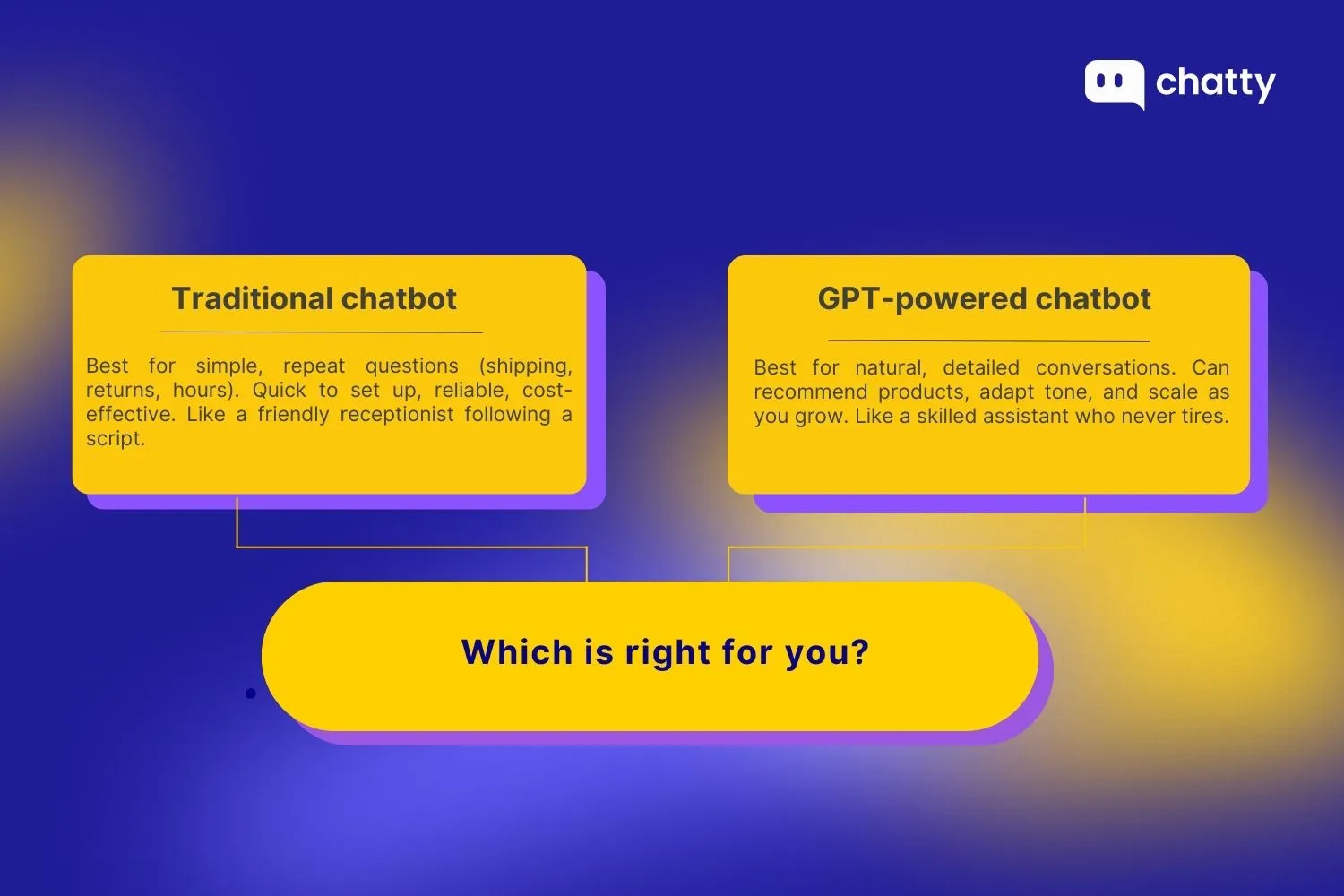
So how do you choose between a traditional chatbot and one powered by GPT? It depends on what your business needs right now.
If your customers mostly ask simple, repeat questions (shipping times, return policies, store hours), a traditional chatbot is enough. It's affordable, easy to set up and reliable for quick answers, a bit like a receptionist following a clear script.
If your customers want deeper, more natural conversations, a GPT-powered chatbot makes more sense. It can explain things in detail, recommend products and adjust its tone to how the customer feels.
Cost plays a role too. Traditional bots save money at first but get harder to manage as you grow. GPT-powered bots cost more upfront, then cut manual work as you scale.
Here's a simple way to decide:
- Pick a traditional chatbot if your support is predictable and you want a quick setup.
- Pick a GPT-powered chatbot if you need flexible, human-like support that grows with your business.
Pick the option that matches your stage and what your customers expect. Each one earns its place when it fits the job.
Chatty, the AI sales agent for Shopify
Chatty is the app we build, so weigh this section with that in mind.
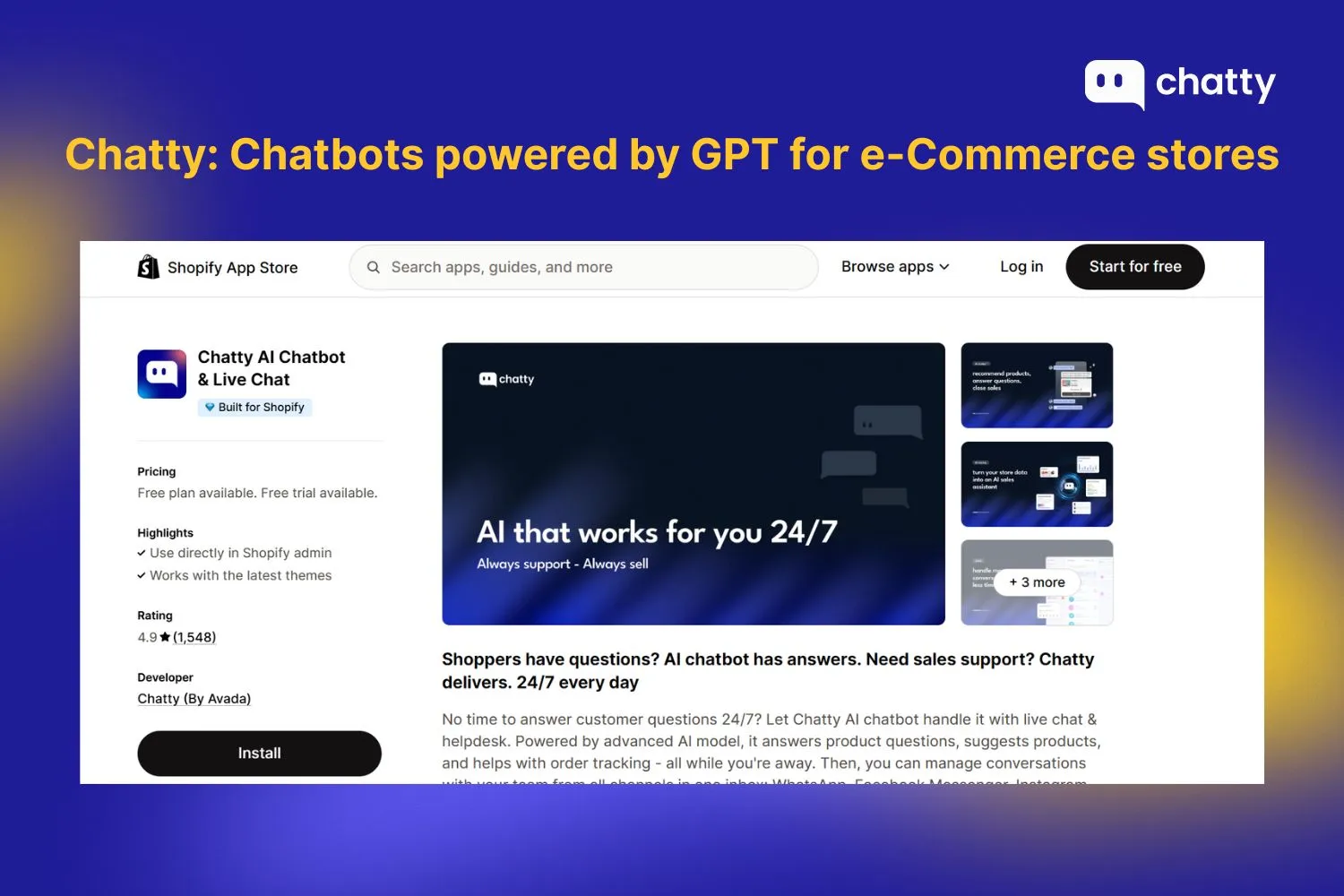
Chatty is best for a Shopify store that wants AI replies in its chat without building a scripted flow. Trade-off: Chatty works only on Shopify, and refunds and cancellations stay in Shopify admin.
Chatty is an AI sales agent rather than a scripted chatbot. It writes each answer from your store's data instead of following a fixed script. It can also take actions, such as adding products to the cart and looking up an order.
For the conversations that need a person, your team gets a live chat inbox.
Chatty runs inside your Shopify admin, so you don't have to juggle separate tools. From one inbox, your team can manage conversations from WhatsApp, Messenger, Instagram, email and live chat.
It also helps customers self-serve with a FAQ page you build in the app.
You don't have to start big. Chatty has a free plan with 50 AI conversations a month. Paid plans start at $19.99 a month (checked October 28, 2026).
It holds 4.9 stars from 1,892 reviews on the Shopify App Store, checked the same day.
Worried about setup or cost? The free plan lets you try an AI option on your own store first. It works like a sales assistant on shift around the clock.
FAQ
Not really. Traditional chatbots follow rules and scripts, while ChatGPT, OpenAI's AI assistant, runs on GPT models that understand context and reply more naturally.
The same models can power the chatbot on a store. Think of GPT as a smarter engine, not a rival to the chat window.
In many cases, yes. A GPT-powered chatbot can answer FAQs, handle support and guide sales.
Traditional chatbots are still useful for simple, structured jobs. For most businesses the best setup blends both: rules for the basics and GPT for complex or unpredictable conversations.
It depends on your business. If your customers mostly ask predictable questions, a simple chatbot works. If they need deeper, more personal help, GPT adds real value.
Many stores combine both: a chatbot for routine tasks and GPT for richer conversations.
GPT-powered chatbots can assist with sensitive topics, but they must be set up carefully. You’ll need clear guardrails, data protection policies, and human oversight for critical issues. They’re great for guiding conversations, but humans should still handle highly sensitive, regulated, or life-impacting information to ensure accuracy and trust.
Recap
A chatbot and ChatGPT are not the same thing, but they work better together. The chatbot gives customers structure and an easy way to reach you. The GPT model adds the flexibility to keep the conversation going.
For the best customer experience, pair both. Start with the questions your customers ask most, and let the chatbot route them while the GPT model writes the replies.