













"The customer is always right" is one of the most misunderstood phrases in business. Born in 1905, it still causes problems today.
The paradox is clear: businesses that take this phrase literally often fail. They burn out employees, attract abusive customers, and create unsustainable customer service expectations. Yet ignoring customer feedback entirely leads to different problems.
This guide explains what the phrase actually meant, when you should apply it, and when you should push back. Understanding the difference protects both your team and your customer relationships.
- The phrase was never meant to be taken literally.
"The customer is always right" originally meant treat complaints seriously and respect preferences — not that customers can do no wrong or demand anything they want.
- Customers are right about their experience, not always about facts.
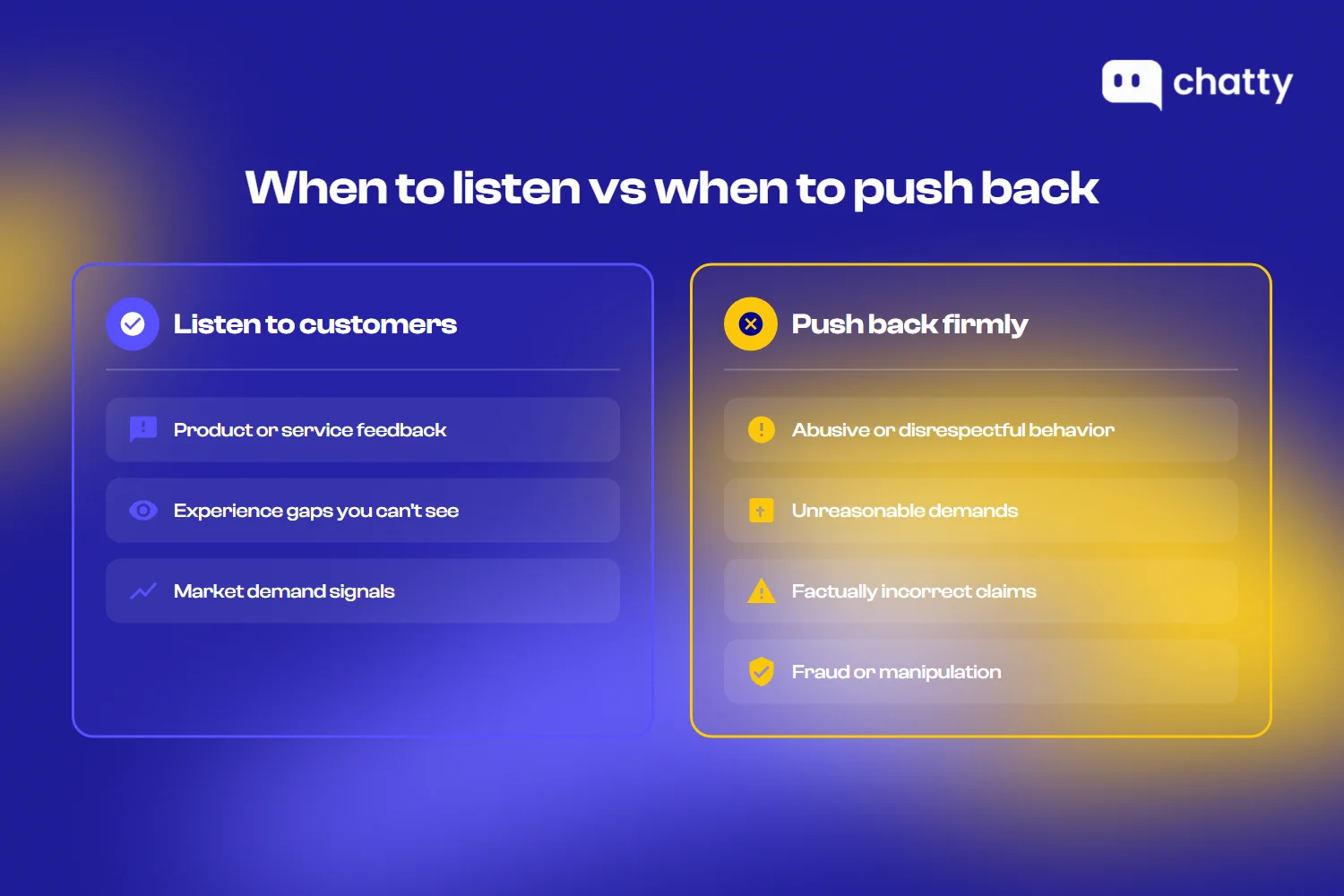
Listen when customers report problems, experience gaps, and market demand — but push back on abusive behavior, unreasonable demands, factual errors, and fraud.
- How you say no matters more than the no itself.
Use the AEO framework — Acknowledge the emotion, Explain the reason behind the policy, and Offer a concrete alternative — to preserve relationships while holding boundaries.
- Protecting employees improves customer service.
Companies with highly engaged employees see 10% higher customer ratings and 20% higher sales — respected staff deliver better service than demoralized ones.
- Replace the phrase with something more balanced.
Modern alternatives like 'listen to understand, not to agree' and 'customers and employees both deserve respect' create better outcomes for everyone.
What does "the customer is always right" actually mean?
The phrase means: treat customer complaints seriously and give them the benefit of the doubt. However, it was never meant to be taken literally.
In fact, the full phrase may have been "the customer is always right in matters of taste." If a customer prefers green over blue, don't argue. Their preference is valid, even if you disagree.
In practice, the phrase means three things:
- Trust customers when they report problems
- Resolve issues without unnecessary argument
- Respect customer preferences in subjective matters
Over time, the meaning got twisted. People started interpreting it as "customers can do no wrong" or "give customers whatever they demand." That was never the intention.
As a result, this misinterpretation creates serious problems:
- Employees feel powerless against unreasonable demands.
- Abusive customers feel entitled to mistreat staff.
- And businesses lose money trying to satisfy impossible requests.
The real meaning is about respect and trust, not submission. You can take customer concerns seriously without agreeing to every demand. You can give someone the benefit of the doubt without letting them abuse your team.
The true origin of "the customer is always right."
So, where did the phrase come from? The history reveals why it made sense at the time.
The key figures behind the phrase
Several retail pioneers popularized this philosophy around the same time:
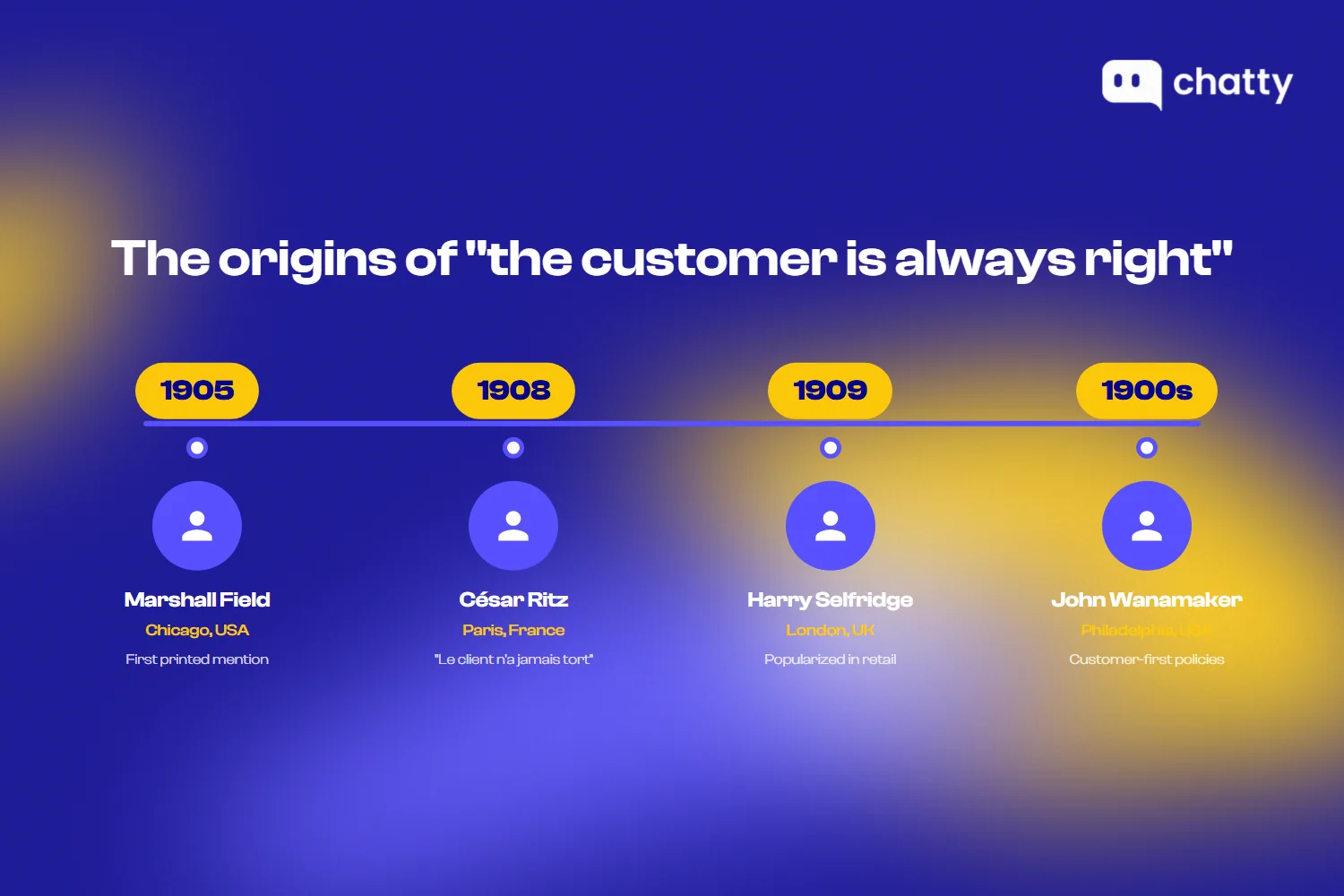
- Marshall Field, the Chicago department store founder, is often credited with the earliest printed mention in 1905. His stores became famous for generous return policies and attentive service.
- Harry Gordon Selfridge brought the concept to London when he opened Selfridges in 1909. He trained staff to treat every customer complaint as legitimate until proven otherwise.
- César Ritz, the Swiss hotelier, used a French version: "Le client n'a jamais tort" (the customer is never wrong). He applied this philosophy at the Ritz hotels starting around 1908.
- John Wanamaker in Philadelphia ran customer-first policies at his department stores during the same era.
Why was it revolutionary at the time?
Before these retailers, shopping was adversarial. Merchants expected customers to inspect goods carefully. Once you buy something, you own the problem. This was known as "caveat emptor," or buyer beware.
However, these pioneers shifted the power dynamic. They offered money-back guarantees, trained staff to be helpful rather than defensive, and built trust through consistent service.
This approach was part of the broader retail revolution of the early 1900s. As a result, department stores competed on experience rather than just price. Treating customers well became a competitive advantage.
In that context, "the customer is always right" made perfect sense. It was a radical statement that put customer satisfaction at the center of business strategy.
When the customer is right (and you should listen)?
The "the customer is always right" phrase still holds value when applied correctly. Here are the situations where customers genuinely deserve the benefit of the doubt.
Product or service feedback
Customers experience your product in ways you can't replicate internally. They encounter bugs, confusing interfaces, and gaps that your team misses.
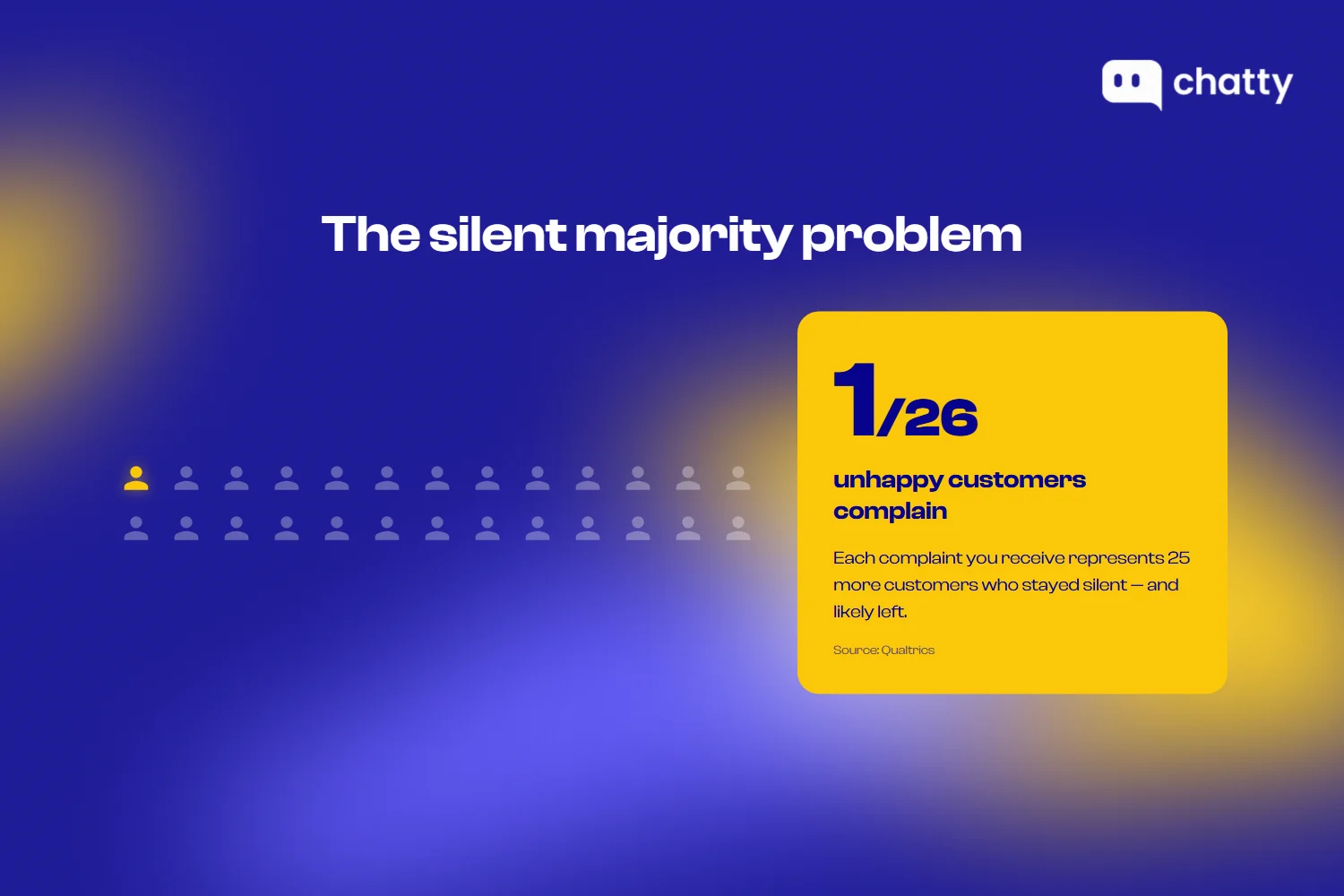
When multiple customers report the same issue, they're almost certainly right. Patterns in complaints reveal real problems. A Qualtrics study found that only 1 in 26 unhappy customers actually complain. That means each complaint likely represents many more who stayed silent.
In practice, treat feedback as data. Even when a single customer seems wrong, their perception is their reality. Understanding why they feel that way often reveals something useful.
Experience gaps you can't see internally
Your team knows how things are supposed to work. Customers only know how things actually work for them.
Broken processes often stay invisible to staff. A checkout flow might work perfectly in testing but fail on certain mobile devices. A support process might make sense to agents but confuse customers completely.
As a result, customers often spot friction points that internal teams miss. They don't have the context that makes you overlook problems. Fresh eyes catch what familiarity hides.
Market demand signals
When customers repeatedly ask for something you don't offer, pay attention. Those requests signal market demand.
"In matters of taste" applies here. If customers want features, products, or services that differ from your assumptions, their preferences are valid. You might not act on every request, but dismissing them means missing opportunities.
The companies that grow fastest often listen to what customers ask for, then build it. Customer requests led to many successful product features. Slack's threads, for example, came from user feedback about messy channels.
That said, listening doesn't mean blind obedience. Customers describe problems better than solutions. Your job is to understand the underlying need and find the best way to address it.
Over time, building a culture that genuinely listens to customers creates a competitive advantage. You catch problems earlier, spot opportunities faster, and build products people actually want.
When the customer is not right (and how to handle it)
Of course, not every customer demand deserves accommodation. Some situations require boundaries. Here's how to handle each one:
Abusive or disrespectful behavior
Verbal abuse, threats, and harassment are never acceptable. No policy should require employees to tolerate mistreatment.
The problem is that "the customer is always right" gets weaponized by bad actors. They quote it to justify terrible behavior.
In this case, give your team clear permission to end abusive interactions. Use a script like: "I want to help you, but I need us to speak respectfully. If this continues, I'll need to end the call." Document incidents and escalate to management when needed.
Unreasonable demands beyond policy
Some requests harm business viability. A customer demanding a full refund for a product they used for 6 months isn't exercising their reasonable rights.
Exploitation of goodwill policies happens. Serial returners, excessive discount demands, and requests for free products drain resources meant for legitimate customers.
The best approach is to document patterns across interactions. For first-time requests, consider flexibility. For repeated exploitation, hold the boundary firmly but politely: "I understand this is frustrating. Our policy exists to serve all customers fairly, and I'm not able to make an exception here."
Factually incorrect claims
Customers sometimes misunderstand products, policies, or their own situations. When they're factually wrong, agreeing with them helps no one.
Instead, educate without condescension. Say: "I can see why you might think that. Let me clarify how this actually works." Provide documentation or screenshots when helpful. Most customers appreciate accurate information when delivered respectfully.
Fraud or manipulation attempts
Refund fraud, fake complaints, and attempts at manipulation exist. Some customers fabricate issues to extract compensation they don't deserve.
When this happens, document everything. Look for patterns across accounts. Respond neutrally: "I've reviewed your account and I'm not able to process this request." Escalate to your fraud or legal team when necessary. Protect your business without accusing directly.
How to say no to customers without losing them?
Saying no is inevitable. The difference between losing a customer and keeping one often comes down to how you deliver the "no."
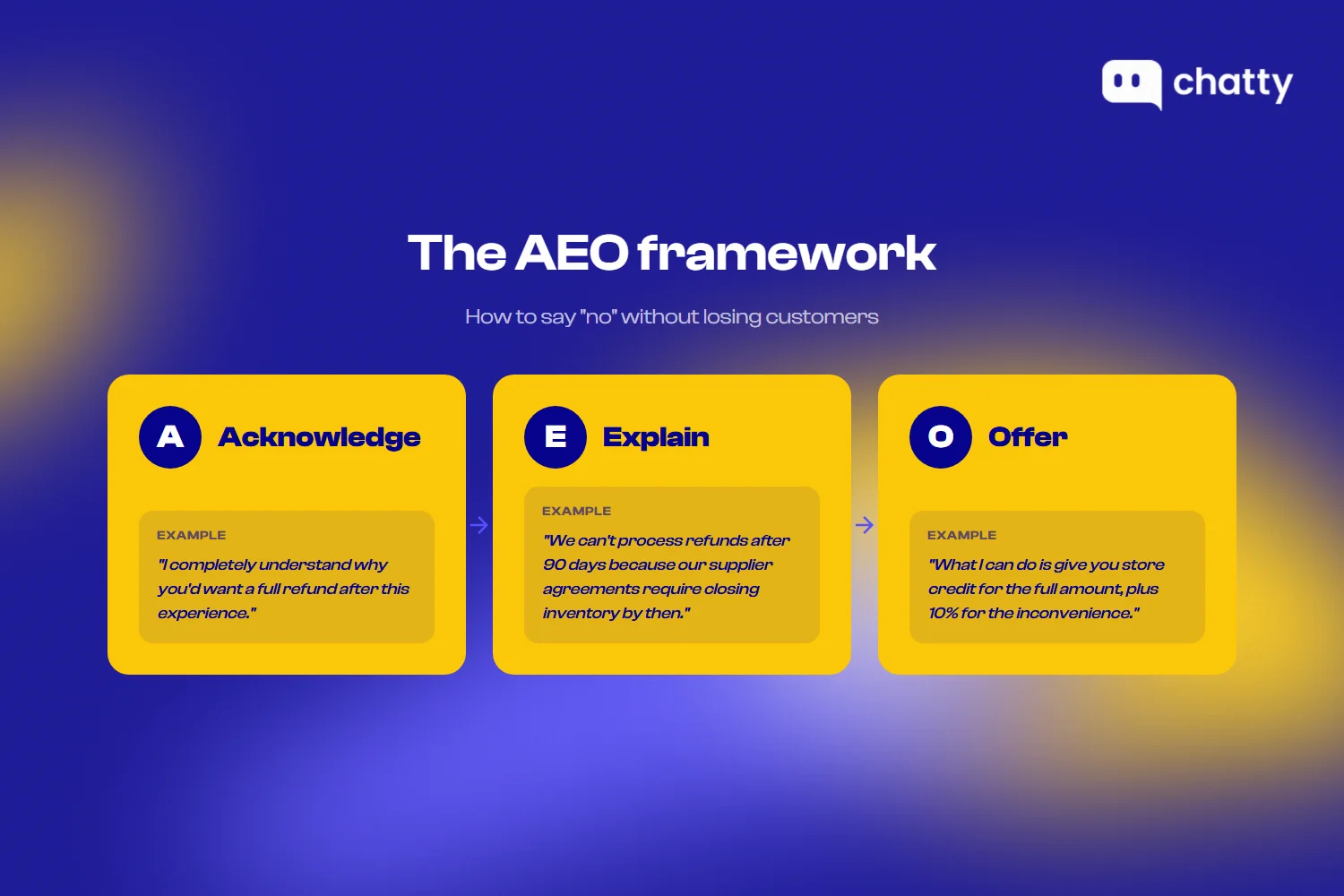
Use the AEO framework: Acknowledge, Explain, Offer
Most "no" conversations fail because they skip straight to the refusal. The AEO framework prevents this:
- Acknowledge their request and emotion first: "I completely understand why you'd want a full refund after this experience."
- Explain the reason, not just the policy: "We're not able to process refunds after 90 days because our supplier agreements require us to close out inventory by then."
- Offer a concrete alternative: "What I can do is give you store credit for the full amount, plus 10% for the inconvenience."
This sequence matters. Skipping acknowledgment makes customers defensive. Skipping explanation makes them feel dismissed. Skipping the offer leaves them with nothing.
Reframe the "no" as protecting them
Customers respond better when they see the boundary as serving their interests, not just company rules.
Compare these two responses:
- Weak: "Our policy doesn't allow refunds after 30 days."
- Strong: "We keep the return window at 30 days so we can reinvest in product quality and keep prices fair for everyone, including you."
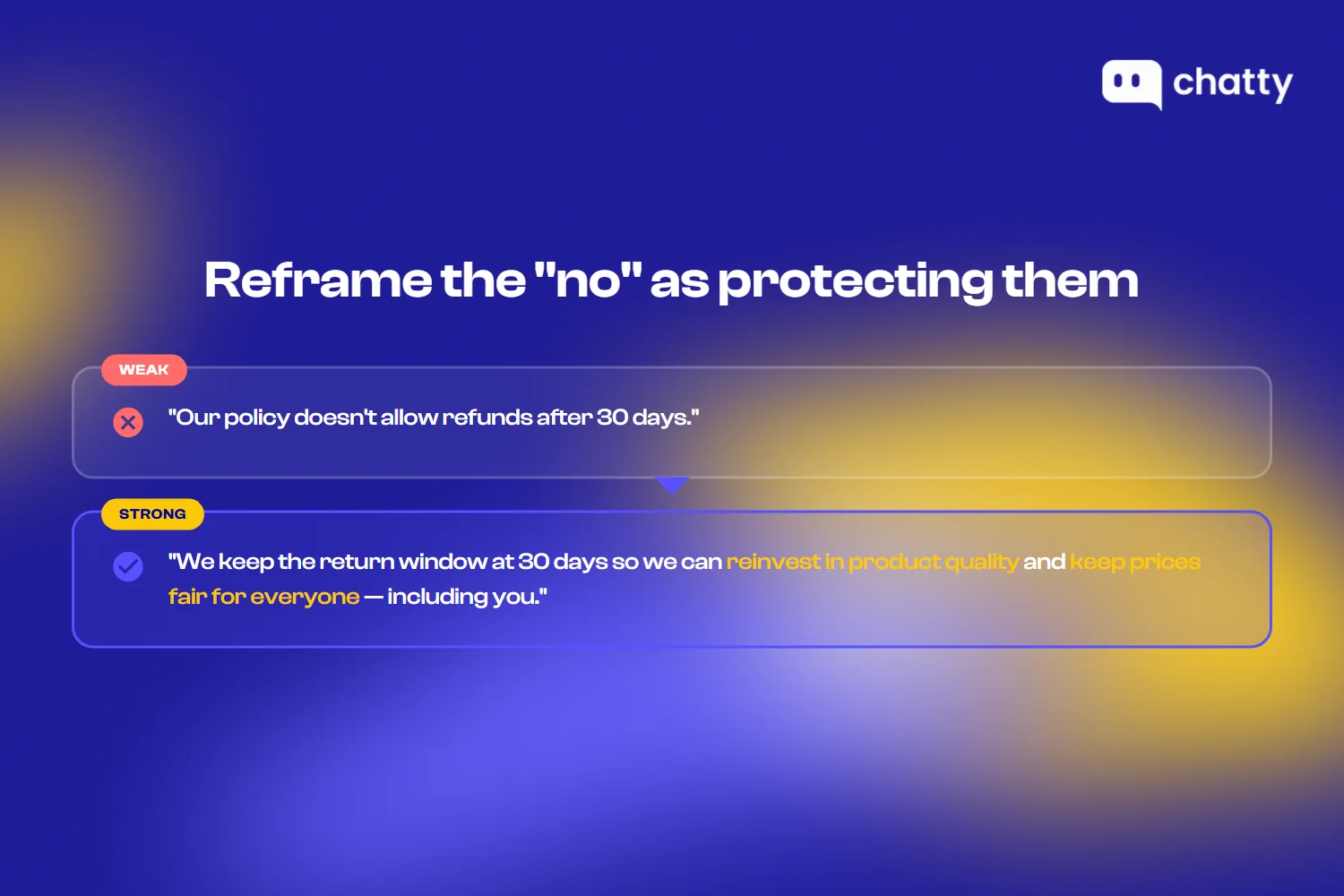
The second version connects the policy to customer benefit. It transforms a restriction into a shared value.
Give two options, never zero
Research in behavioral psychology shows that people accept outcomes more readily when they feel a sense of agency. Offering two alternatives, even limited ones, increases acceptance rates significantly.
Instead of: "I can't refund your subscription."
Try: "I have two options for you. I can pause your subscription for three months at no charge, or I can downgrade you to a lower tier and credit the difference. Which works better for your situation?"
Both options serve your business interests. But the customer chooses, which changes how they feel about the outcome.
Document exceptions to prevent pattern abuse
When you do make exceptions, record why. Note the customer's history, the specific circumstances, and your reasoning.
This protects you from repeat requests ("You did it last time!") and helps identify customers who exploit flexibility. One-time accommodations should stay one-time.
Modern alternatives to "the customer is always right"?
If "the customer is always right" creates more problems than it solves, what should replace it? Here are four philosophies that leading companies now use instead:
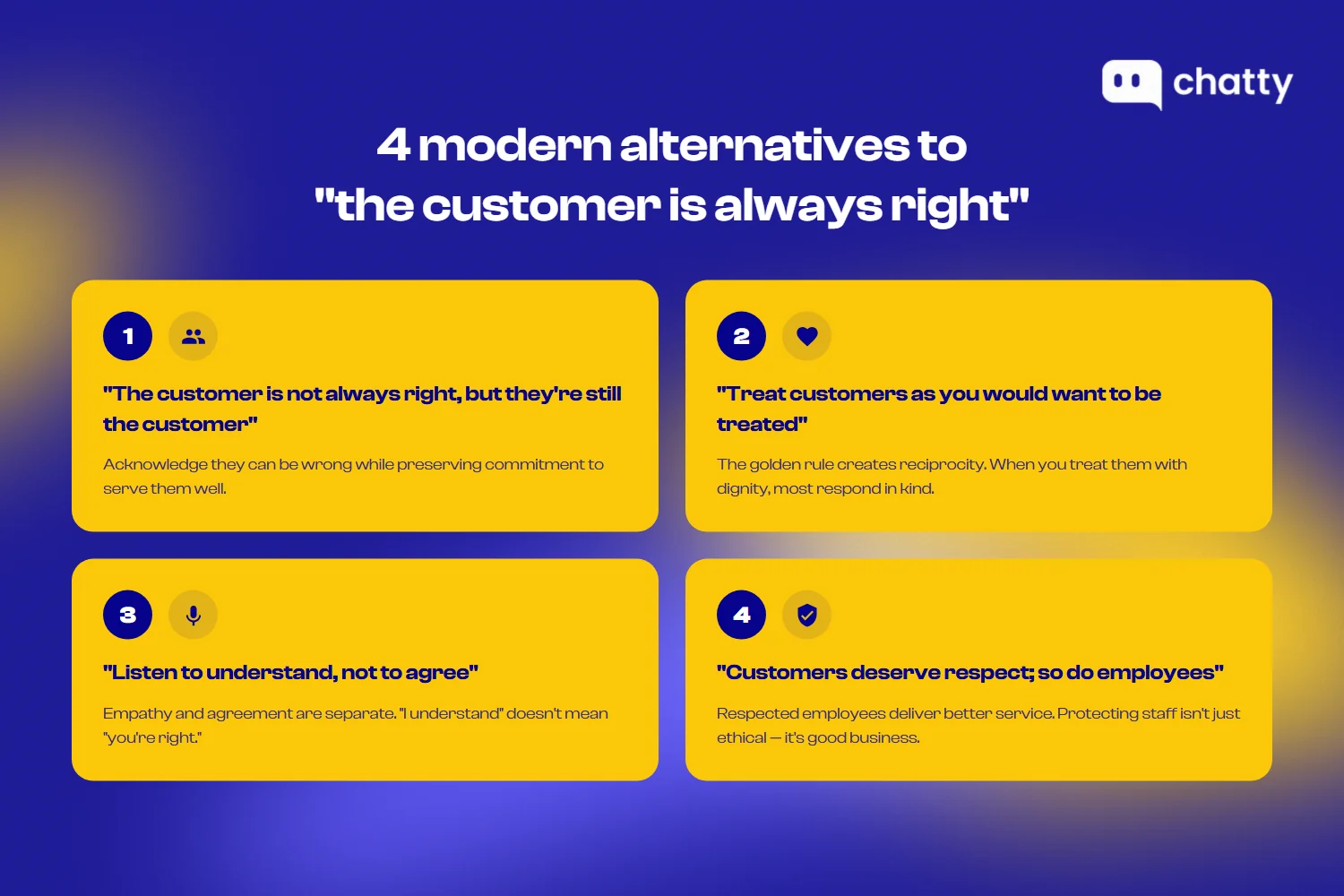
"The customer is not always right, but they're still the customer."
This reframe solves the core tension. It acknowledges that customers can be wrong about facts, policies, or appropriate behavior. At the same time, it preserves the commitment to serve them well.
The shift matters because it gives employees permission to disagree without disrespecting. A customer claiming a feature exists when it doesn't is factually wrong. But you can correct them while still solving their underlying problem. Resolution becomes the goal, not agreement.
"Treat customers as you would want to be treated."
The golden rule works because it creates reciprocity. When you treat customers with dignity, most respond in kind. When you let them mistreat you, the worst ones escalate.
This philosophy also reminds teams that customers are people having a bad moment, not enemies to defeat. The framing changes how agents approach difficult conversations.
"Listen to understand, not to agree."
This phrase solves the empathy problem. Many agents avoid validating customers' emotions because they fear it would mean conceding the argument.
In reality, empathy and agreement are separate. Saying "I understand why that's frustrating" doesn't mean "You're right." It means "I see your perspective." Customers feel heard. Employees maintain appropriate boundaries. Both can happen simultaneously.
"Customers deserve respect; so do employees."
Southwest Airlines built its reputation on this principle: employees come first. The reasoning is practical, not ideological. Respected employees deliver better service than demoralized ones.
Gallup research supports this. Companies with highly engaged employees see 10% higher customer ratings and 20% higher sales (Gallup). Protecting staff isn't just ethical. It's good business.
Final thought
Here's our honest take: this phrase has done more harm than good.
It gave bad actors a weapon. It made managers side with abusive customers over loyal employees. It created a generation of service workers who learned to swallow their dignity to keep a job.
The irony? Businesses that dropped this mindset often saw service quality improve. When employees feel protected, they show up differently. They solve problems with confidence instead of fear. They stay longer, which means customers talk to experienced people who actually know how to help.
We believe the future belongs to companies brave enough to say: "We respect you as a customer, and we expect respect in return." That's not anti-customer. That's pro-relationship.
FAQ
The phrase is attributed to several retail pioneers from the early 1900s. Marshall Field of Chicago has the earliest printed mention around 1905. Harry Gordon Selfridge popularized it in London. César Ritz used a French version at his hotels. All of them promoted similar customer-first philosophies around the same time.
Some historians believe the original phrase was "the customer is always right in matters of taste." This version clarifies that customers' preferences are valid, even if staff disagree. If a customer wants something unusual, don't argue with their choice.
The literal interpretation is largely outdated. Modern business education focuses on customer experience, lifetime value, and sustainable service models. Most programs now teach balanced approaches that respect both customers and employees.
Acknowledge their concern, then redirect. "I understand you feel strongly about this. Our policy exists to serve all customers fairly. Here's what I can do for you." Stay calm, offer alternatives, and don't argue about the phrase itself.
Yes, and sometimes it's necessary. Appropriate situations include repeated abuse of staff, consistent attempts at fraud, demands that cost more to serve than they generate, and behavior that harms other customers. Document issues carefully and end relationships professionally.
Businesses generally have the right to refuse service for non-discriminatory reasons. You cannot refuse based on protected characteristics like race, religion, or disability. You can refuse based on behavior. Consult local laws and document your reasoning clearly.
These companies empower employees to make judgment calls. They provide generous policies but also train staff to recognize abuse. The key is hiring people who naturally want to help, then trusting them to set appropriate limits.
Customer-centric means prioritizing customer needs in your business decisions. Customer-doormat means accepting any demand regardless of reasonableness. The difference is boundaries. Customer-centric companies serve customers well within sustainable limits. Doormats exhaust themselves trying to satisfy everyone.