









At High Tech Pet, an AI is the whole sales team
Automatic pet doors that sell for up to $770, two founders, nobody on live chat. In ten weeks Chatty's AI turned about 1 in 6 buying conversations into a sale and closed every order on its own, no human ever stepping in.
- Published
Who they are
- Website
- hitecpet.com
- Industry
- Pet supplies
- Key features used
- AI chatbotAutomation
Meet High Tech Pet, a California manufacturer of technical pet hardware: the Power Pet line of automatic dog and cat doors, electronic fencing, and ultrasonic bark collars.
These are considered purchases. A door runs $180 to $770 and installs into a wall or sliding glass door, so it has to match the pet's weight and the customer's setup. The catch: the whole company is about two people, with nobody on live chat.

On a door that bolts into a wall and has to fit the pet, the questions come before the money. On this catalog, they are not the easy kind.
Every day, shoppers arrived with questions only an expert could settle:
- Will a door rated for a 70 lb dog fit a barndominium wall?
- Does a patio insert seal against a right-closing sliding glass door?
- What actually separates the PXR-M from the PXR-MW?
- How quiet is the motor once it is running?
Answer one wrong on a $400 purchase and it comes back as a return, a refund, and a soured customer. But the only people who could answer them were the two who designed, built, and shipped the product. Staffing a chat window around the clock was never an option, so the questions went unanswered. On a considered purchase, an unanswered question does not wait. It leaves.
Chatty trained itself on High Tech Pet's Shopify catalog and went to work as the store's only salesperson. It does not stop at answering the question; it carries the shopper all the way to a paid order.
Chatty sells in four steps, following the buyer from first question to checkout:
- Product recommendation. It learned the full catalog, so it names the exact door for a shopper's dog and doorway, and explains why.
- Model comparison. Close variants are where buyers freeze, so Chatty lays a PXR-M against a PXR-MW and gives a clear, confident call.
- Objection handling. When the price lands hard, it reframes the value or offers a cheaper model that still fits, instead of losing the sale.
- Closing in the chat. Once a buyer decides, it carts the product and returns a checkout link, without ever leaving the conversation.
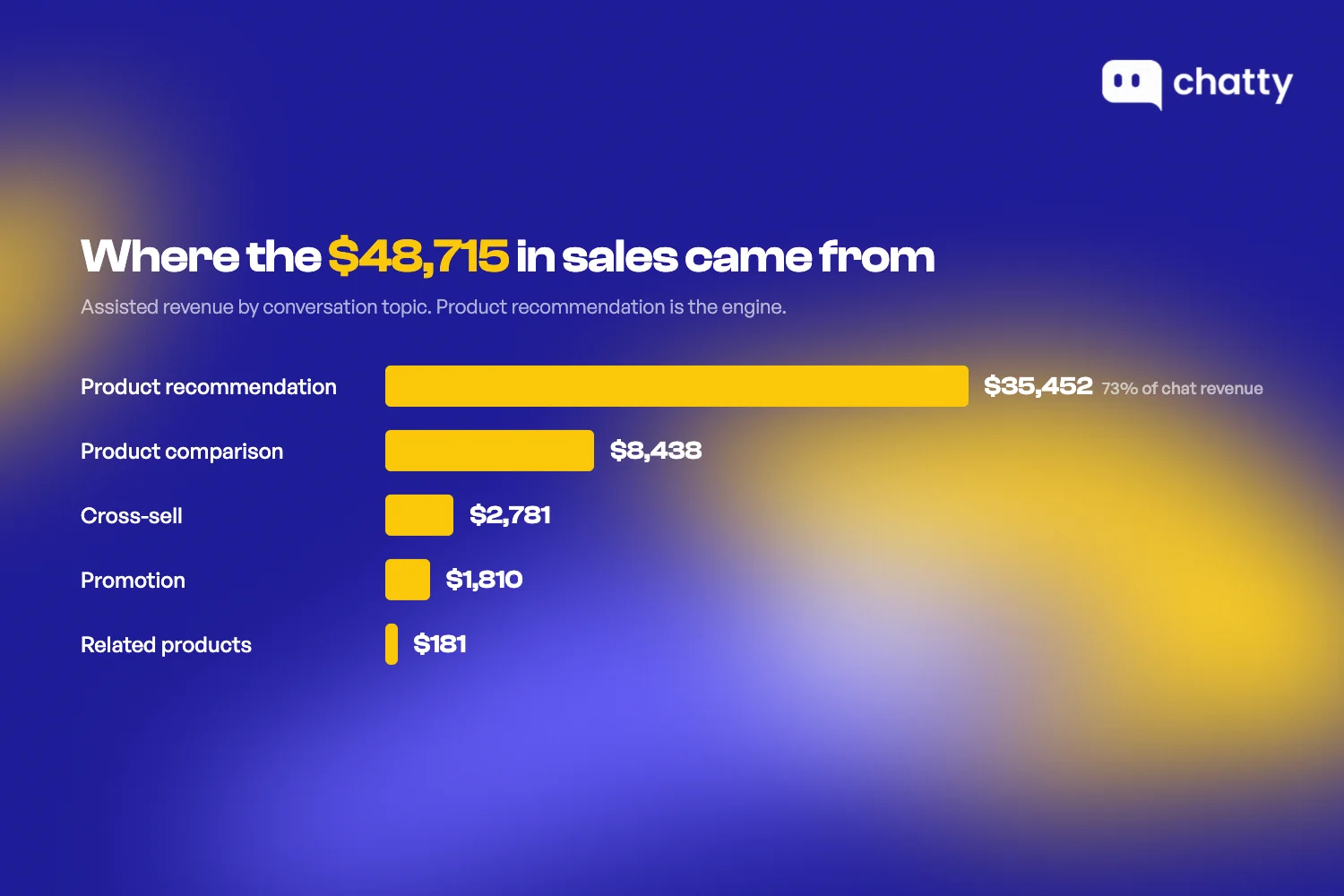
The first step carries the store. Product recommendation drove nearly three-quarters of everything Chatty sold:
From complaint to sale
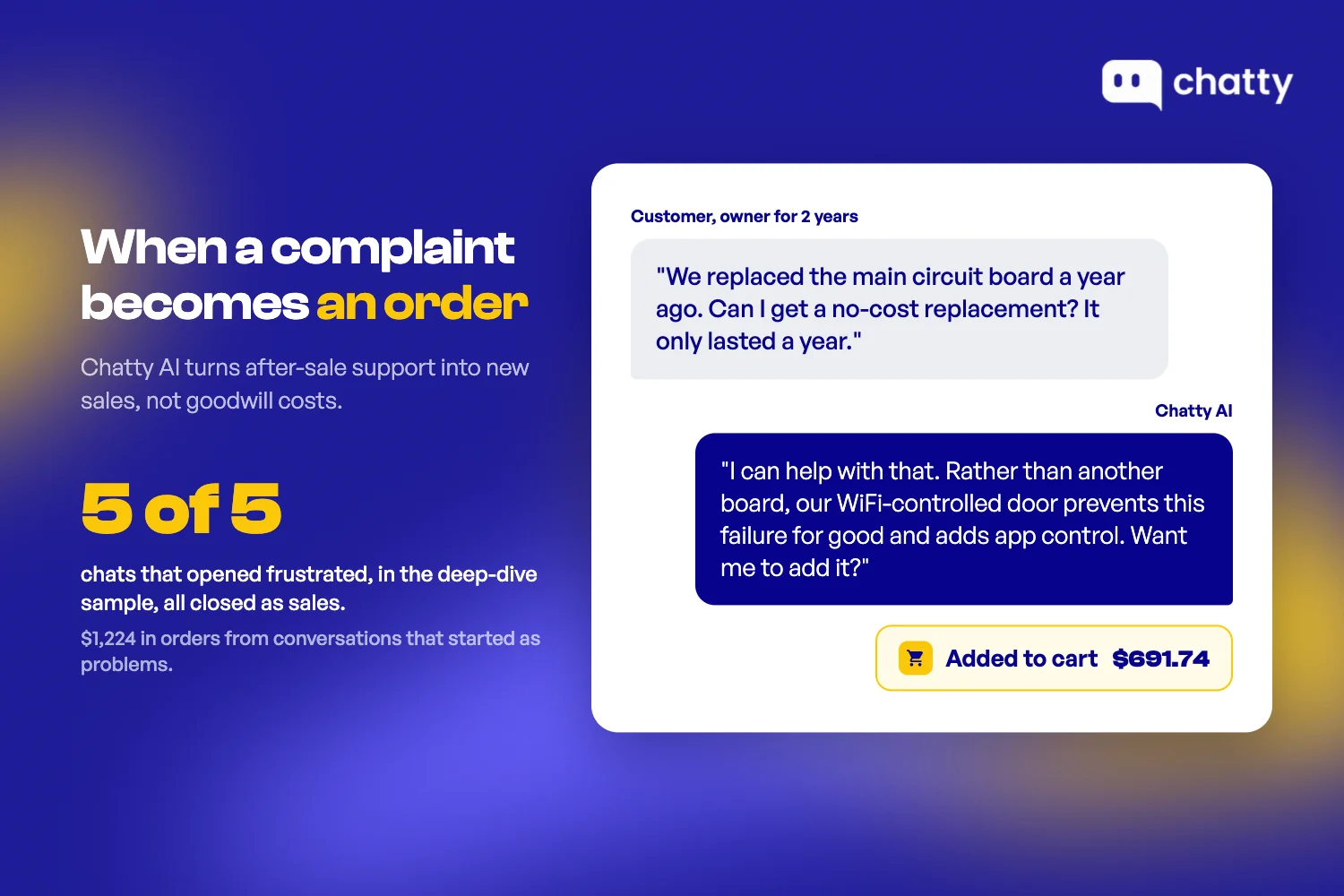
Chatty does not only sell to people who came to buy. Many who write in are longtime owners with a worn cable or a dead circuit board, annoyed and expecting a free part. A typical store hands them a goodwill part and eats the cost. Chatty offers the upgrade instead: the newer door that ends the problem for good, not a patch. In the deep-dive sample, five chats that opened as a complaint all closed as sales. Here is one of them:
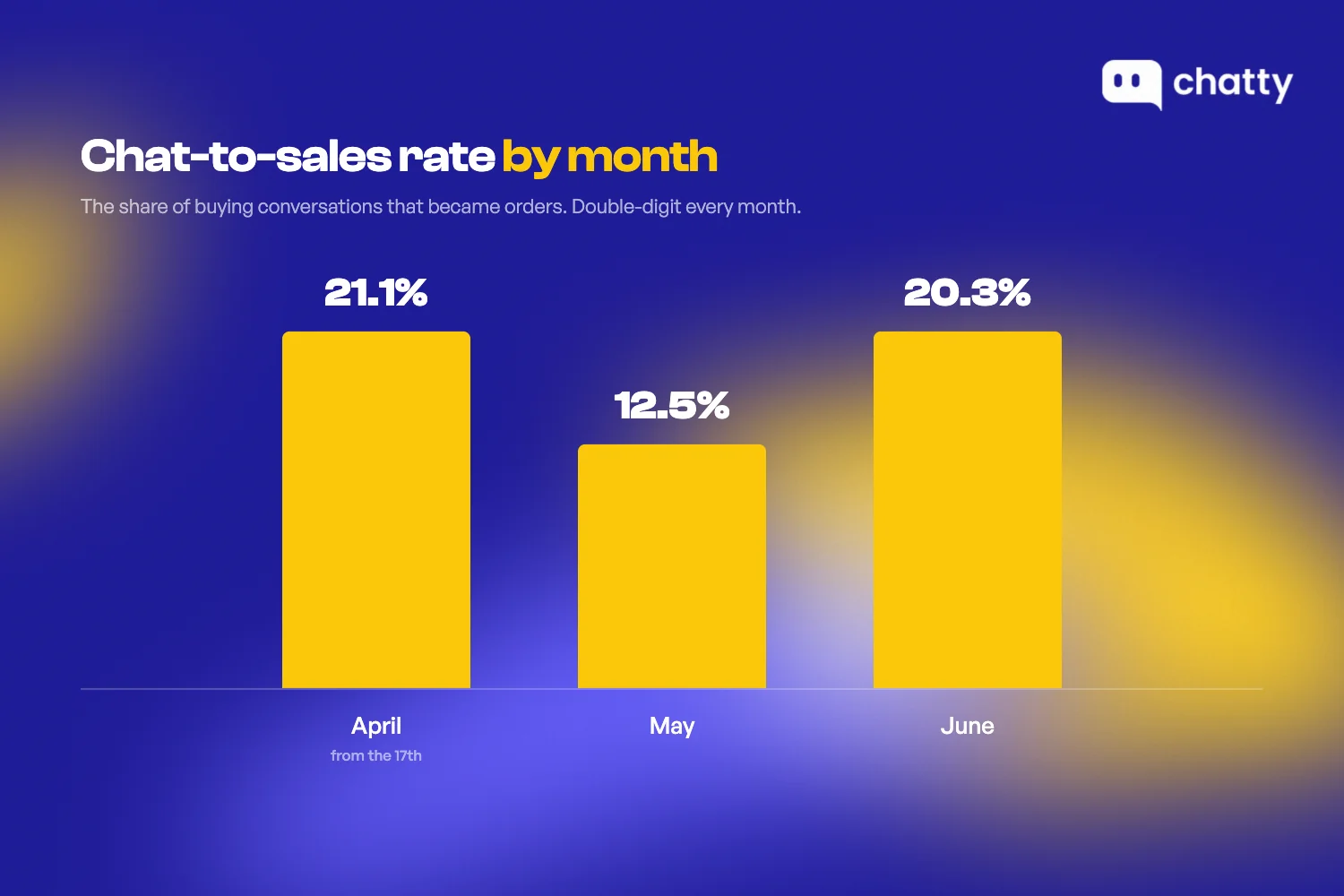
The pattern held for the full window. About one in six buying conversations became an order, and none of those orders needed a person to close it.
Chat-to-sales stayed double-digit every month and hit its high in June:
Set against the starting point, the shift is clean:
| Before Chatty | After Chatty | |
| Who answered pre-sale questions | No one. Two founders, no chat staff | AI, 24/7, 3,948 questions answered |
| Buying conversations that converted | 0%, no channel existed | 16.6%, peaking at 20.3% in June |
| Human hours spent closing orders | n/a | 0. Every order closed by AI alone |
| Escalations to a human | n/a | 4 of 1,567 conversations |
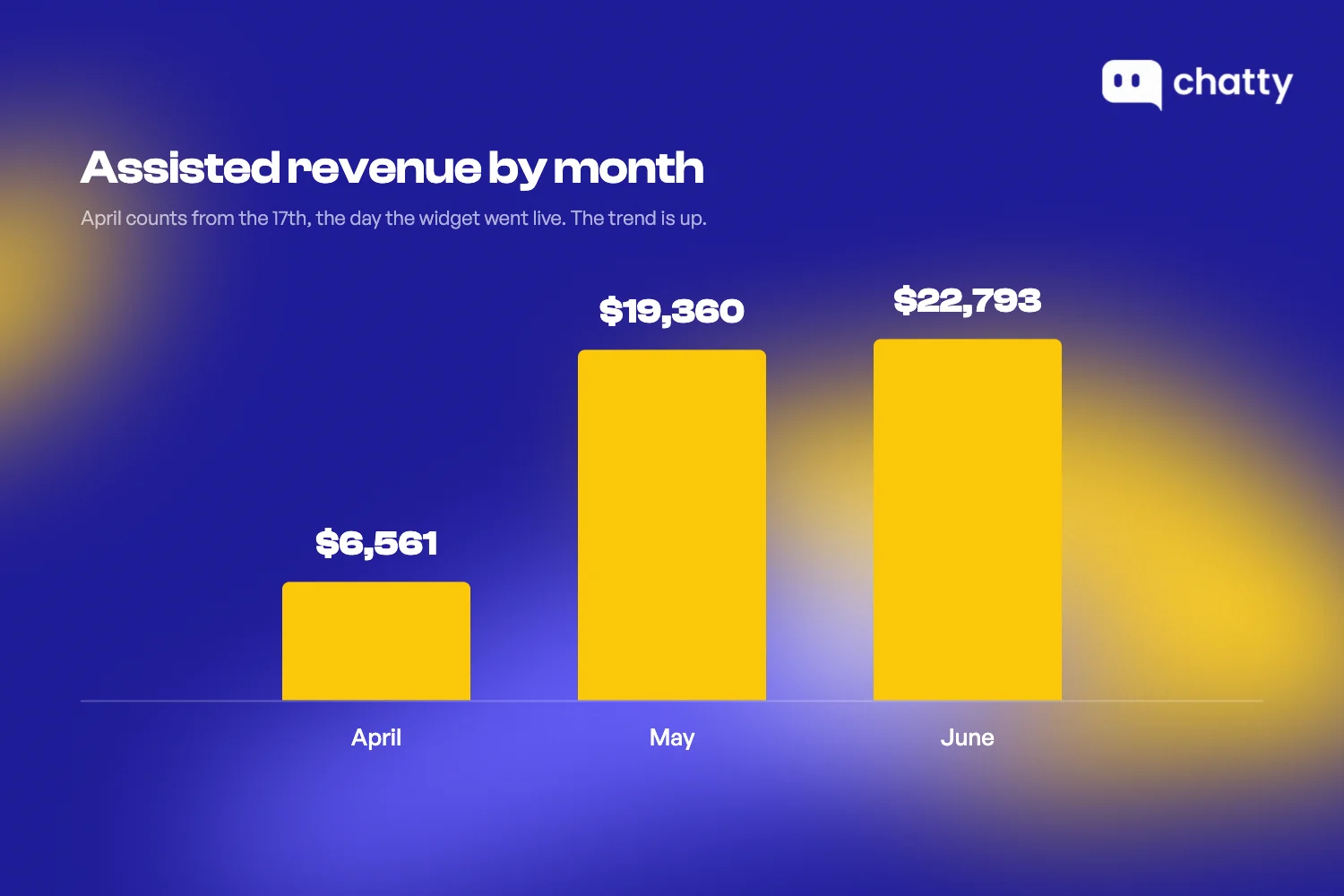
Revenue rose every month, climbing steadily from April to June even as the conversion rate dipped in May:
Underneath the headline, the numbers held up as the volume grew:
- 99.7% of conversations resolved without a human.
- About 70% of questions answered across every topic, rising to 80 to 89% on the buying topics that carry the revenue.
- 84% of orders closed the same day the customer chatted.
Every number here counts assisted chat revenue only, the sales Chatty can attribute to a conversation, not the store's total.
All figures cover April 17 to June 30, 2026, from the day Chatty went live.
High Tech Pet is not a special case. It is a clean example of a category: technical, high-priced gear that installs into the home and gets sold by a handful of people. Pet doors, electronic fencing, smart-home hardware, the same forces run through all of them.
Line up the category's problems against what Chatty does about them:
| The category problem | What the AI does |
| A wrong purchase is an expensive return: buyers must match pet weight, mount type, and model on a $180 to $770 product | Advises in context and recommends the right model, lifting chat-to-sales to 16.6% |
| Too many variants paralyze the choice | Compares models instantly, its most accurate topic |
| Long product life means constant parts and repair demand | Diagnoses the failure, then recommends and upsells the upgrade |
| Support is the real sales channel, but the team is tiny | Becomes the only salesperson, always on |
| High order value makes buyers hesitate | Handles the objection with product value and budget options |
The hard part of selling this gear is the mismatch: the decision is heavy, sizing plus a high price, while the seller is light on staff. Chatty, which knows the catalog, closes that gap, and the numbers prove it closed here.
More related case studies



Your store’s case study is waiting to be written
These results are not outliers. They are what happens when your AI actually knows your products, your policies, and your customers.