








Every AI sales agent comparison eventually turns into a feature checklist: who has proactive chat, who has revenue tracking, who's cheaper. That checklist misses the question that actually determines whether the AI gives your customers a good answer: what did the AI learn from, and how precisely does it know that answer is still true?
Chatty trains its AI directly on your product catalog, structured records with price, variants, and stock status, with no product cap on Plus. Zipchat trains on a broader crawl of your store's pages, products, blog posts, FAQs, and policies, measured in "training pages" rather than product count. That single architectural choice is the root cause of nearly every other difference between them: pricing tiers, feature gating, and where each tool wins.
- The real difference is how each AI learns your store. Chatty trains on structured product records (price, variants, stock) with no product cap on Plus; Zipchat crawls store pages, metered in training pages. That split drives almost every other gap.
- Chatty has a real free plan; Zipchat has only a 7-day trial. Chatty: 50 AI conversations/month at $0, renewing. Zipchat's cheapest access is a 7-day trial on its $49/month Starter plan.
- Zipchat unlocks proactive AI and revenue tracking one tier lower. Both ship from Zipchat's $49 Starter; Chatty gates them to its $68.99 Pro plan.
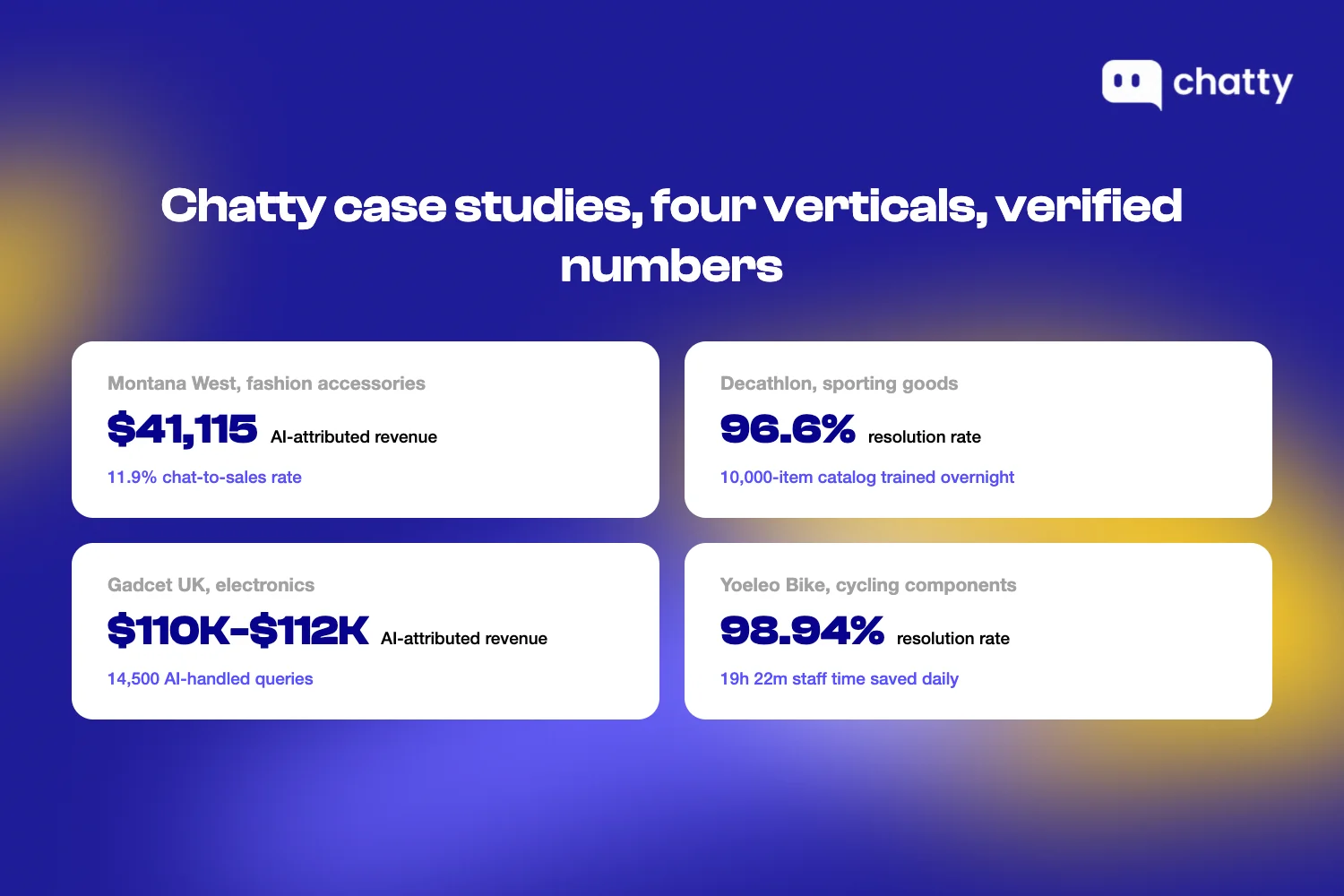
- Chatty's edge is named, dollar-figure case studies. Montana West ($41,115 AI revenue), Decathlon (96.6% resolution), Gadcet UK ($110K+), Yoeleo Bike (98.94%) — specific, sourced numbers.
- Zipchat wins on multi-store pricing and platform reach. It covers 2-20 stores per subscription across Shopify, WooCommerce and Wix, plus a benchmarked 20-39% WhatsApp cart-recovery rate. Chatty is single-store, Shopify-only.
The real difference: product-trained AI vs page-trained AI
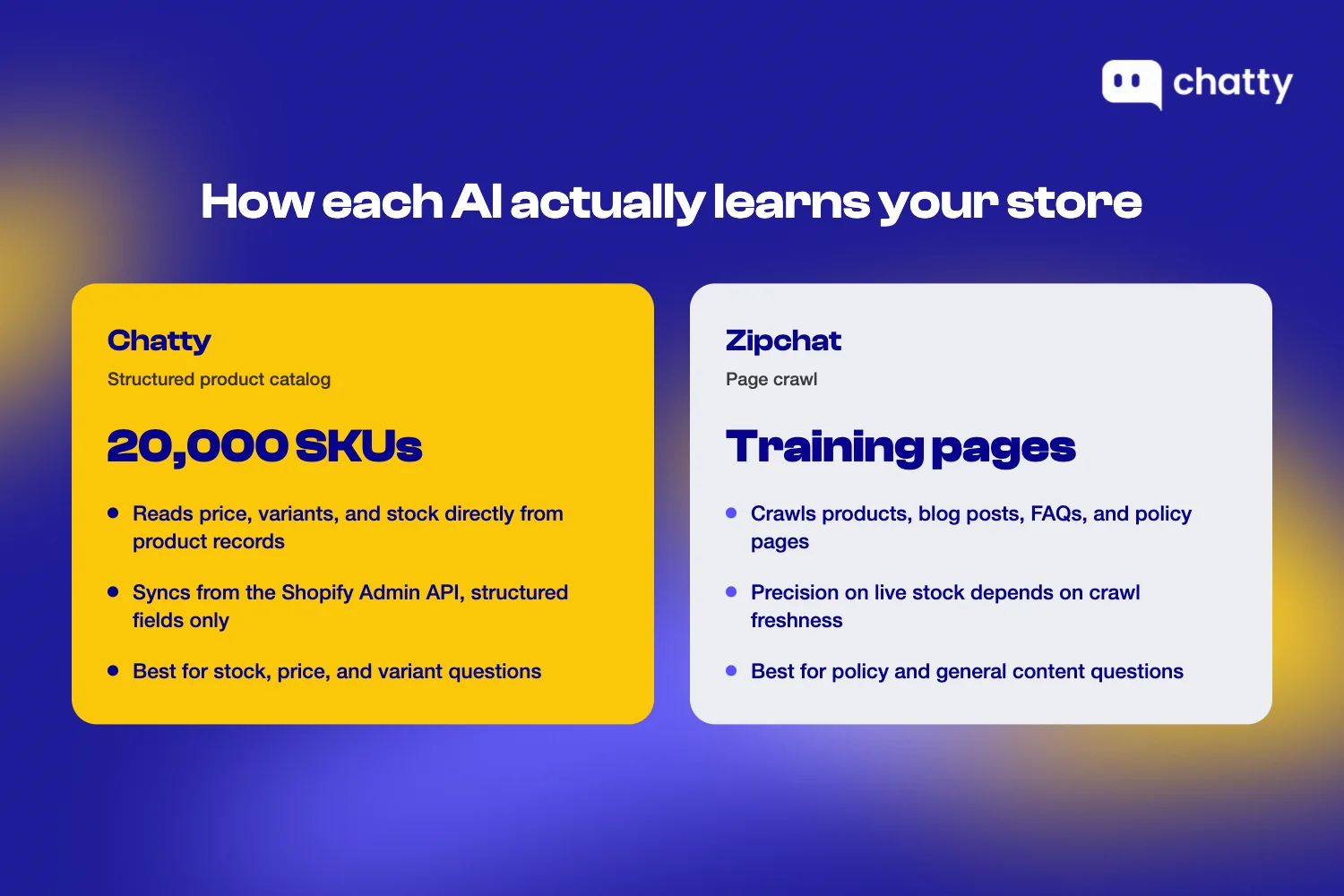
Chatty's AI answers a question like "is the size 9 in stock" by looking up a live product record. Zipchat's AI answers the same question by matching it against crawled page content, which may or may not reflect current inventory depending on crawl freshness.
This isn't a marginal implementation detail. It's the difference between a sales agent that reasons over your catalog the way an inventory system does, and one that reasons over your content the way a search engine does.
Why product-level training wins on transaction accuracy
A shopper asking "does this jacket run true to size" or "do you have this in stock in blue" is asking a catalog question, not a content question. Chatty's product-level training is built to answer exactly that: variant, price, and stock data pulled from structured records, not inferred from a product description page that may be out of date.
Decathlon, one of the world's largest sporting goods retailers, is the clearest evidence for this. Chatty's AI learned Decathlon's 10,000-item catalog overnight and reached a 96.6% resolution rate, cutting response time from over four hours to instant, according to Chatty's published case study. That kind of resolution rate on a catalog that size is a training-precision result, not a chat-volume result.
Why page-level training wins on content breadth
Zipchat's crawl-based approach has a real advantage: it picks up policy pages, blog content, and FAQ text that a pure product feed doesn't include. A question like "what's your return window for international orders" is a content question, and a broader crawl is built to catch it.
The tradeoff is precision on live commerce data. A page crawl runs on a schedule; a structured product feed reflects the catalog as it exists at query time. For questions about price, stock, or variant availability, that gap matters. For questions about policy and general information, it mostly doesn't.
How this plays out in a real onboarding timeline
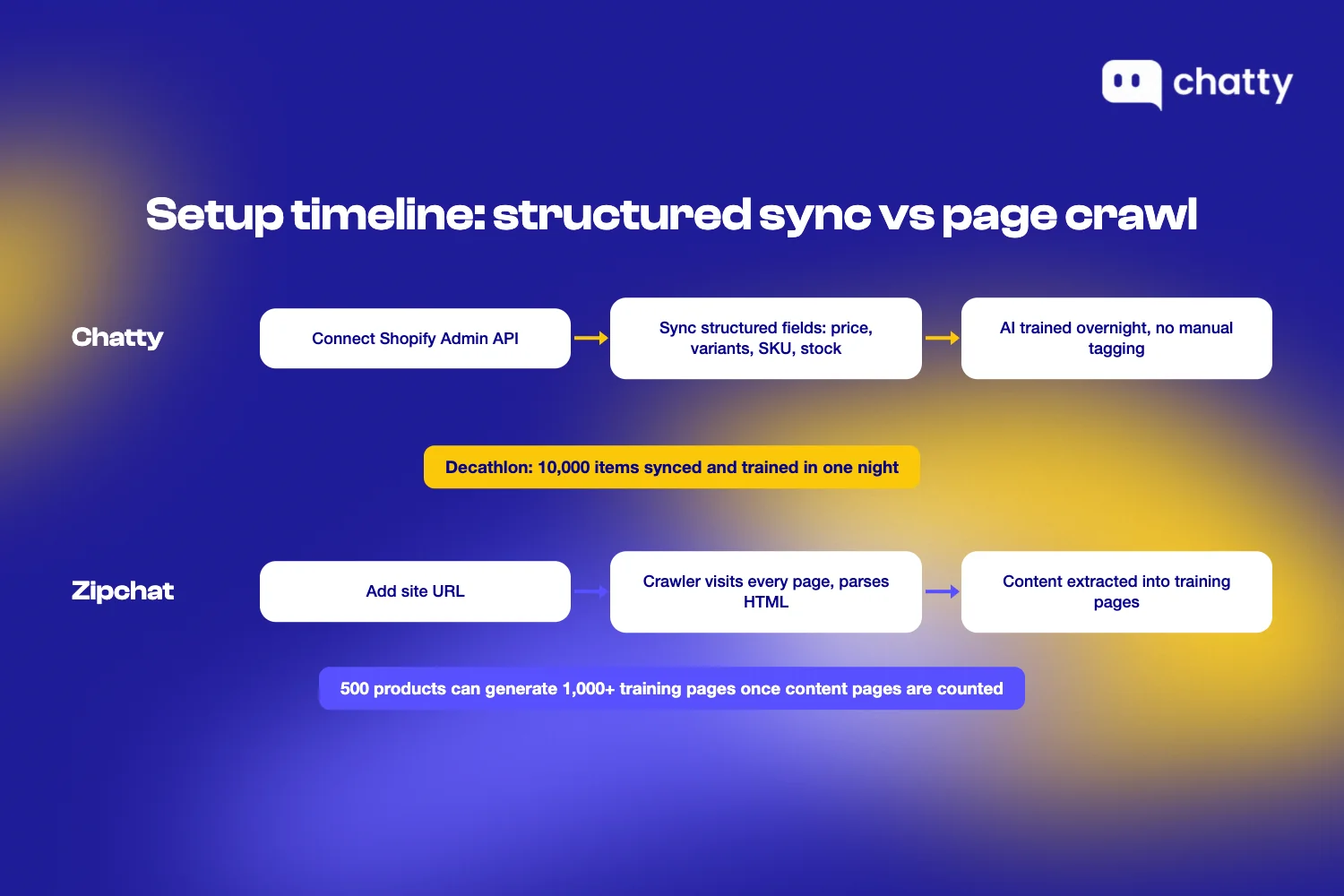
The training method also decides how fast a store gets to a usable AI, and how much manual cleanup that requires. Chatty's Shopify-native product sync pulls structured fields, title, price, variants, SKU, inventory count, directly from the Shopify Admin API, so the AI reads exactly what the store's inventory system already tracks. Decathlon's full 10,000-item catalog synced and trained in a single overnight run, with no manual tagging required, according to Chatty's published case study.
A page-crawl setup runs differently. The crawler has to visit every URL, parse the HTML, and extract text into "training pages," a unit that mixes product pages, blog posts, and policy pages into one count. That's why Zipchat prices in training pages rather than product count: a 500-product store might generate 1,000+ training pages once collections, variants, and content pages are counted separately. The tradeoff is setup flexibility (any page becomes trainable content) against setup precision (the AI has to infer structured facts like "in stock" from page text rather than reading them from a field).
What this training difference does at scale
Chatty's own platform data, measured across 24,239 stores and 5,965,674 AI answers, shows how often the AI closes a conversation without handing it to a person, and that rate moves with product complexity. Technical, spec-heavy products close at the high end; broad, judgment-heavy categories close lower. Closing without escalation is not the same as being right, so read it as a workload number rather than an accuracy score.
Yoeleo Bike is the sharpest example. Its AI resolves 98.94% of technical questions, bearing sizes, frame compatibility, component fit, on a product line where getting the answer wrong means a returned order. Chatty's team describes the result as the AI "knowing every bearing size, every compatibility requirement," a claim that only holds up if the underlying training data is structured enough to encode that level of detail. Page-crawled content, written for human browsing rather than machine lookup, is a harder source to extract that precision from.
Gadcet UK, an electronics retailer, shows the same pattern at higher volume: 14,500 AI-handled queries across website, Instagram, and Facebook, an 81-83.9% AI resolution rate, and $110,000-$112,000 in AI-attributed revenue, with December 2025 alone contributing $24,800 without adding headcount.
Feature-by-feature: where the training difference cascades
Once you see the training-data split, the rest of the feature comparison reads less like "who has more" and more like "which features each architecture makes easy to ship first."
| Capability | Chatty | Zipchat |
| AI training source | Structured product catalog, no product cap on Plus | Page crawl (products, blog, FAQ, policy), metered in training pages |
| AI model tiers | Two models: Standard (Basic plan), Pro (Pro plan and up) | Same model across all four tiers |
| Proactive outbound / cart recovery | Pro plan ($68.99/mo) and up | Starter plan ($49/mo) and up |
| Revenue attribution | Included, full tracking marketed platform-wide | Included from Starter plan |
| WhatsApp cart-recovery campaigns | Not a named, benchmarked feature | Yes, published 20-39% recovery rate |
| Multi-store coverage | Priced per store | 2-20 stores per subscription |
| Platform support | Shopify only | Shopify, WooCommerce, Wix, headless via JS snippet |
| Free tier | Yes, 50 AI conversations/mo, renews, no trial clock | No free tier, 7-day trial on paid plans |
Proactive AI and cart recovery: real on both, gated differently
Chatty ships proactive engagement and automatic abandoned-cart recovery as named Pro-plan features ($68.99/month and up), backed by a public roadmap logging view-cart triggers, cart reminders, and country-specific proactive chat shipped through 2025. Zipchat includes the same category of capability one tier lower, from its $49/month Starter plan.
Where Zipchat pulls ahead specifically is channel: its cart recovery runs through automated WhatsApp campaigns with a published recovery rate of 20% to 39% (39.6% on its best-disclosed single campaign), reaching shoppers within minutes of abandonment. Chatty's abandoned-cart feature is a proactive in-chat trigger; it doesn't publish an equivalent WhatsApp-specific benchmark. If WhatsApp recovery is a named channel strategy for your store, that's a genuine, sourced Zipchat strength.
Revenue attribution: both track it, Chatty's proof is more granular
Both platforms report AI-attributed revenue. The difference shows up in how each proves it. Chatty publishes four full case studies, each with a dollar figure or conversion rate tied to a named merchant:
- Montana West (fashion accessories): $41,115 in AI-attributed revenue over 6 months, 11.9% chat-to-sales rate, 80.71% of conversations fully AI-handled during a holiday surge that took daily volume from 30-40 chats to over 200.
- Decathlon (sporting goods): 96.6% resolution rate on a 10,000-product catalog trained overnight, 9% chat-to-sales conversion, above industry average.
- Gadcet UK (electronics): $110,000-$112,000 in AI-attributed revenue, 81-83.9% resolution rate across 14,500 queries spanning website and social channels.
- Yoeleo Bike (cycling components): 98.94% resolution rate on technical compatibility questions, $29,586 in assisted revenue, 19 hours 22 minutes of staff time returned daily.
Zipchat also publishes named results, The Pigment at a 33% chat conversion rate, Little Roastery at 17%, Ring Automotive at 12% conversion across 1,400+ chats with above-average order value on converted chats. These are real, verifiable numbers. They're optimized around conversion rate as the headline metric rather than absolute dollar figures, which makes them harder to compare apples-to-apples against Chatty's revenue-first case studies, not weaker, just structured differently.
Pricing side by side, verified July 2026
The pricing gap tracks the same training-architecture split: Chatty's tiers are built around conversation volume and product count; Zipchat's are built around reply volume and training pages.
| Tier | Chatty | Zipchat |
| Entry | $0/mo: 50 AI conversations, 200 products trained, unlimited human chat, 1 store | No free tier: 7-day trial on paid plans |
| Cheapest paid | $19.99/mo: 100 conversations, 1,500 products, Standard AI model | $49/mo: ~200 conversations, 1,000 training pages, 2 stores, proactive AI + revenue tracking included |
| Mid-tier | $68.99/mo: 500 conversations, 8,000 products, Pro AI model, proactive engage + cart recovery + social AI | $129/mo: ~600 conversations, 15,000 training pages, 5 stores |
| Top tier | $199/mo: 1,000 conversations, unlimited products, unlimited team seats, dedicated AI consultant | $499/mo: ~2,500 conversations, 300,000 training pages, 20 stores |
Two things follow directly from this table. First, Chatty is the cheaper way to start for a single Shopify store: a real free tier with no trial deadline, and a $19.99 entry paid tier versus Zipchat's $49 floor. Second, Zipchat's entry tier includes more out of the box, proactive AI and revenue tracking that Chatty reserves for its $68.99 Pro plan. Comparing Chatty Basic to Zipchat Starter compares two different feature sets at two different prices; the fairer comparison is Chatty Pro to Zipchat Starter, where the feature gap mostly closes and the price gap ($68.99 vs $49) tilts back toward Zipchat.
Shopify App Store standing, verified July 2026
Both tools carry the Built for Shopify badge, but at very different review scale.
| Chatty | Zipchat | |
| Rating | 4.9★ | 4.8★ |
| Reviews | 1,880 | 179 |
| 5-star share | 96% | 97% |
Chatty carries roughly 10x the Shopify review volume. Zipchat's own materials point to stronger standing on G2, Capterra, and Product Hunt instead, platforms where Chatty doesn't maintain the same public presence. Both are true at once, they're just measuring adoption on different platforms, and for a Shopify-first buyer, the Shopify App Store number is the more directly relevant one.
Which one fits your store
Three questions cut through the rest of the comparison faster than any feature table.
1. Is your bottleneck catalog accuracy or content breadth? If your customers mostly ask about stock, price, and variants, product-trained AI has the structural edge, that's the Decathlon and Yoeleo pattern. If they mostly ask about policies, general content, and FAQs, a broader page crawl covers more of that ground natively.
2. Which plan are you actually going to pay for? Chatty Basic ($19.99) against Zipchat Starter ($49) isn't a fair fight, Zipchat wins on proactive AI and revenue tracking at that price point because Chatty doesn't include either yet. Move the comparison to Chatty Pro ($68.99) and the feature gap closes; what's left is WhatsApp-specific recovery and multi-store pricing.
3. Do you run one Shopify store, or a portfolio across platforms? One Shopify store: Chatty's free tier and $19.99 entry point are hard to beat on cost. Multiple stores, or stores outside Shopify: Zipchat's 2-20 store plans and WooCommerce/Wix support are a structural fit Chatty doesn't offer at any price.
Running the numbers on a single-store Shopify budget
A single-store apparel or accessories merchant doing roughly 4,000 conversations over six months, Montana West's actual volume, sits comfortably inside Chatty Pro's 500-conversations-per-month cap at $68.99/month, or $413.94 over six months. The same conversation volume on Zipchat would require its $129/month Growth tier (roughly 600 conversations/month), or $774 over six months, because Zipchat's reply-based metering counts each AI message rather than each conversation.
That's a real cost difference, but it's conditional on volume shape. A store with fewer, longer conversations (multiple back-and-forth replies per shopper) burns through Zipchat's reply cap faster than Chatty's conversation cap, which counts the full thread as one unit regardless of message count. A store running WhatsApp broadcast campaigns as a primary recovery channel flips the calculation the other way, since that's priced into Zipchat's plan and not a Chatty feature at any tier.
Running the numbers on a multi-store portfolio
For a 5-store portfolio, the two pricing models diverge sharply. Zipchat's $129/month Growth tier covers all 5 stores under one subscription, $25.80 per store per month. Chatty prices per store, so 5 stores on Pro ($68.99 each) costs $344.95/month combined, roughly 13x more than the equivalent Zipchat coverage. Multi-store operators are the clearest case where Zipchat's pricing model wins outright, not on features, on arithmetic.
Neither tool is strictly better. Chatty wins on catalog-level training precision, a real free tier, and four dollar-figure case studies across four different verticals. Zipchat wins on multi-store economics, platform reach, and a benchmarked WhatsApp recovery channel. The right call depends on which of those two problems, catalog accuracy or platform reach, is actually the one costing you sales today.
FAQ
Chatty trains its AI directly on structured product records, price, variants, stock status, with no product cap on Plus. Zipchat trains on a broader crawl of store pages, product listings, blog posts, FAQs, and policy pages, measured in "training pages" rather than product count.
Both approaches work. Product-level training tends to answer inventory and pricing questions more precisely; page-level training covers more ground on policy and content questions but with less precision on live stock.
Chatty's entry point is lower: a genuinely free plan (50 AI conversations/month, no trial clock) versus Zipchat's $49/month Starter (7-day free trial, no free tier). For a single Shopify store on a budget, Chatty is the cheaper way in.
At the next tier, Zipchat's $49/month Starter includes proactive AI and revenue tracking that Chatty only unlocks at $68.99/month Pro. Which one is actually cheaper depends on which features you need on day one.
Yes, starting at the Pro plan ($68.99/month). Chatty's Shopify listing names "Proactive engage" and "Auto-recover abandoned carts" as standard Pro features, backed by a public product roadmap showing multiple proactive-chat features shipped through 2025.
Zipchat includes proactive AI from its $49/month Starter plan, one tier lower than where Chatty unlocks the same capability.
Yes. Chatty markets "full tracking" of AI-attributed revenue, and its four public case studies (Montana West, Decathlon, Gadcet UK, Yoeleo Bike) each report a specific dollar figure or conversion rate tied to AI conversations.
Montana West alone attributes $41,115 in revenue to AI chat over six months, at an 11.9% chat-to-sales rate.
Yes, this is one of Zipchat's clearest structural advantages. Its plans cover 2 to 20 stores under a single subscription, from the $49/month Starter tier up.
Chatty prices and licenses per store, so running a portfolio of storefronts means a separate Chatty subscription for each one.
Zipchat, if you need it. Zipchat runs natively on Shopify, WooCommerce, and Wix, plus headless storefronts via a JavaScript snippet. Chatty is Shopify-only.
If every store you run sits on Shopify, this isn't a deciding factor either way.