











Many chatbot experiences fail to meet user expectations. In a global survey, customers rated their chatbot experiences only 6.4 out of 10, with 50% often feeling frustrated and nearly 40% reporting negative interactions. Poor design means users struggle to get answers, repeat information, or abandon their task entirely.
A well-designed chatbot customer journey addresses these issues by focusing on intent progression rather than isolated questions. By tracking context and guiding users step by step, chatbots can support decisions, reduce friction, and deliver timely assistance.
In this article, you will learn:
- What is a chatbot customer journey is.
- Why journey-first design outperforms feature-first bots.
- The key stages of an AI-powered chatbot journey.
- Best practices and real-world examples.
- Chatbot experiences are failing users, scoring just 6.4 out of 10 globally. Half of users feel frustrated and nearly 40% report negative interactions, signaling a widespread design problem.
- Building chatbots around FAQs and departments ignores how customers actually think. Users arrive with goals and problems, not knowledge of internal categories, so feature-first bots consistently deliver answers at the wrong moment.
- A chatbot journey is defined by intent progression, not isolated question-and-answer exchanges. Tracking context across the full conversation lets chatbots guide users step by step rather than treating each message as a fresh request.
- Journey-first design directly reduces friction and improves conversion outcomes. Gradually narrowing choices based on user intent at each stage prevents confusion and keeps customers moving toward a decision.
- Real-time adaptability is what separates chatbot journeys from traditional customer journeys. Unlike static journey maps, chatbot journeys adjust dynamically based on user inputs across websites, apps, and messaging platforms.
What is a chatbot customer journey?
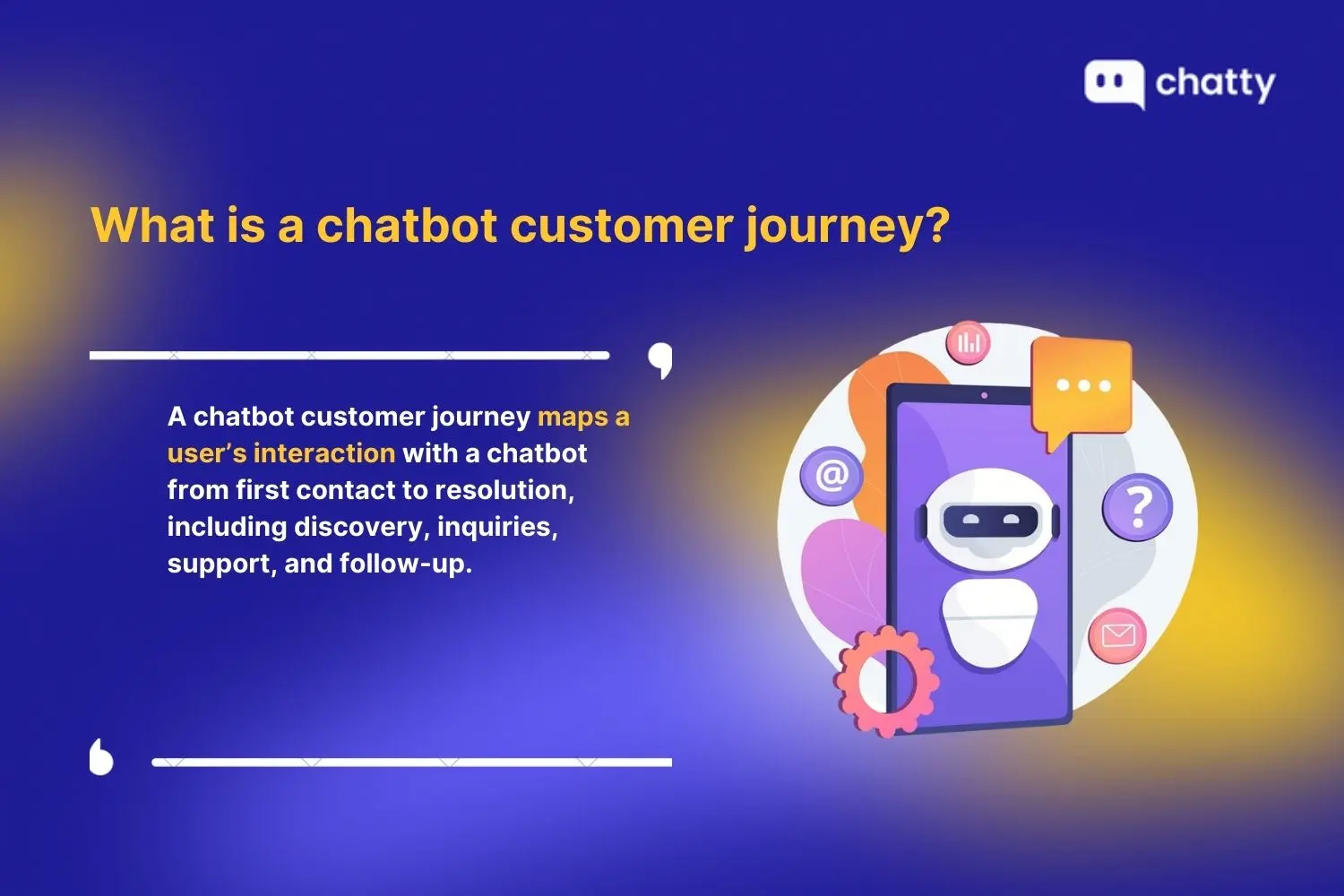
A chatbot customer journey is the complete path a user takes when interacting with a chatbot, from the first message to the outcome. It maps how the chatbot guides customers through different stages, such as discovery, inquiry, problem-solving, and follow-up support.
Unlike traditional customer journeys, chatbot journeys happen in real time and adapt based on user inputs. For example, a chatbot might greet a visitor on a website, ask qualifying questions, provide instant answers, recommend products, or escalate the conversation to a human agent when needed.
A well-designed chatbot customer journey focuses on intent, context, and timing. It anticipates what users need at each step and delivers the right response without friction. When done correctly, it improves response speed, reduces customer effort, and creates a more consistent experience across channels like websites, apps, and messaging platforms.
Why the customer journey matters in chatbot design
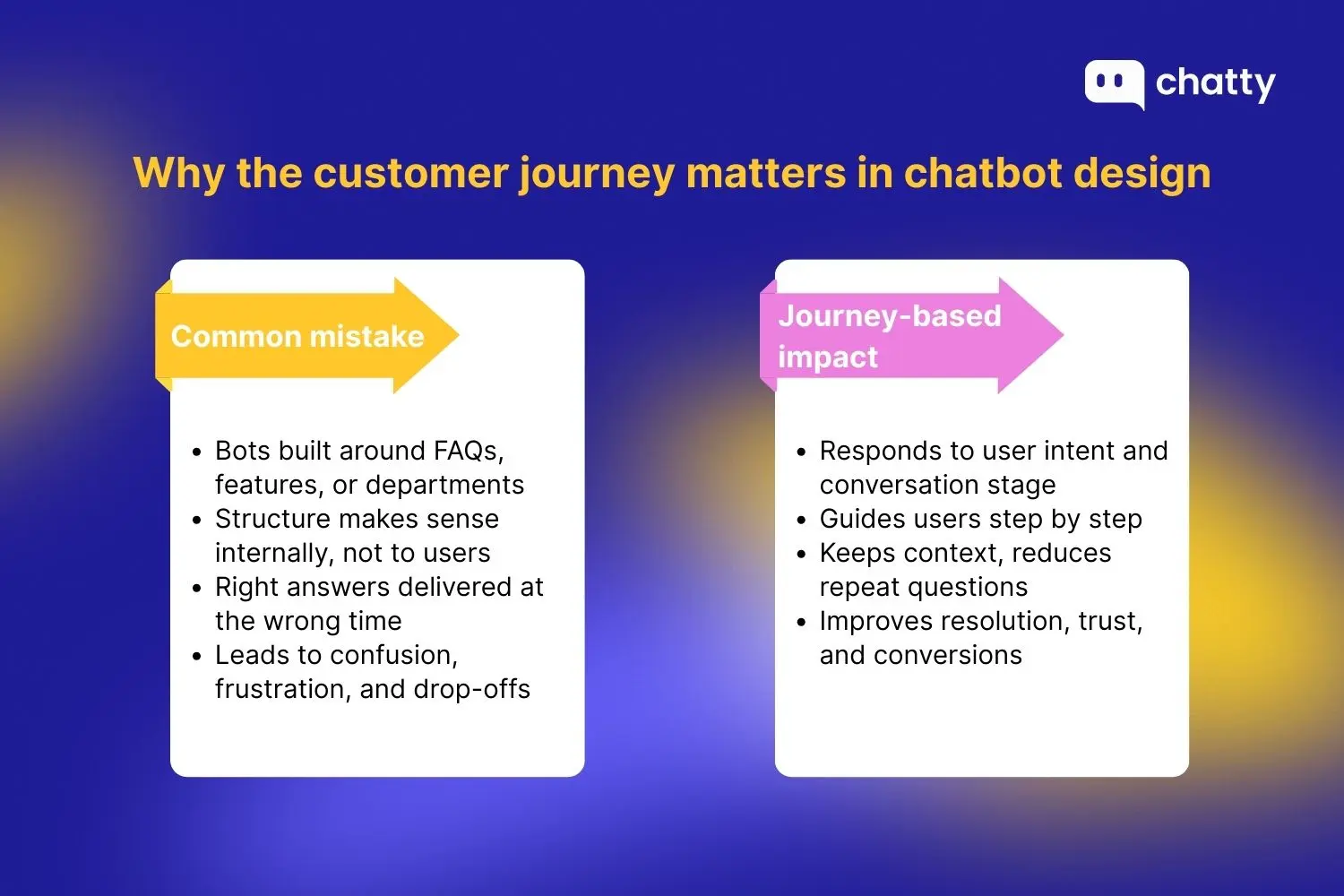
Common failure: Building bots by features, not by journey
A common mistake in chatbot design is organizing the bot around internal structures instead of real user behavior. Many chatbots are built based on FAQ lists, individual features, or company departments such as sales, support, and billing. While this structure is logical for internal teams, it does not match how customers think or act.
Users approach a chatbot with a goal or problem, not with knowledge of internal categories. When a chatbot follows a feature-based structure, it may provide correct information at the wrong moment.
For example, a user who is still exploring options might receive detailed explanations too early, or someone seeking quick help may be pushed into long menus. This disrupts the flow of the conversation and fails to support decision-making, often leading to frustration or drop-off.
Business impact of a well-designed chatbot journey
A journey-based chatbot responds to user intent at each stage. It guides users step by step and narrows choices gradually. This reduces confusion and improves conversions. In e-commerce, chatbot interactions have been shown to increase conversion rates by up to 30% compared to non-bot users.
Maintaining context across the conversation also lowers customer effort. Users do not need to repeat information or start over. Companies using AI chatbots report faster response times and higher first contact resolution, as common issues are solved on the first interaction.
Real-world results support this impact. AA Ireland achieved an 11% increase in quote-to-purchase conversion after deploying a journey-driven chatbot. Brands like 1-800-Flowers increased order value by guiding users with personalized suggestions. Over time, these smooth journeys build trust, retention, and long-term customer value.
The difference between the AI chatbot customer journey and the traditional chatbot customer journey
To clearly illustrate how AI-powered chatbot journeys differ from traditional chatbot journeys, the table below compares both approaches across key dimensions of the customer experience:
| Criteria | Traditional Chatbot | AI-Powered Chatbot |
|---|---|---|
| Intent Handling | Keyword-based, rule-driven logic | NLP-driven intent recognition |
| Context Awareness | None or minimal | Strong multi-turn memory |
| Conversation Flow | Fixed, linear scripts | Dynamic, adaptive dialogue |
| Decision Support | Predefined responses | Personalized, real-time recommendations |
| Handling Complexity | Limited | Capable of managing complex and vague queries |
| Escalation Logic | Fixed triggers | Intelligent human handoff |
| Learning Over Time | No | Continuous learning and improvement |
Overall, AI-powered chatbot journeys provide more accurate, flexible, and personalized interactions. This leads to smoother customer experiences, higher engagement, improved conversion rates, and lower operational costs for businesses.
The stages of the chatbot customer journey (AI-powered)
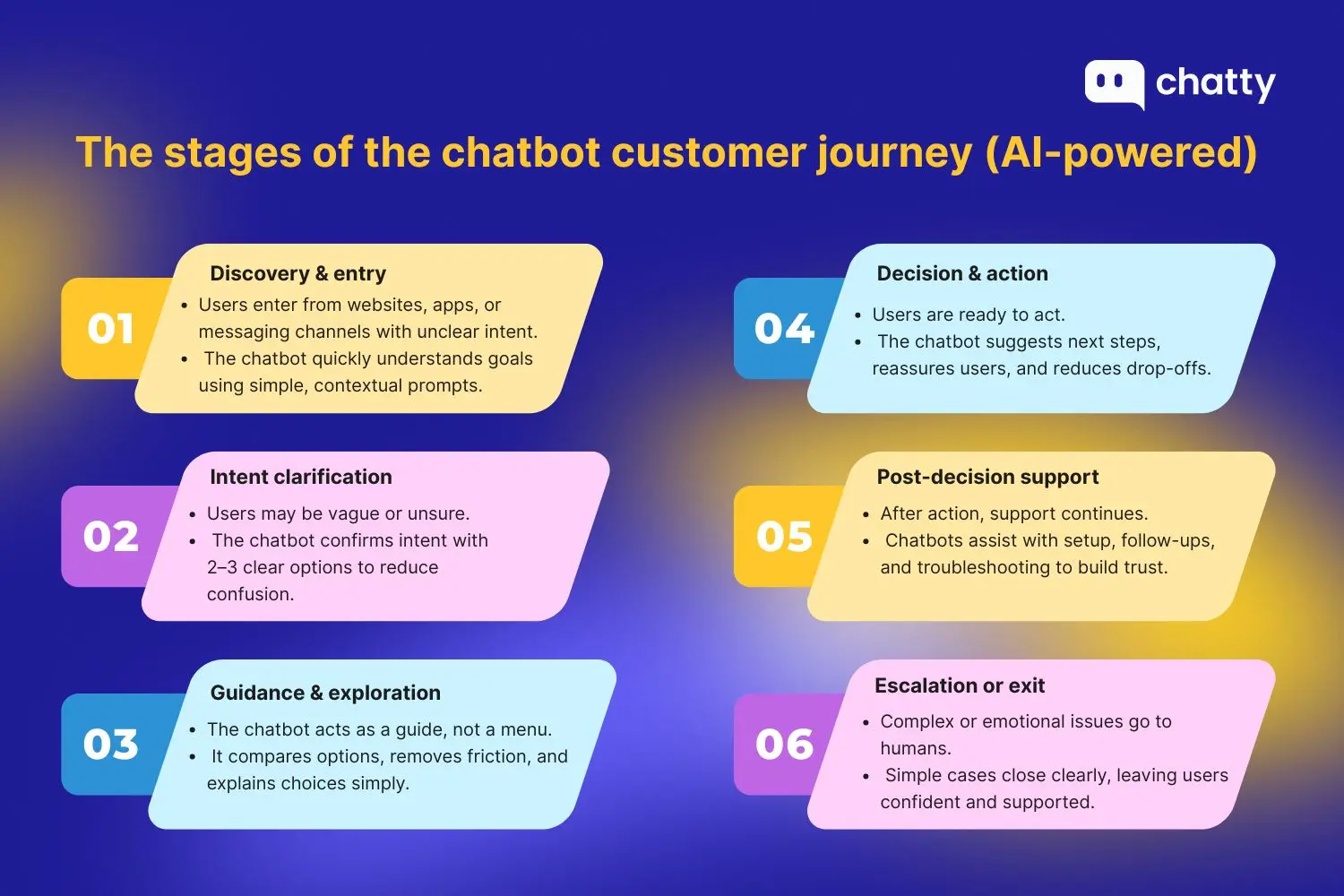
An effective AI chatbot does more than answer questions. It guides users through a structured journey that feels natural, helpful, and goal-driven. Platforms like Chatty show how AI-powered conversations can support users smoothly at every stage. Let’s explore.
Stage 1: Discovery & entry
Users usually enter a chatbot from different customer touchpoints such as the homepage, product pages, checkout, mobile apps, or messaging platforms, often with unclear or exploratory intent. At this stage, the chatbot’s priority is to quickly understand the user’s goal without asking too many or irrelevant questions.
Instead of pushing users into rigid flows, the chatbot should use context and behavior to guide the conversation. Focused prompts such as “Are you comparing products, checking an order, or looking for support?” help clarify intent while keeping the interaction simple. This reduces friction, sets a helpful tone, and helps users move forward from the first message.
Stage 2: Intent clarification
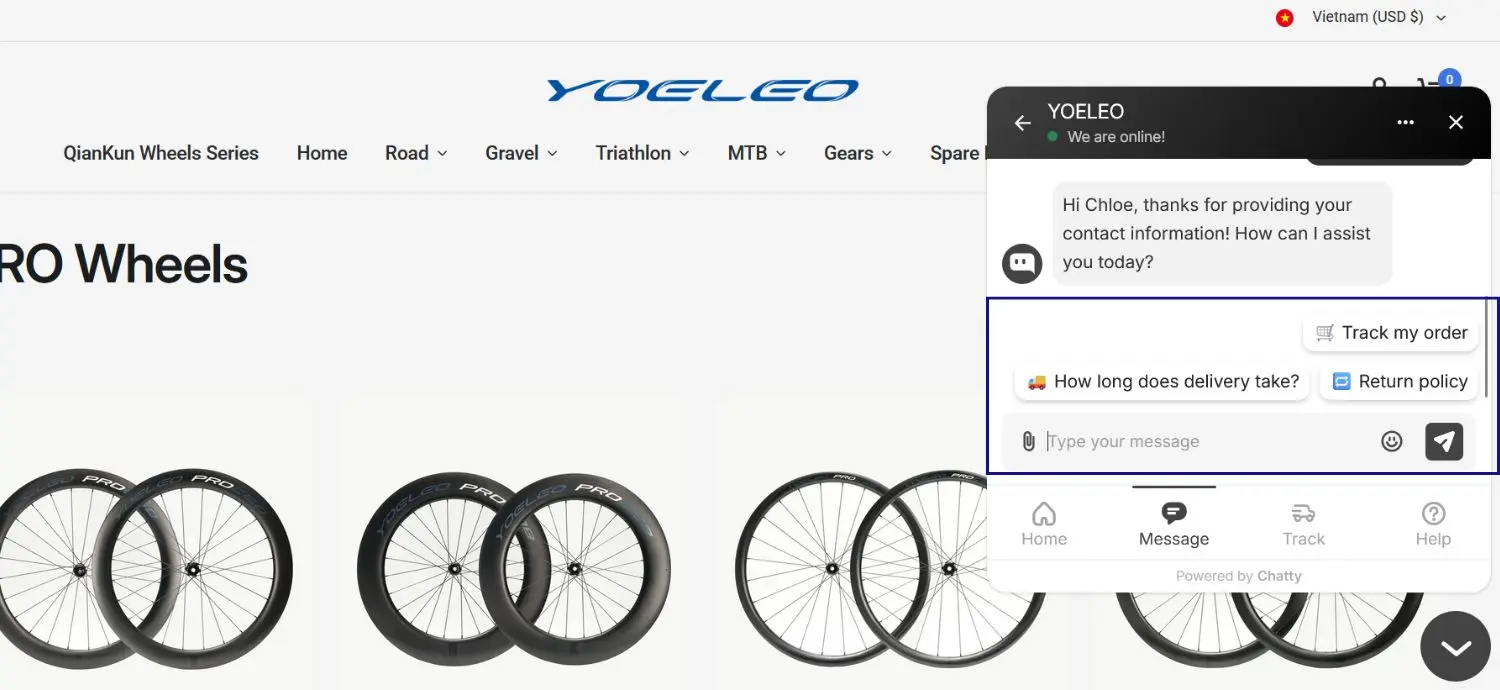
Many users struggle to clearly express their needs. They may use vague wording, incomplete requests, or emotional cues like frustration and uncertainty. At this stage, the chatbot must interpret, confirm, and refine the user’s intent before continuing.
Rather than asking broad follow-up questions, effective chatbots provide two to three structured options. For example, offering options such as order tracking, delivery changes, or refund requests helps users quickly identify their goal. This approach speeds up intent clarification, reduces confusion, and keeps the experience simple and user-friendly.
Stage 3: Guidance & exploration
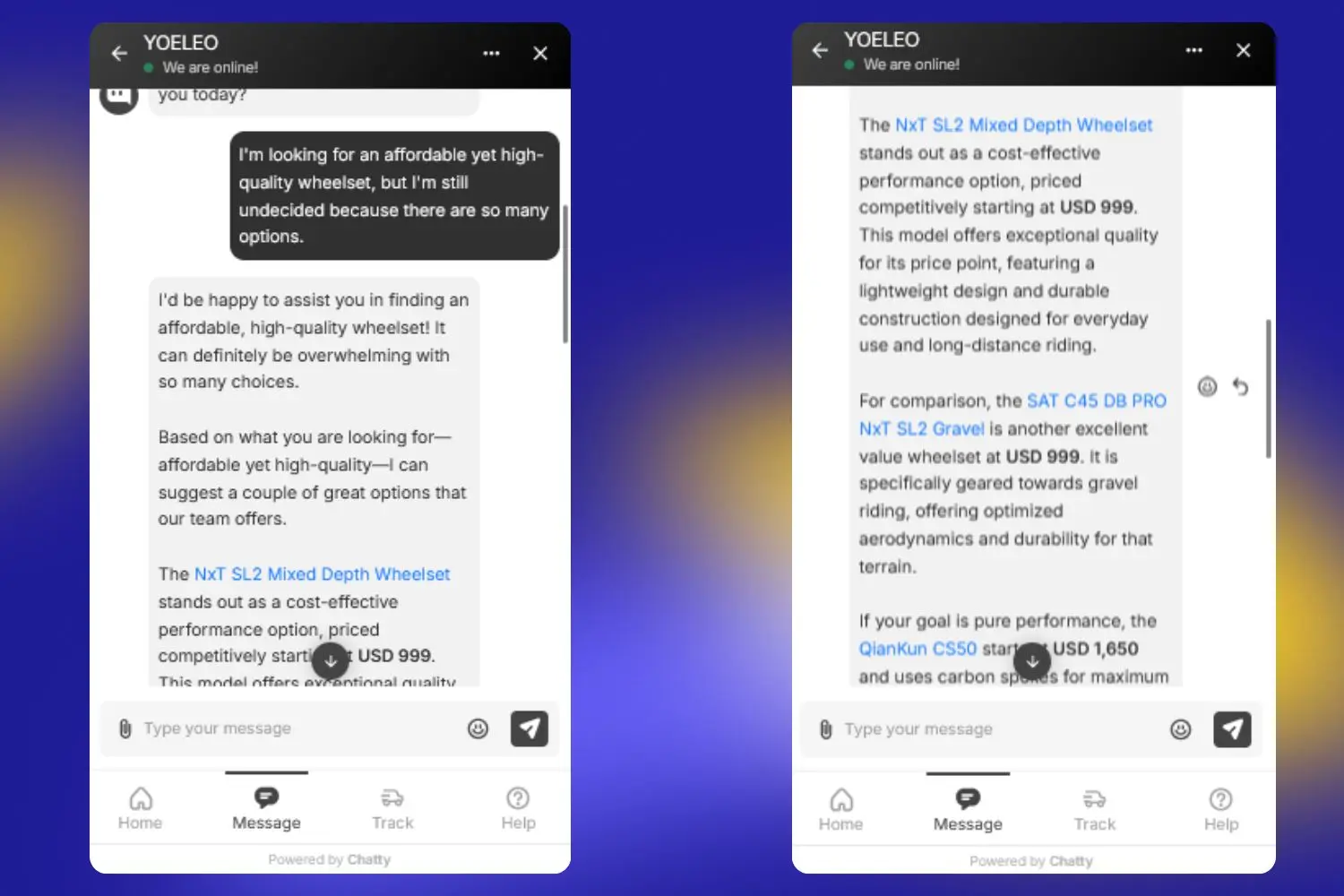
Once intent is clear, the chatbot should act as a guide rather than just a source of information. Instead of listing features or policies, it should compare options, remove unsuitable choices, and explain trade-offs in simple language. This allows users to explore confidently, understand their options, and make informed decisions without feeling overwhelmed.
Stage 4: Decision & action
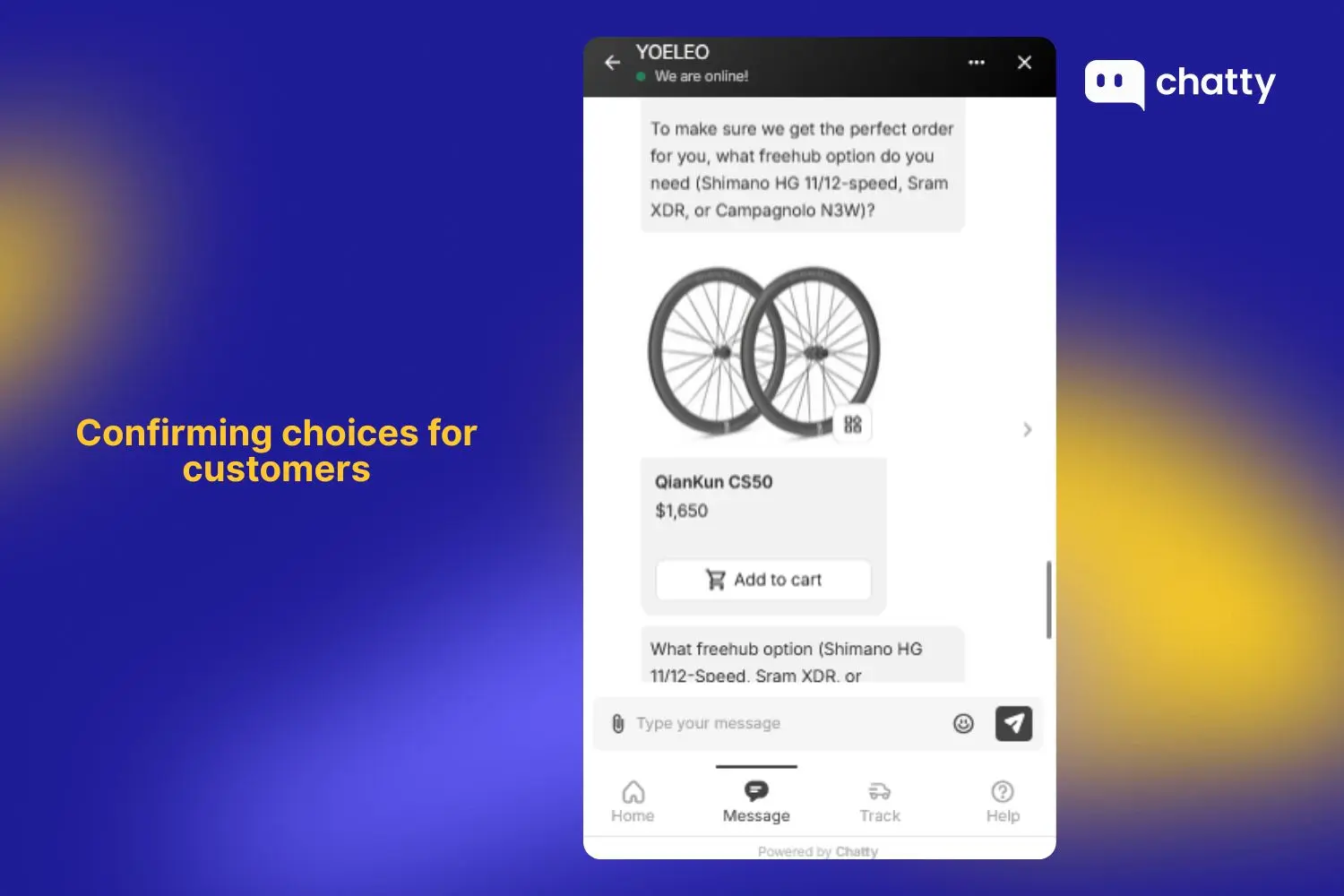
This is the critical moment when users decide to act, whether that means completing a purchase, submitting a request, or confirming a booking. The chatbot should proactively suggest clear next steps and reduce emotional risk through reassurance.
By confirming choices, summarizing benefits, and addressing last-minute doubts, the chatbot helps users move forward with confidence. This reduces hesitation, lowers drop-off rates, and increases successful conversions.
Stage 5: Post-decision support
The journey does not end once an action is completed. Setup assistance, troubleshooting, and follow-up communication are essential for satisfaction and long-term retention. Chatbots can guide onboarding, provide step-by-step instructions, and proactively check in to ensure everything is working smoothly.
This stage plays a critical role in building trust and loyalty, as timely and effective post-decision support often determines whether users continue using the product or service.
Stage 6: Escalation or exit
Finally, the chatbot must recognize when to transfer conversations to human agents or conclude interactions clearly. Complex issues, emotional situations, or sensitive requests should be handled by real people. In simpler cases, the chatbot should confirm resolution and close the conversation politely, ensuring users leave feeling supported and respected.
Best practices for designing high-performing chatbot journeys
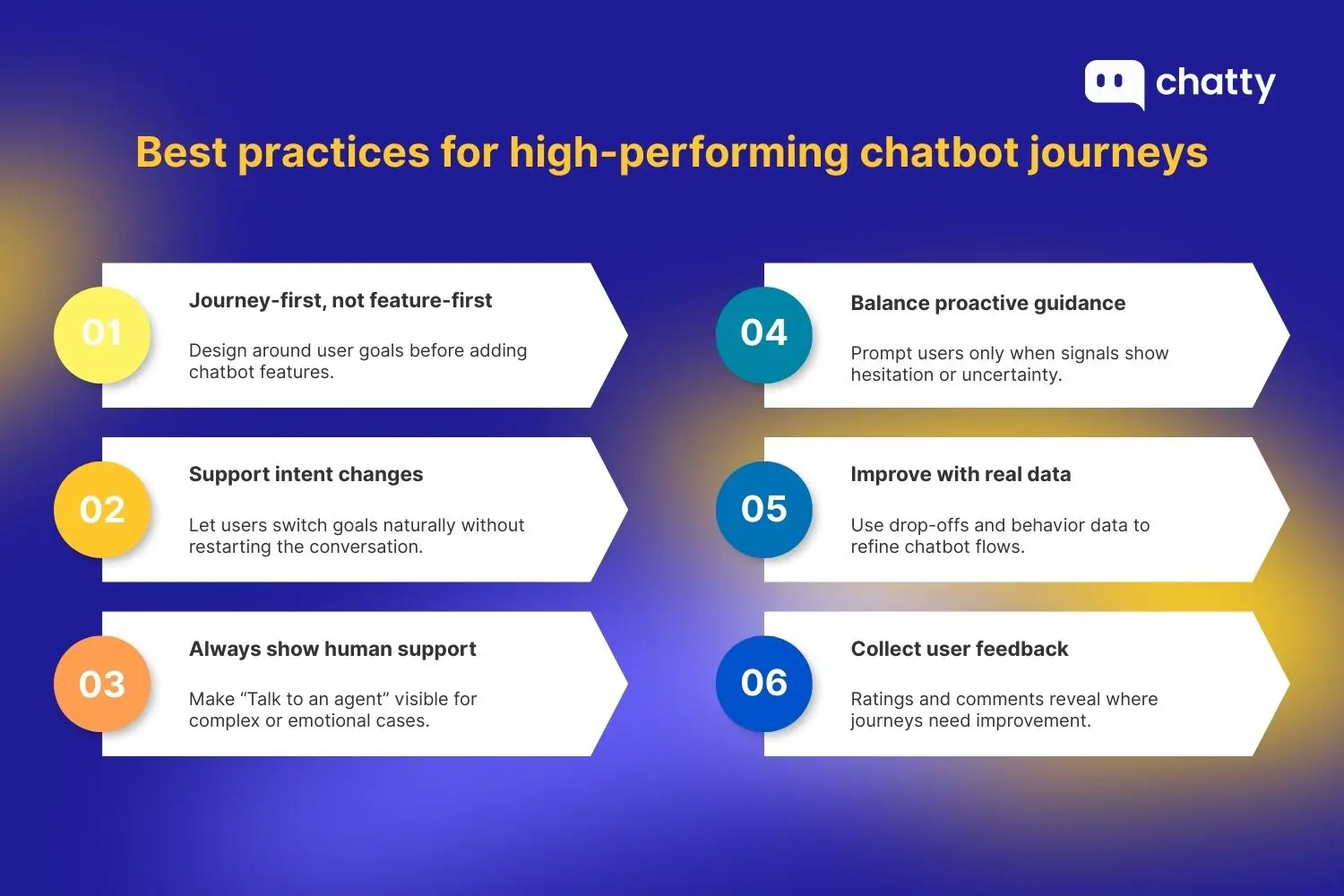
Designing a high-performing chatbot journey requires thoughtful planning around user goals, conversational flow, and continuous improvement. The following chatbot best practices focus on creating intuitive, efficient, and genuinely helpful chatbot journeys.
Journey-first, feature-second
Chatbot design should begin with understanding what users want to achieve, not with selecting features. Customer journey visualization helps teams map user goals and decision points to design clearer conversational flows.
For example, in an e-commerce chatbot, the main journeys might include product discovery, order tracking, and returns. Mapping these journeys first helps structure clear conversation flows before adding tools like AI recommendations or payment integrations. This ensures every feature supports a real user need, resulting in simpler and more effective interactions.
Design for intent transitions
Users often change their purpose during a conversation. For instance, a user may start by browsing product information but later decide to place an order or ask about delivery. A well-designed chatbot recognizes this shift and adapts smoothly, instead of forcing the user to restart. Supporting natural intent transitions makes conversations feel more fluid and prevents frustration caused by rigid flows.
Always visible human fallback
Some situations require human assistance, such as handling complaints, complex technical issues, or emotional concerns. A chatbot for customer support should always display an easy option like “Talk to an agent.” For example, if a user repeatedly receives unhelpful answers, the chatbot can suggest human support. Passing conversation history to the agent ensures faster resolution and avoids asking users to repeat themselves.
Proactive vs reactive balance
High-performing chatbots know when to guide users and when to wait. For example, a travel booking chatbot might proactively suggest travel dates or seat upgrades after detecting hesitation, while staying silent when users are confidently progressing. Proactive prompts should feel helpful, not disruptive, and be triggered by clear behavioral signals.
Continuous learning loops
Chatbot journeys should improve over time based on real usage data. For example, if analytics show that users frequently drop off at a payment step, designers can simplify that flow or clarify instructions. Regular testing, performance tracking, and updates allow the chatbot to adapt to evolving user needs and business goals.
User feedback is important
User feedback provides direct insights into experience quality. For example, after completing a chat, users can rate helpfulness or leave a short comment. If many users report confusion at a certain step, designers can quickly adjust the flow. Continuous feedback collection ensures the chatbot remains user-centered and effective.
Read more: For a deeper look at effective chatbot design strategies, explore these detailed chatbot best practices.
What are the future trends in chatbot interactions and customer journey management?
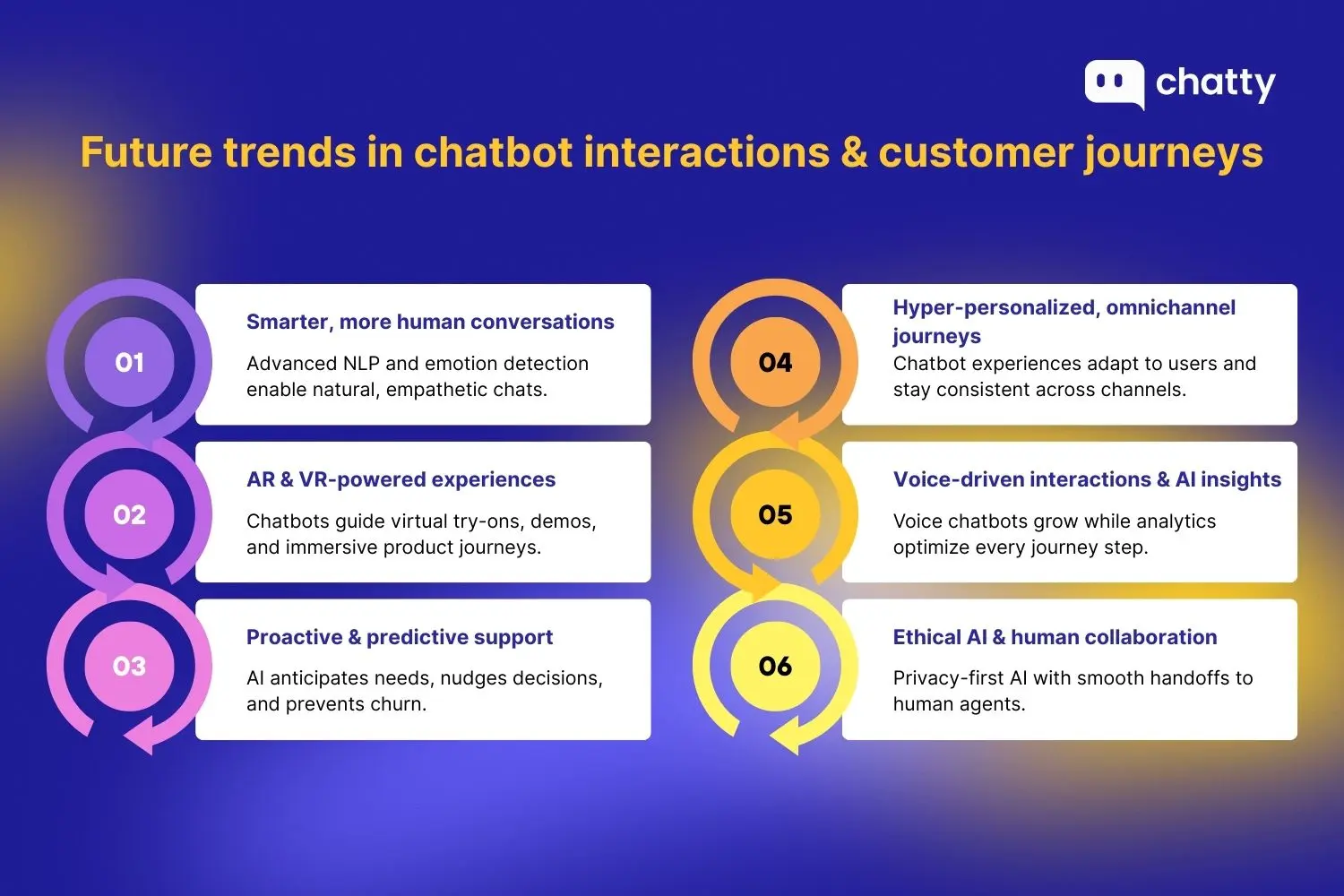
Rapid advances in artificial intelligence, data analytics, and immersive technologies are reshaping how chatbots interact with users and manage customer journeys. Future chatbots will move beyond simple automation to deliver intelligent, proactive, and highly personalized experiences across multiple touchpoints.
Smarter conversations with advanced NLP and emotional intelligence
Future chatbots will leverage advanced natural language processing (NLP) to better understand complex queries, context, and user intent. This enables more natural, accurate, and human-like conversations. Emotional intelligence will further enhance interactions by detecting user sentiment such as frustration, confusion, or satisfaction, allowing chatbots to respond empathetically. Combined with multilingual support, these improvements will help businesses deliver consistent, high-quality service to global audiences.
Immersive experiences with AR and VR integration
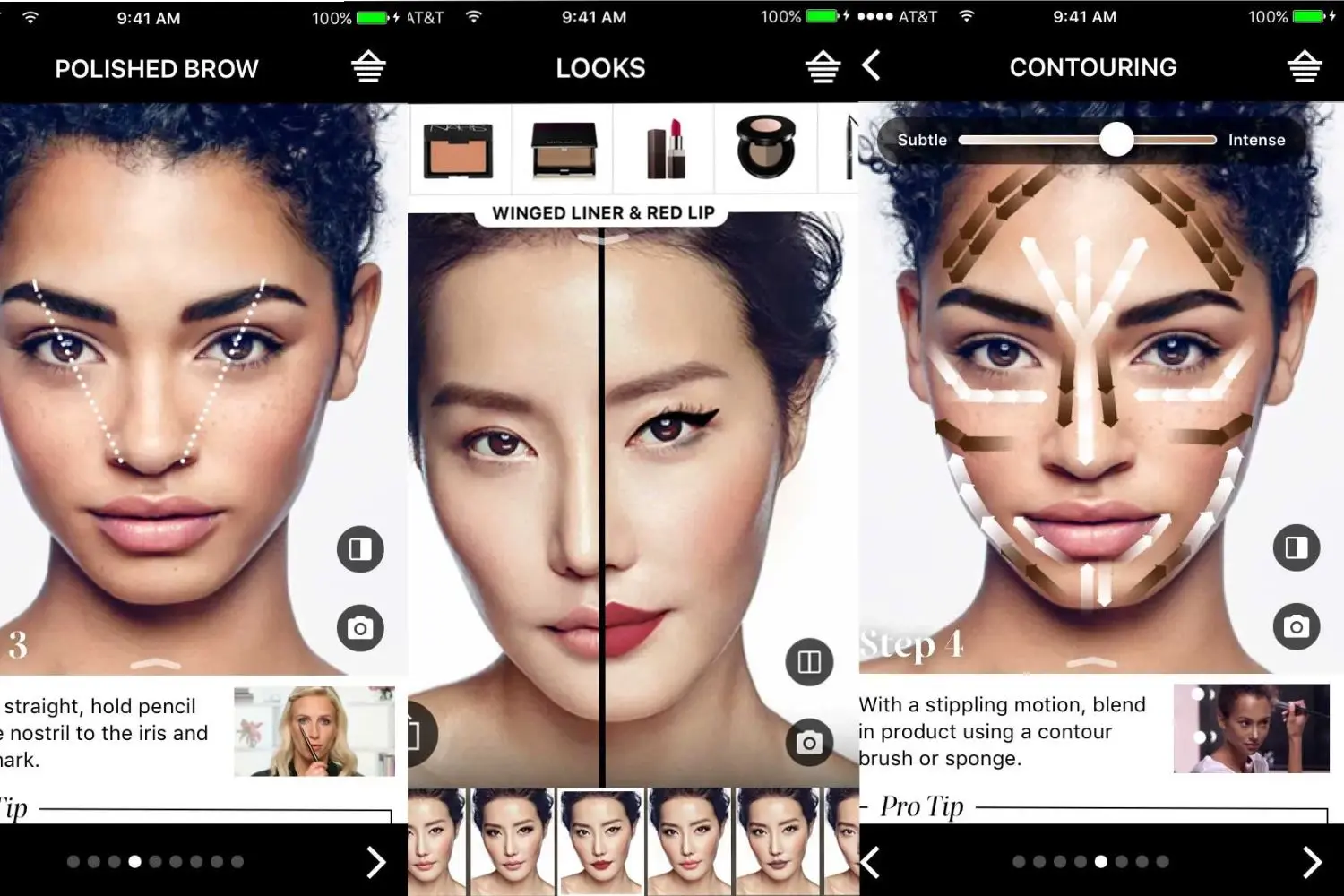
The integration of augmented reality (AR) and virtual reality (VR) will create immersive chatbot experiences. In retail, customers can virtually try on clothes, accessories, or makeup through AR-powered chatbots, improving confidence and reducing product returns. In VR environments, chatbots can act as virtual assistants in digital showrooms, guiding users through interactive product demonstrations and personalized recommendations.
For example, Sephora uses AR virtual try-on tools that allow customers to test makeup shades in real time. This improves purchase confidence and reduces product returns. In VR environments, chatbots can guide users through digital showrooms and interactive product demos.
Proactive and predictive customer support
Future chatbots will increasingly rely on predictive analytics to anticipate customer needs. By analyzing user behavior, browsing history, and previous interactions, chatbots can offer proactive support, such as reminding users about upcoming renewals, assisting abandoned carts, or suggesting timely upgrades. This proactive approach increases engagement, speeds up decision-making, and helps reduce churn.
Hyper-personalization and omni-channel continuity
Advancements in AI will enable hyper-personalized chatbot journeys tailored to individual preferences, behaviors, and real-time context. At the same time, seamless omnichannel integration will ensure consistent experiences across web, mobile, social media, and in-store interactions. Customers will be able to move between channels without losing conversation context, creating smoother and more cohesive journeys.
Voice-driven interactions and AI-powered insights

Voice-activated chatbots will support hands-free interactions through smart speakers and mobile devices, accelerating the growth of voice commerce. Meanwhile, AI-driven analytics will provide actionable insights into customer behavior, preferences, and pain points, allowing businesses to continuously optimize journeys and improve service quality.
Many companies have successfully adopted this trend, most notably Amazon’s Alexa. It enables hands-free voice interactions through smart speakers and mobile devices. Users can search, order products, and manage services using natural voice commands
Ethical AI, data privacy, and human-AI collaboration
As chatbots become more powerful, ethical AI and data privacy will be essential. Transparent data usage and regulatory compliance will build customer trust. In parallel, hybrid support models will combine chatbot efficiency with human empathy, enabling seamless handoffs for complex or sensitive issues and delivering superior customer experiences.
Example: The chatbot customer journey in an e-commerce store
Yoeleo Bike, a high-performance cycling brand, demonstrates how an AI-powered chatbot can transform complex customer journeys into smooth purchasing experiences. Their products require precise compatibility checks, such as bearing sizes, frame fit, and brake systems, making technical clarity essential before purchase.
At the entry stage, customers used the chatbot directly on product pages to ask detailed questions instead of searching long specification documents. During intent clarification and guidance, the AI instantly analyzed technical data and delivered accurate compatibility answers, helping users understand which components worked together. This removed uncertainty and built trust in high-value purchase decisions.
When customers needed advanced advice, the chatbot seamlessly handed off conversations to specialists with full technical context. This journey design led to over 90% of conversations handled by AI, a 98% resolution rate, and nearly $30,000 in assisted revenue within 30 days.
Final thought
A strong chatbot customer journey is not about answering more questions, but about guiding users toward the right outcome. When chatbot design follows the chatbot customer journey, users experience less friction and make better decisions. AI-powered chatbots enhance this journey by understanding context, adapting to changing intent, and knowing when to hand off to a human.
As expectations grow, designing around the chatbot customer journey will become essential for customer experience teams. Businesses that invest in mapping and improving this journey will see higher conversion rates, stronger retention, and more meaningful customer relationships.